Building or replacing a pier is a significant waterfront project. The finished structure may look simple, but long-term performance depends on what happens below the waterline as much as the decking and railings you see above it.
Water depth, soil conditions, piling type, structural loads, wave and boat-wake exposure, materials, access and local permitting requirements can all affect how a pier should be built.
That makes choosing the right pier construction company especially important.
Dream Boat Docks has served Texas waterfront property owners since 1987, providing pier construction and repair services, piling, docks, boat houses, boat lifts, bulkheads and other marine construction services throughout Lake Conroe, Lake Houston and the Greater Houston area.
This guide explains what waterfront property owners should look for when comparing pier contractors and which questions are worth asking before construction begins.
Key Takeaways
- Look for a contractor with specific marine construction experience rather than general residential construction experience alone.
- Piling type and installation method should be selected around the property, soil conditions and structural requirements.
- There is no universal piling depth, fastener material or construction method that is right for every Texas waterfront.
- Fixed and floating structures each have advantages depending on water levels, exposure and intended use.
- Permitting varies between Lake Conroe, Lake Houston and coastal or tidally influenced waterways.
- A strong proposal should clearly identify materials, project scope, permitting responsibilities, foundation requirements and optional features.
- The best pier contractor should be able to explain why a particular design makes sense for your property rather than simply selling the same system to every homeowner.
What Does a Pier Construction Company Do?
A marine pier contractor builds structures designed specifically for waterfront conditions.
That can involve much more than framing and decking.
Depending on the project, pier construction may include:
- Site evaluation
- Piling installation
- Structural framing
- Decking
- Railings
- Stairs and ramps
- Lighting
- Electrical coordination
- Boat-lift integration
- Boat-house integration
- Shoreline transitions
- Repairs or remodeling
- Permitting coordination
Unlike an ordinary deck, a pier must transfer loads into the lakebed, riverbed or seabed while also dealing with water, soil movement, corrosion and environmental exposure.
That is why marine construction experience matters.
Dream Boat Docks provides complete pier construction and repair services for both residential and commercial waterfront properties.
Pier vs. Dock: Is There a Difference?
The words “pier” and “dock” are often used interchangeably by property owners, and their meaning can vary by region.
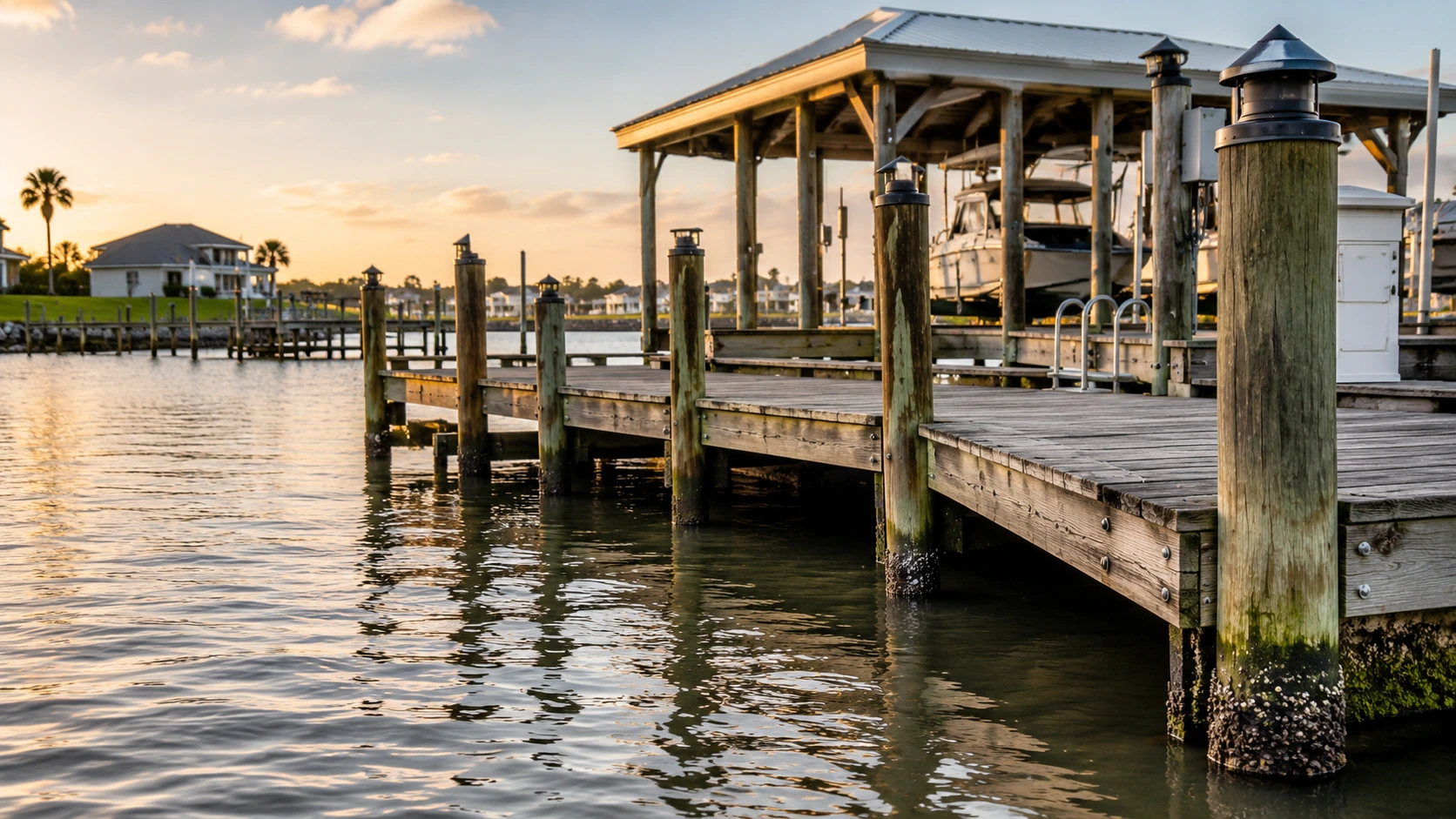
In general, a pier is commonly understood as a structure extending from land over the water, usually supported by pilings.
A dock can refer more broadly to a structure used for water access or boat storage and may be:
- Fixed
- Floating
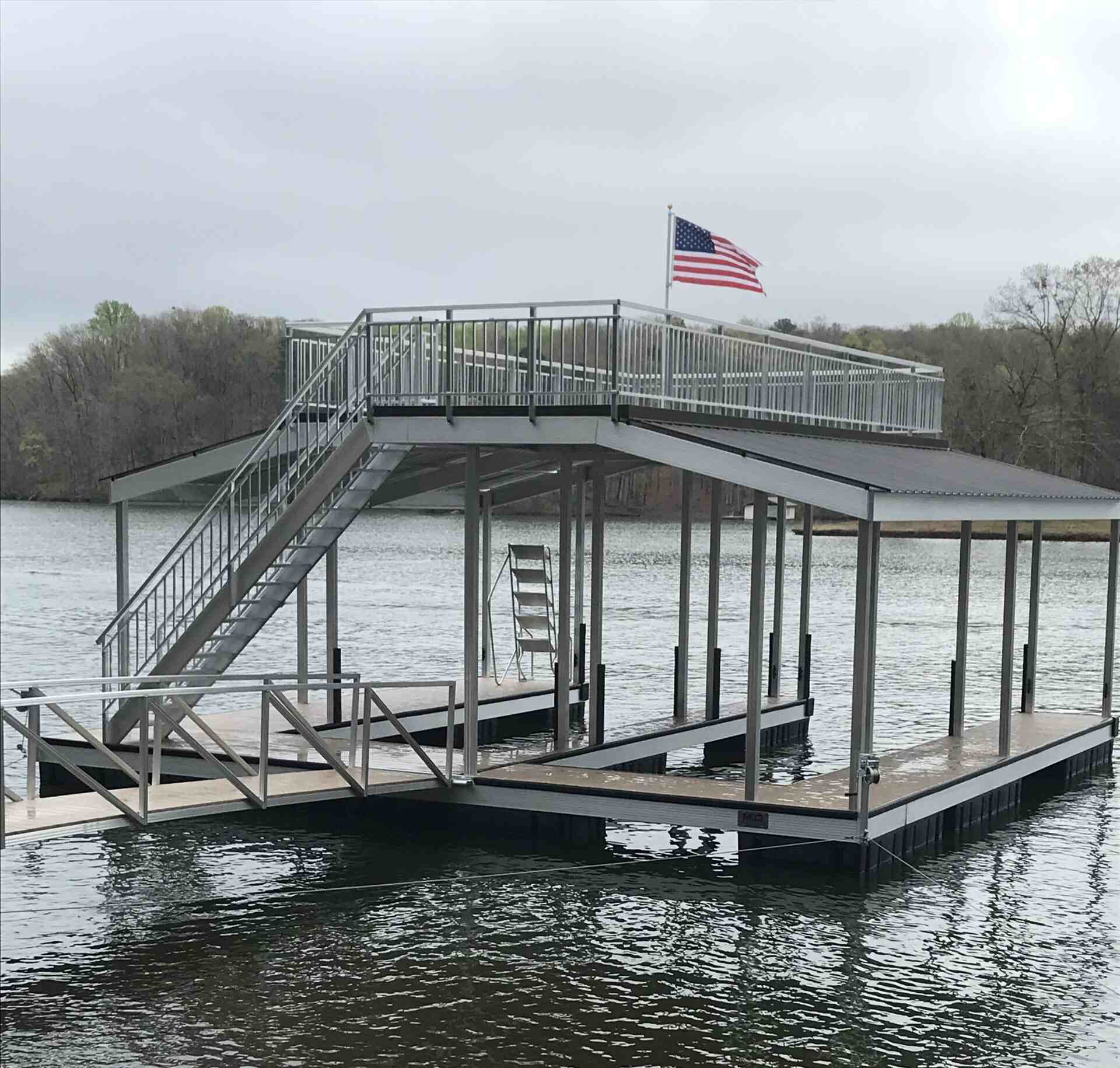
- A combination of fixed and floating sections
The terminology matters less than selecting a structure that fits the water conditions and how the owner intends to use it.
Dream Boat Docks builds custom boat docks as well as fixed-pile piers and other waterfront structures.
For homeowners comparing configurations, see our guide to choosing the right dock type for your waterfront property.
Why Marine Construction Experience Matters
Waterfront construction presents conditions that ordinary land-based projects do not.
A marine contractor may need to account for:
- Water depth
- Saturated soils
- Shoreline erosion
- Variable water levels
- Boat wakes
- Tidal movement
- Wind
- Corrosion
- Marine organisms
- Equipment access from land or water
- Existing bulkheads or docks
Those factors can influence everything from the piling system to the decking material.
A contractor experienced with Houston-area waterways should also understand that the same design is not appropriate everywhere.
A Lake Conroe property may have very different conditions from a pier near Seabrook, Baytown or Clear Lake.
Start With the Foundation: Pier Pilings
The visible part of a pier gets most of the attention, but the pilings below it are critical to the performance of the structure.
Pilings transfer the weight and forces acting on the pier into the underlying soil.
Depending on the project, pier foundations may use:
- Treated timber pilings
- Steel pilings
- Concrete pilings
- Composite materials
- Other engineered piling systems
Dream Boat Docks provides marine piling and pile-driving services for residential, commercial and industrial projects.
How Deep Should Pier Pilings Be?
There is no standard piling depth that applies to every waterfront property.
Required embedment depends on factors such as:
- Soil conditions
- Water depth
- Pier dimensions
- Piling material
- Expected structural loads
- Wind and wave exposure
- Lateral loads
- Site-specific foundation requirements
Depending on the project, pilings may be installed to a specified embedment depth or to other criteria established by the structural design and subsurface conditions.
“Deeper” is not automatically better. The goal is to install a foundation appropriate for the actual loads and soil conditions.
Water Jetting vs. Hammer-Driven Pilings
Another sign of an experienced pier contractor is the ability to use different installation methods when conditions call for them.
Dream Boat Docks uses both water-jet technology and weighted-hammer pile driving for marine piling installation.
Neither approach should be described as universally superior.
The appropriate installation method can depend on:
- Soil conditions
- Piling material
- Piling dimensions
- Water depth
- Access
- Existing structures
- Required foundation capacity
A contractor should be able to explain why a particular method is appropriate for your property rather than relying on the same approach everywhere.
Choosing Pier Materials
Material selection affects appearance, maintenance, durability and project cost.
Pressure-Treated Wood
Pressure-treated lumber remains popular because it offers:
- Traditional waterfront appearance
- Competitive initial cost
- Straightforward repairs
- Familiar construction
The tradeoff is ongoing exposure to moisture, sunlight and biological deterioration.
Proper treatment level and material selection matter in marine construction.
Composite Decking
Composite decking can be attractive for waterfront owners who want:
- Low routine maintenance
- Resistance to rot
- Resistance to splintering
- Consistent appearance
- Multiple color and finish options
Composite decking can become hot in direct Texas sunlight, so product and color selection should take sun exposure into account.
Concrete, Steel and Other Structural Materials
More demanding residential or commercial projects may incorporate concrete, steel, composite or other engineered structural components.
Material selection should be based on structural requirements rather than simply choosing the material with the highest perceived durability.
Hardware and Corrosion Resistance
Fasteners and connectors are relatively small parts of a pier, but they play an important structural role.
Waterfront exposure can accelerate corrosion, particularly around saltwater and brackish water.
Appropriate hardware may include:
- Hot-dip galvanized fasteners
- Suitable grades of stainless steel
- Coated connectors
- Other corrosion-resistant products rated for the environment
There is no rule that every Houston-area pier should use 316 stainless steel throughout.
Hardware should instead be selected according to:
- Freshwater versus saltwater exposure
- Structural requirements
- Material compatibility
- Manufacturer specifications
- Applicable design requirements
Using compatible materials also matters because combinations of dissimilar metals can contribute to galvanic corrosion.
Fixed Pier or Floating Dock?
Both fixed and floating systems can be appropriate.
Fixed-Pile Piers
Fixed structures are supported by pilings and may be well suited to locations where a stable platform is desirable.
Advantages can include:
- Solid feel underfoot
- Strong support for larger structures
- Easy integration with certain boat lifts
- Permanent waterfront access
Dream Boat Docks often uses fixed-pile solutions on inland lakes such as Lake Conroe and Lake Houston when property conditions support that approach.
Floating Docks
Floating docks move with changing water levels.
They may be useful where:
- Water elevation changes significantly
- Tidal movement affects boarding height
- A floating transition provides better access
The right choice depends on more than whether the property is inland or coastal.
Water-level variation, wave exposure, water depth, intended use and permitting should all be evaluated.
Hybrid Systems
Some properties benefit from a fixed section combined with a floating section.
A hybrid layout can provide the stability of a fixed structure while maintaining flexible access where water levels fluctuate.
For a more detailed comparison, see our guide to choosing the right dock type for your waterfront property.
Think About How You Will Use the Pier
Before choosing a contractor, think beyond the basic footprint.
A well-designed pier should reflect how the owner plans to use the property.
Possible features include:
- Fishing areas
- Seating
- Lighting
- Safety railings
- Boat lifts
- Personal-watercraft storage
- Benches
- Cleaning stations
- Electrical service
- Storage
- Connection to a boat house
- Composite or wood decking
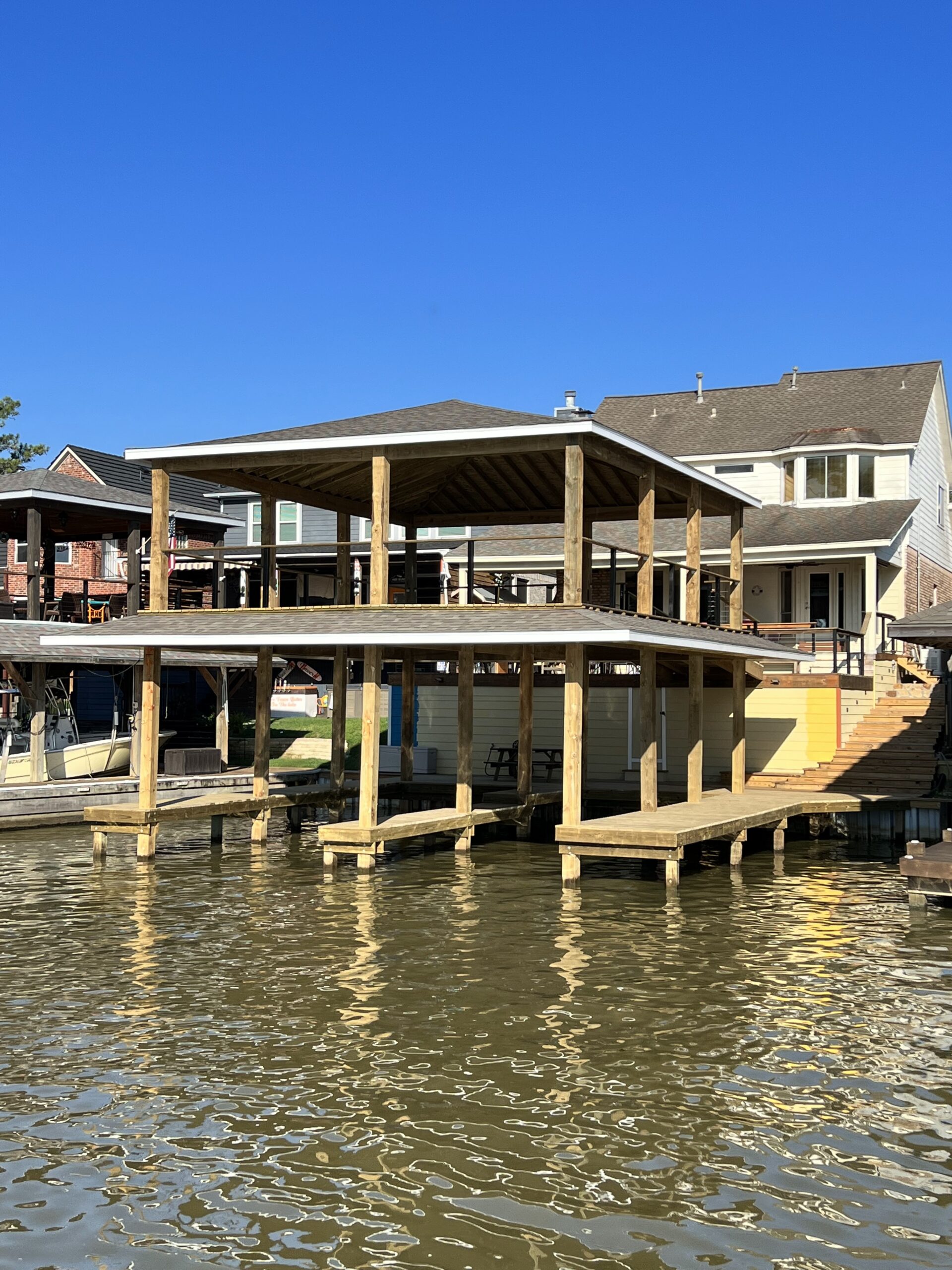
Dream Boat Docks also installs boat lifts and builds custom boat houses, allowing these elements to be planned alongside the pier instead of being treated as unrelated additions later.
How a Pier Relates to Your Bulkhead
A pier and bulkhead serve different structural purposes.
The pier provides water access and has its own foundation.
A bulkhead primarily retains soil and helps stabilize the shoreline.
One does not automatically rely on the other for structural support.
However, where a pier meets the shoreline, the two systems should be coordinated.
Important considerations can include:
- Erosion
- Drainage
- Changes in elevation
- Pier access
- Bulkhead cap design
- Soil loss
- Stairs or ramps
- Future repairs
If an existing bulkhead is leaning, deteriorating or allowing significant soil loss, it should be evaluated as part of the waterfront project.
Ask About Equipment and Site Access
Pier construction often requires equipment that ordinary residential contractors do not use.
Depending on the site, this can include:
- Pile-driving equipment
- Barges
- Excavators
- Cranes
- Water-jet equipment
- Material-handling equipment
The contractor should evaluate how materials and equipment will reach the project.
Some waterfronts provide easy land access.
Others require substantial portions of the project to be completed from the water.
Site access can affect both construction methods and cost.
Understand the Permitting Requirements
Permitting requirements vary significantly by waterway.
A contractor should never tell you that every Texas pier requires the exact same permits.
Lake Conroe
Private structures on Lake Conroe are regulated by the San Jacinto River Authority.
SJRA requires authorization before constructing or maintaining private structures on the reservoir or SJRA-controlled land. Residential applications require plans drawn to scale, accurate measurements and other property information before a construction permit is issued.
Dream Boat Docks regularly provides Lake Conroe dock, pier and waterfront construction services.
Lake Houston
Lake Houston uses a different permitting framework.
The City of Houston requires a construction permit for stationary and floating piers on Lake Houston, and annual licensing requirements also apply.
Dream Boat Docks provides Lake Houston dock, pier and bulkhead construction throughout the area.
Coastal and Tidally Influenced Waterways
Projects in areas such as Seabrook, Clear Lake, Kemah and Baytown can involve additional local, state or federal requirements depending on location and project scope.
Some projects in regulated or navigable waters may involve the U.S. Army Corps of Engineers or other agencies.
The important point is that federal permitting is not automatically required for every residential pier in Greater Houston.
The applicable jurisdiction should be identified early in the project.
How Long Does Pier Construction Take?
There is no reliable universal schedule.
Total project time depends on:
- Design
- Pier size
- Permitting
- HOA review
- Engineering when required
- Material availability
- Site access
- Water depth
- Piling installation
- Weather
- Additional features
For some projects, physical construction can move relatively quickly once permits, plans and materials are ready.
More complex projects or those requiring multiple approvals can take longer.
A reputable pier construction company should give you a project-specific schedule rather than promising that every job will take the same number of weeks.
What Should Be Included in a Pier Construction Quote?
A detailed proposal should make it reasonably clear what is included.
Depending on the project, look for information about:
- Pier dimensions
- Piling material
- Piling installation
- Framing material
- Decking
- Railings
- Hardware
- Boat lifts
- Electrical scope
- Lighting
- Permitting responsibilities
- Engineering, if required
- Demolition of existing structures
- Site access
- Allowances
- Exclusions
- Warranty terms
- Payment schedule
The lowest bid is not necessarily the lowest total cost if important components are missing from the scope.
Ask questions whenever a proposal is unclear.
Questions to Ask a Pier Construction Company
Before hiring a contractor, ask:
Do you regularly build marine structures?
A contractor should be able to show completed piers, docks, pilings, boat houses and other waterfront work.
Review Dream Boat Docks’ completed waterfront projects to see examples of its marine construction.
Have you worked on my waterway?
Local experience can help with permitting, access and understanding common shoreline conditions.
What piling system do you recommend and why?
The contractor should be able to explain the recommendation based on the property rather than simply naming a preferred material.
How will the pilings be installed?
Ask whether the project calls for water jetting, hammer driving or another method and why.
Who is responsible for permits?
Know whether the contractor will manage, assist with or leave permitting to the property owner.
Does the project require engineering?
Some projects or jurisdictions require professional engineering. Other projects may require it because of structural complexity.
What materials will be used?
Ask for enough detail to understand the piling, framing, decking, hardware and other important components.
What insurance do you carry?
Verify that the contractor maintains insurance appropriate for the work being performed.
Can I see similar completed projects?
A relevant project portfolio can tell you more than broad marketing claims.
How Long Does a Pier Last?
There is no universal lifespan for a waterfront pier.
Service life depends on:
- Piling material
- Decking
- Hardware
- Water conditions
- Salt exposure
- Marine organisms
- Construction quality
- Maintenance
- Storm exposure
- Vessel impacts
- Soil conditions
A properly designed and maintained pier can provide many years of service, but quoting a fixed 20-, 30- or 50-year lifespan without considering the materials and environment can be misleading.
Periodic inspection is one of the best ways to identify developing problems early.
What Maintenance Does a Pier Need?
Maintenance requirements depend heavily on material.
Property owners should periodically inspect:
- Pilings
- Framing
- Deck boards
- Fasteners
- Railings
- Bracing
- Lighting
- Electrical components
- Boat-lift connections
- Shoreline transitions
Look for:
- Loose boards
- Corrosion
- Rot
- Splitting
- Movement
- Missing fasteners
- Changes in alignment
- Soil loss around the shoreline
Major storms, high-water events or vessel impacts may justify an additional inspection.
Can a Pier Be Repaired Instead of Replaced?
Often, yes.
A pier does not necessarily need complete replacement because one component has deteriorated.
Depending on the condition of the structure, repairs may include:
- Deck replacement
- Framing repairs
- Piling work
- Bracing
- Railings
- Hardware
- Boat-lift repairs or replacement
- Lighting
- Shoreline-transition repairs
However, extensive foundation deterioration may make replacement more practical.
Dream Boat Docks provides waterfront remodeling and repair services as well as new construction.
Will a New Pier Increase Property Value?
A professionally built pier can improve the functionality and market appeal of a waterfront property.
For buyers who boat, fish or spend significant time on the water, direct and well-maintained water access can be an attractive feature.
However, there is no dependable universal percentage by which a pier increases property value.
The effect depends on:
- Local real-estate conditions
- Water access
- Pier condition
- Design
- Permitting
- Maintenance
- Buyer preferences
The most practical reason to build a pier is to improve how the property functions for the owner.
Potential resale appeal should be viewed as an additional benefit rather than a guaranteed return.
Why Choose Dream Boat Docks?
Dream Boat Docks has served Texas waterfront property owners since 1987.
The company provides:
- Custom piers
- Pilings and pile driving
- Boat docks
- Boat houses
- Boat lifts
- Bulkheads
- Waterfront remodeling and repairs
That range of services is useful when a pier is only one part of a larger waterfront plan.
A property may need new pilings today and a boat lift, boat house, bulkhead repair or expanded dock later.
Planning those features together can reduce conflicts and create a waterfront that works as a complete system.
Dream Boat Docks serves Lake Conroe, Lake Houston, Seabrook, Clear Lake, Kemah, Baytown and other Greater Houston waterfront communities.
Choose a Pier Contractor Based on Your Property, Not a Template
The right pier should be designed around the shoreline and the people who will use it.
A basic fishing pier on a protected lake does not need the same design as a structure supporting a boat lift, large entertaining area or commercial load.
Before choosing a pier construction company, look for a contractor that asks about:
- Your property
- Water depth
- Soil and shoreline conditions
- Boat and lift needs
- Intended use
- Maintenance preferences
- Future plans
- Budget
The contractor should then be able to explain the recommended foundation, materials and construction method in plain language.
Dream Boat Docks designs and builds custom piers and waterfront structures throughout Greater Houston.
If you’re planning a new pier, replacing an aging structure or considering a larger waterfront project, contact Dream Boat Docks for a site evaluation and free estimate.
Frequently Asked Questions
What should I look for in a pier construction company?
Look for specific marine construction experience, relevant completed projects, appropriate equipment, clear material specifications, knowledge of local permitting and a detailed written scope.
The contractor should also be able to explain why the recommended piling, construction method and materials are appropriate for your property.
Do I need a permit to build a residential pier?
Often, yes, but requirements depend on the body of water and jurisdiction.
Lake Conroe private structures require SJRA authorization. Lake Houston piers require City of Houston construction permitting and annual licensing. Coastal and other projects may involve additional agencies depending on location and scope.
How deep should pier pilings be?
There is no universal depth.
Piling embedment depends on soil conditions, structural loads, water depth, piling type and foundation requirements.
A marine contractor should evaluate the individual project before specifying piling depth.
Is hammer driving better than water jetting?
Not universally.
Both methods have legitimate applications. Dream Boat Docks uses both water-jet technology and weighted-hammer pile driving depending on project conditions.
Learn more about Dream Boat Docks’ piling and pile-driving services.
Is a fixed pier better than a floating dock?
It depends on the property.
Fixed-pile structures provide a stable platform and can work well on many inland lakes.
Floating docks can be advantageous when water levels change substantially.
Hybrid systems can combine benefits of both.
For additional guidance, see our dock type comparison.
What is the best material for pier decking?
Pressure-treated wood and composite are both common choices.
Wood provides a traditional appearance and lower initial cost.
Composite offers reduced routine maintenance and resistance to rot and splintering.
The best option depends on budget, appearance, sun exposure and maintenance preferences.
Should every pier use stainless-steel hardware?
No.
Hardware should be selected for the environment, structural requirements and materials used.
Stainless steel can be appropriate in corrosive environments, while hot-dip galvanized or other properly specified hardware may be suitable for other applications.
Can a pier be connected to a boat house or boat lift?
Yes.
Piers are often incorporated into larger waterfront systems that include boat houses, boat lifts, docks and other features.
Planning those elements together can make the finished project more functional.
Can Dream Boat Docks repair an existing pier?
Yes.
Dream Boat Docks provides pier construction and repair services along with piling, dock, bulkhead and waterfront remodeling work.
Will a pier survive a hurricane?
No marine contractor should describe a pier as hurricane-proof.
A properly designed structure can be built with appropriate foundations, bracing, connections and materials for expected environmental loads, but extreme storms can exceed design conditions.
How do I get started?
Begin with a site evaluation.
Dream Boat Docks can review the shoreline, water depth, existing structures and your goals before recommending a pier design and construction approach.
Planning a new pier or waterfront renovation? Contact Dream Boat Docks for a free estimate.