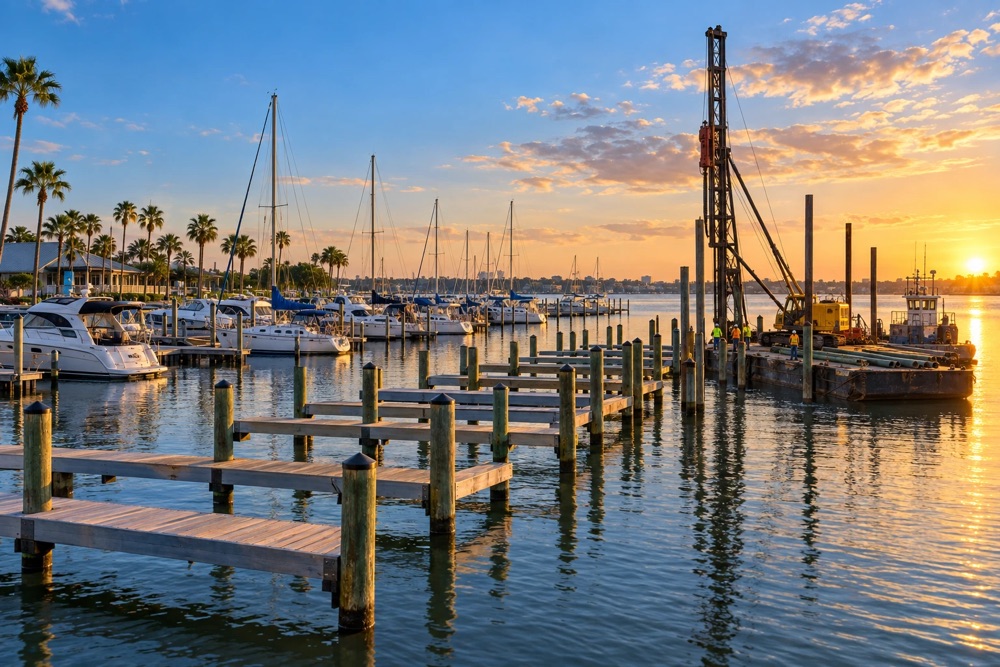
A stationary pier can create stable, convenient access to the water while providing space for boating, fishing, relaxing, and entertaining.
But the part you walk on is only one piece of the structure.
A well-built fixed pier depends on its pilings, framing, connections, decking, shoreline conditions, water depth, and the loads the structure is expected to support. Local permitting requirements can also vary significantly between Lake Conroe, Lake Houston, and coastal areas around Greater Houston.
Dream Boat Docks has served Texas waterfront property owners since 1987, building stationary, floating, and hybrid docks along with piers, boat houses, boat lifts, pilings, bulkheads, and other marine structures throughout Lake Conroe, Lake Houston, and Greater Houston.
This guide explains how stationary pier construction works, when a fixed structure makes sense, how it compares with a floating dock, and what homeowners should consider before beginning a project.
What Is a Stationary Pier?
A stationary, or fixed, pier is supported by pilings installed into the lakebed, riverbed, or seabed.
Unlike a floating dock, the primary walking surface does not rise and fall with normal changes in water level.
The pilings support structural framing, which in turn supports the decking and any compatible features incorporated into the design.
Depending on the project, a stationary pier may include:
- Boat slips
- A boat lift
- Fishing areas
- Seating
- Railings
- Lighting
- Electrical service
- Storage
- Water connections
- Connection to a boat house
- Access to a floating dock section
Dream Boat Docks provides custom pier construction and repair services for residential and commercial waterfront properties.
Why Choose a Stationary Pier?
One of the main advantages of a fixed pier is the stable walking surface.
Because the deck is supported by pilings rather than flotation, it generally does not move with every small wave or change in weight.
That can make a stationary structure appealing for:
- Fishing
- Entertaining
- Regular foot traffic
- Seating areas
- Boat-lift integration
- Covered structures
- Properties where a solid platform is preferred
Fixed piers can also be highly customized.
However, stationary does not automatically mean better.
A floating dock can be more appropriate where substantial water-level changes would make a fixed deck difficult to access.
The correct choice depends on the property.
Stationary vs. Floating Docks
Both systems have legitimate applications.
Stationary Piers
A stationary pier may be a good fit when:
- Water levels are reasonably compatible with a fixed deck elevation
- A stable platform is important
- The structure needs to support certain lifts or additional features
- Site and foundation conditions support driven pilings
Floating Docks
Floating docks move vertically with the water.
They may be advantageous when:
- Water levels change substantially
- Maintaining a relatively consistent boarding height is important
- Site conditions favor a floating approach
Floating docks still require a properly designed anchoring or guide system and appropriate connections to the shore.
Hybrid Designs
A property does not always have to choose one or the other.
A stationary walkway can lead to a floating dock or slip, combining a stable approach with flexibility at the water.
Dream Boat Docks builds stationary, floating, and hybrid systems and discusses these configurations in its guide to choosing the right dock type for your waterfront property.
The Foundation: Pier Pilings
The foundation is one of the most important parts of stationary pier construction.
Pilings transfer loads from the pier into the underlying soil.
Depending on the project, piling materials may include:
- Treated timber
- Steel
- Concrete
- Composite materials
- Other engineered systems
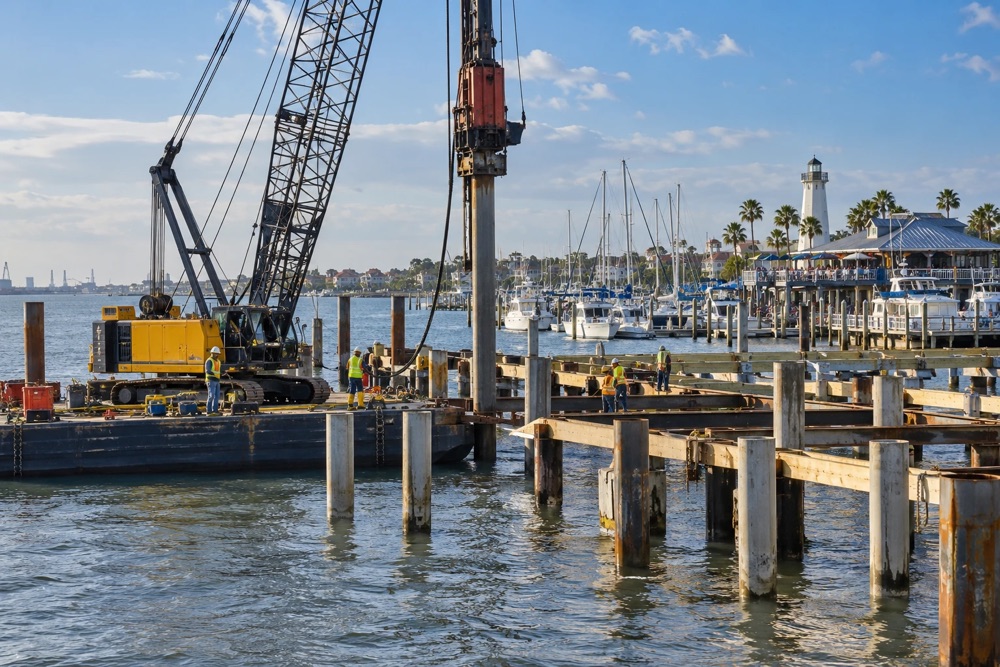
Dream Boat Docks provides marine piling and pile-driving services for residential, commercial, and industrial projects. Its piling work includes timber, steel, concrete, sheet, and mini piling applications.
How Deep Do Stationary Pier Pilings Need to Go?
There is no universal depth.
Required piling embedment can depend on:
- Soil conditions
- Water depth
- Piling type
- Pier size
- Structural loads
- Boat-lift loads
- Wind exposure
- Wave or wake forces
- Lateral loading
- Foundation design
The goal is not simply to drive every piling as deep as possible.
The foundation should provide the capacity required for the structure and site.
Do Pilings Have to Be Driven to Refusal?
Not necessarily.
“Refusal” generally describes a condition where additional pile penetration becomes very difficult under a particular driving method.
That does not mean every residential pier piling should automatically be driven until it cannot move any farther.
Foundation performance can depend on:
- Skin friction
- End-bearing capacity
- Embedment
- Pile dimensions
- Material
- Soil conditions
- Structural loads
Depending on the project, piling installation may be based on specified embedment, installation criteria, engineering requirements, or other site-specific factors.
Water Jetting vs. Hammer Driving
Different piling-installation methods can work in different conditions.
Dream Boat Docks uses marine pile-driving techniques appropriate to the project rather than relying on one method for every shoreline.
Factors that can influence installation include:
- Soil
- Piling material
- Diameter
- Water depth
- Access
- Existing structures
- Required foundation capacity
Neither water-assisted installation nor hammer driving should be described as universally superior.
An experienced marine contractor should be able to explain why a particular method makes sense for the property.
Choosing Piling Materials
Different piling materials offer different advantages.
Treated Timber
Treated timber is widely used in marine construction because it offers:
- Structural strength
- Familiar installation
- Cost efficiency
- Availability
Treatment specifications should match the intended exposure.
Timber used in freshwater conditions may have different requirements from wood exposed to brackish or saltwater.
Steel Pilings
Steel can offer high structural capacity and may be useful in demanding marine or commercial applications.
Corrosion protection needs to be considered, particularly in coastal or salt-influenced environments.
Concrete Pilings
Concrete can provide substantial strength and durability for certain applications but may involve different installation requirements and equipment.
Composite Pilings
Composite systems can provide corrosion and rot resistance and may make sense for certain waterfront environments.
There is no universally best piling material.
The appropriate choice depends on the loads, environment, project requirements, and budget.
For additional background, Dream Boat Docks also provides an overview of common piling types.
Choosing Decking for a Stationary Pier
Once the foundation and framing have been planned, homeowners can consider the visible deck surface.
Two common options are pressure-treated wood and composite decking.
Pressure-Treated Wood
Wood remains popular because it provides:
- A traditional waterfront appearance
- Competitive initial cost
- Straightforward board replacement
- Familiar construction
Wood requires more ongoing maintenance than many composite products and may eventually crack, splinter, weather, or deteriorate.
Composite Decking
Composite decking can provide:
- Resistance to rot
- Resistance to splintering
- Lower routine maintenance
- Consistent appearance
- Numerous colors and finishes
However, composite decking should not automatically be described as cooler than wood.
Surface temperatures can become high in direct Texas sunlight, with performance varying by product, color, and exposure.
Homeowners should compare actual products rather than relying on a generic “barefoot test.”
Dream Boat Docks uses pressure-treated wood and composite options in its custom boat dock construction.
What Hardware Should Be Used?
Waterfront hardware needs to account for moisture and corrosion.
Depending on the environment and application, appropriate components may include:
- Hot-dip galvanized fasteners
- Suitable stainless-steel grades
- Coated connectors
- Other corrosion-resistant structural hardware
Not every Texas pier requires 316 stainless steel throughout.
Material selection should consider:
- Freshwater vs. brackish or saltwater exposure
- Structural loads
- Connected materials
- Manufacturer requirements
- Corrosion conditions
Material compatibility also matters because dissimilar metals can contribute to galvanic corrosion in wet environments.
Can a Stationary Pier Support a Boat Lift?
Often, yes.
A fixed-pile structure can work well with a boat lift when the pier and foundation are designed for the additional loads.
Lift planning should consider:
- Vessel weight
- Vessel length and beam
- Hull configuration
- Lift capacity
- Piling location
- Water depth
- Electrical requirements
- Future boat upgrades
It is easier to coordinate these requirements when the lift is included in the original pier design.
Dream Boat Docks provides custom boat lift installation for pontoons, bass boats, wake boats, personal watercraft, and other vessels.
Can You Add a Boat House?
A stationary pier may also serve as part of a larger boat-house structure.
Depending on the property and applicable regulations, a boat house can incorporate:
- Covered vessel storage
- Boat lifts
- Lighting
- Storage
- Seating
- Fishing space
- Upper decks where allowed
A roof adds substantial design considerations.
The structure may need to account for:
- Wind loads
- Foundation loads
- Framing
- Connections
- Roof uplift
- Clearances
- Local restrictions
That is why a future boat house should ideally be considered when the original pier foundation is designed.
Learn more in Dream Boat Docks’ custom boathouse design and construction guide.
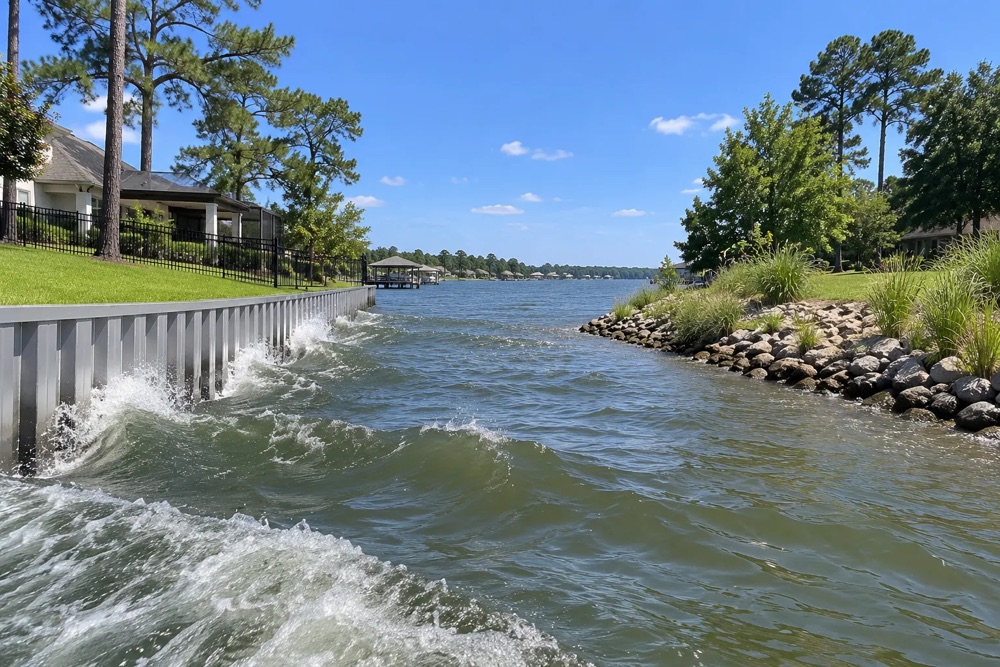
How Does a Pier Relate to the Bulkhead?
A pier and bulkhead perform different functions.
The pier provides access over the water and has its own foundation.
A bulkhead primarily retains soil and helps stabilize the shoreline.
A stationary pier does not automatically need to be structurally attached to a bulkhead.
However, the two systems should be considered together where the pier reaches land.
Important issues can include:
- Erosion
- Soil loss
- Drainage
- Elevation changes
- Access
- Stairs or ramps
- Bulkhead condition
If the bulkhead is leaning, bowing, deteriorating, or allowing soil to escape, it is worth evaluating before building a new pier.
Does Every Pier Need a Bulkhead?
No.
Some waterfront properties can support a pier without a bulkhead.
A bulkhead may be appropriate when the shoreline requires soil retention or erosion control, but it should not be installed simply because a pier is being built.
Shoreline conditions should determine whether additional stabilization is necessary.
Stationary Pier Construction on Lake Conroe
Lake Conroe private waterfront structures fall under the San Jacinto River Authority’s licensing and permitting program.
SJRA states that no person may construct, operate, or maintain a private structure on Lake Conroe or SJRA land without the proper permit or license.
For a residential structure, SJRA currently requires:
- A residential license agreement
- Plans drawn to scale
- Accurate measurements
- Location of the proposed structure on the property
- Distances from adjacent properties
- HOA, POA, or architectural-control approval where required
Construction cannot begin until the project has been approved and a construction permit has been issued.
Importantly, SJRA does not say that every residential dock application automatically requires a professional engineer’s stamped plans. Engineering may still be appropriate or required depending on the project.
Dream Boat Docks provides waterfront construction throughout Lake Conroe.
Stationary Pier Construction on Lake Houston
Lake Houston follows a different regulatory system.
Current City of Houston requirements state that Lake Houston piers require a separate construction permit and an annual license.
The City’s current Lake Houston structural provisions also require piers, bulkheads, and jetties to be designed and sealed by a professional engineer licensed in Texas. The City inspects the site before the permit is issued and after construction.
The City maintains separate fees for Lake Houston pier construction and annual residential pier licensing.
That means Lake Houston requirements should not simply be copied from Lake Conroe permitting guidance.
Dream Boat Docks provides Lake Houston pier, dock, boat house, bulkhead, and waterfront construction.
What About Coastal Texas Properties?
Stationary piers around Seabrook, Clear Lake, Kemah, La Porte, Baytown, and other coastal or tidally influenced areas may involve different requirements.
Depending on the property and work, approvals can involve:
- Local municipalities
- Texas General Land Office
- U.S. Army Corps of Engineers
- Other state or federal authorities
- HOA or property-owner associations
Coastal structures can also face different material and corrosion considerations than freshwater piers.
A permitting review should begin with the exact property rather than assuming every Texas waterfront follows the same process.
How the Stationary Pier Construction Process Works
Every project is different, but a typical process involves several stages.
1. Site Evaluation
The contractor reviews:
- Shoreline conditions
- Existing structures
- Water depth
- Intended use
- Vessel needs
- Access
- General foundation conditions
More detailed surveying, engineering, or subsurface investigation may be required depending on the project and jurisdiction.
2. Design
The layout can then address:
- Pier dimensions
- Piling configuration
- Deck elevation
- Slip dimensions
- Boat lifts
- Boat houses
- Seating
- Fishing areas
- Utilities
- Materials
3. Permitting
Applicable permits and approvals are identified and submitted.
The process differs by waterway and jurisdiction.
4. Foundation Installation
Pilings are installed according to the project’s requirements.
5. Framing and Decking
Beams, joists, bracing, decking, railings, and other structural elements are installed.
6. Additional Features
Depending on the project, this may include:
- Boat lifts
- Electrical systems
- Lighting
- Water service
- Seating
- Storage
- Roof structures
7. Inspection and Completion
Required jurisdictional inspections and contractor quality checks are completed before the finished structure is placed into normal use.
How Long Does It Take to Build a Stationary Pier?
There is no universal construction schedule.
Total project time can depend on:
- Design complexity
- Permitting
- Engineering
- Water access
- Piling installation
- Material availability
- Utilities
- Boat lifts
- Boat houses
- Weather
Physical construction may take several weeks for many residential projects once plans, permits, and materials are ready.
The overall project can take longer because design and permitting occur before construction begins.
A site-specific schedule is more useful than promising that every pier can be completed in two or three weeks.
How Long Does a Stationary Pier Last?
There is no dependable universal lifespan.
Actual service life depends on:
- Piling material
- Framing
- Decking
- Hardware
- Water conditions
- Construction quality
- Maintenance
- Storm exposure
- Vessel impacts
- Corrosion
- Biological deterioration
A properly built and maintained pier can provide many years of service, but specifying a fixed lifespan without knowing the materials and conditions can be misleading.
Does a Stationary Pier Increase Property Value?
A well-built pier can improve the functionality and market appeal of a waterfront property.
For a buyer who owns a boat, fishes, or values direct water access, a permitted and well-maintained pier can be an attractive feature.
However, there is no reliable universal percentage by which a stationary pier increases property value.
Its effect depends on:
- Local real-estate conditions
- Water access
- Condition
- Design
- Permitting
- Buyer demand
The primary reason to build a pier should be to improve the use and enjoyment of the waterfront.
Potential resale appeal is an additional benefit rather than a guaranteed financial return.
Stationary Pier Maintenance
Fixed does not mean maintenance-free.
Property owners should periodically watch for:
- Loose deck boards
- Corrosion
- Rot
- Splitting
- Piling damage
- Loose railings
- Deteriorated framing
- Failed fasteners
- Boat-lift connection problems
- Changes in alignment
- Shoreline erosion
It is also wise to inspect the structure after:
- Major storms
- Unusually high water
- Debris impacts
- Vessel collisions
- Other events that could affect the foundation or framing
If the pier begins to feel or look substantially different during normal use, consider having it evaluated.
Dream Boat Docks also provides waterfront remodeling and repair services for aging docks, piers, and boat houses.
Why Work With Dream Boat Docks?
Dream Boat Docks has served Texas waterfront property owners since 1987.
Its marine construction services include:
- Piers
- Pilings and pile driving
- Boat docks
- Boat lifts
- Bulkheads
- Waterfront construction and remodeling
The company builds stationary, floating, and hybrid waterfront structures throughout Lake Conroe, Lake Houston, and Greater Houston.
That range of services can be especially useful when a project involves more than the pier itself, such as a lift, boat house, piling work, shoreline repairs, or future expansion.
Choose the Pier That Fits Your Waterfront
The best pier is not automatically stationary or floating.
It is the structure that fits the property.
For one homeowner, a fixed pier may provide exactly the stable fishing, entertaining, and boat-access area they want.
Another property may work better with a floating dock.
A third may benefit from a hybrid system.
The right decision starts with:
- The shoreline
- Water depth
- Water-level variation
- Soil conditions
- Vessel
- Intended use
- Future plans
- Budget
From there, the foundation, materials, layout, and features can be designed around the site rather than forcing the property to fit a predetermined dock style.
If you’re considering a stationary pier, floating dock, boat house, boat lift, or larger waterfront project, contact Dream Boat Docks to request a site evaluation and free estimate.
Frequently Asked Questions
What is a stationary pier?
A stationary pier is a fixed waterfront structure supported by pilings installed into the lakebed, riverbed, or seabed.
Unlike a floating dock, its main deck does not normally rise and fall with water-level changes.
Is a stationary pier better than a floating dock?
Not universally.
A stationary pier provides a stable walking surface and can work well for many waterfront properties.
A floating dock can be better when substantial water-level changes make a fixed deck inconvenient.
Some properties benefit from combining both systems.
How deep should pilings be for a stationary pier?
There is no universal depth.
Piling requirements depend on soil conditions, water depth, material, pier loads, wave exposure, lateral forces, and other site-specific factors.
A contractor should evaluate the property before specifying embedment.
Do pier pilings need to be driven to refusal?
Not always.
Foundation requirements can be based on embedment, soil resistance, structural capacity, engineering criteria, or other project-specific factors.
“Drive every piling to refusal” is not a universal rule for residential pier construction.
What is the best material for stationary pier decking?
There is no single best material.
Pressure-treated wood provides a traditional appearance and often a lower upfront cost.
Composite decking offers lower routine maintenance and resistance to rot and splintering.
The right choice depends on budget, appearance, sun exposure, and maintenance preferences.
Does composite decking stay cooler than wood?
Not necessarily.
Composite surface temperature depends on the specific product, color, and amount of direct sunlight.
Some products are designed to reduce heat buildup, but homeowners should compare specific materials rather than assuming all composite decking stays cool.
Do I need a permit for a stationary pier on Lake Conroe?
Yes.
SJRA requires authorization before a private structure can be constructed, operated, or maintained on Lake Conroe or SJRA-controlled land.
Residential applications currently require scaled plans, measurements, location information, and HOA/POA/ACC approval where applicable.
Do I need a permit for a stationary pier on Lake Houston?
Yes.
Lake Houston piers are subject to City of Houston construction-permit and annual-license requirements.
Current City provisions also require Lake Houston piers to be designed and sealed by a Texas-licensed professional engineer.
Can a stationary pier support a boat lift?
Yes, when the foundation and framing are designed for the additional loads.
The vessel, lift capacity, piling configuration, water depth, and electrical requirements should be considered during design.
Can I add a boat house to an existing stationary pier?
Sometimes.
The existing pilings and framing need to be evaluated to determine whether they can support the additional roof, wind, lift, and structural loads.
If they cannot, reinforcement or new foundation work may be required.
Does every stationary pier need a bulkhead?
No.
Bulkheads retain soil and help control shoreline erosion, while piers provide water access.
Some properties need both, but a bulkhead should not be installed simply because a stationary pier is being built.
Can an existing stationary pier be repaired?
Often, yes.
Depending on its condition, repairs can include decking, framing, hardware, bracing, pilings, railings, boat lifts, and other components.
Widespread foundation deterioration may make partial or complete replacement more practical.
Planning a stationary pier or waterfront project? Contact Dream Boat Docks for a site evaluation and free estimate.