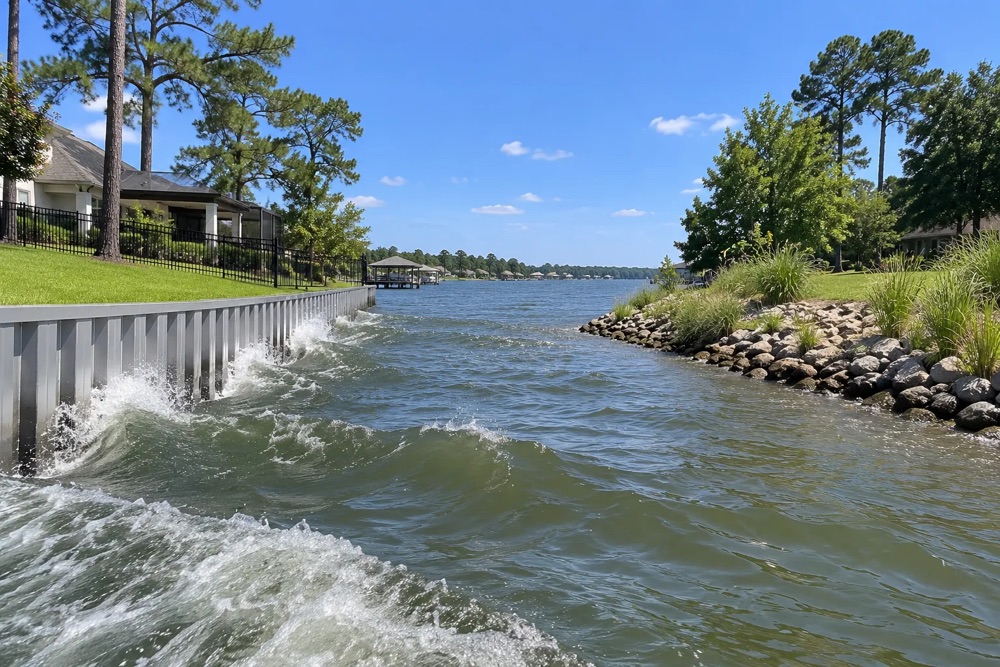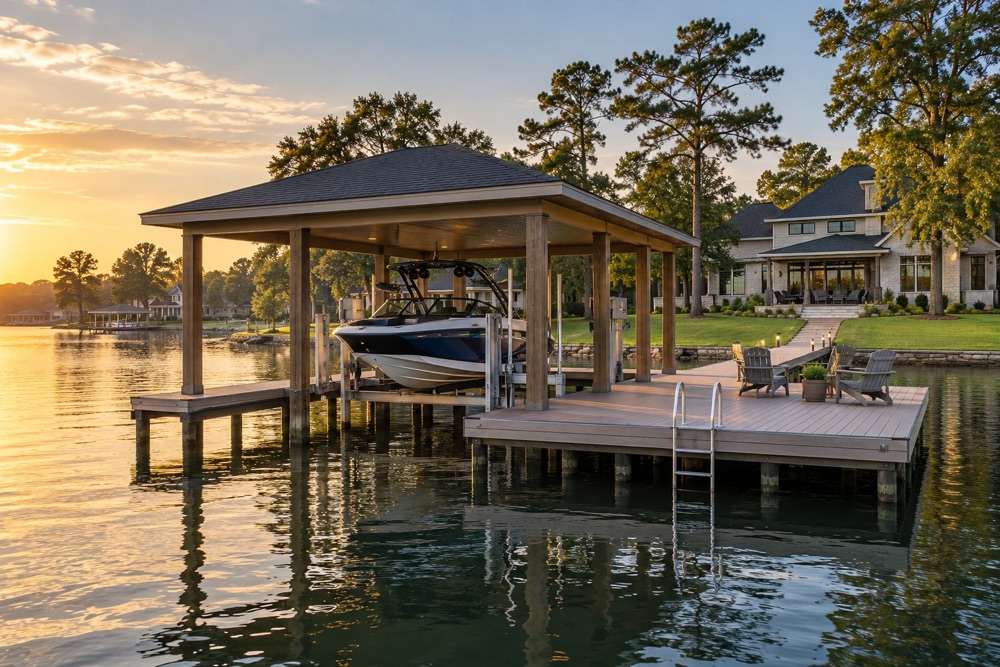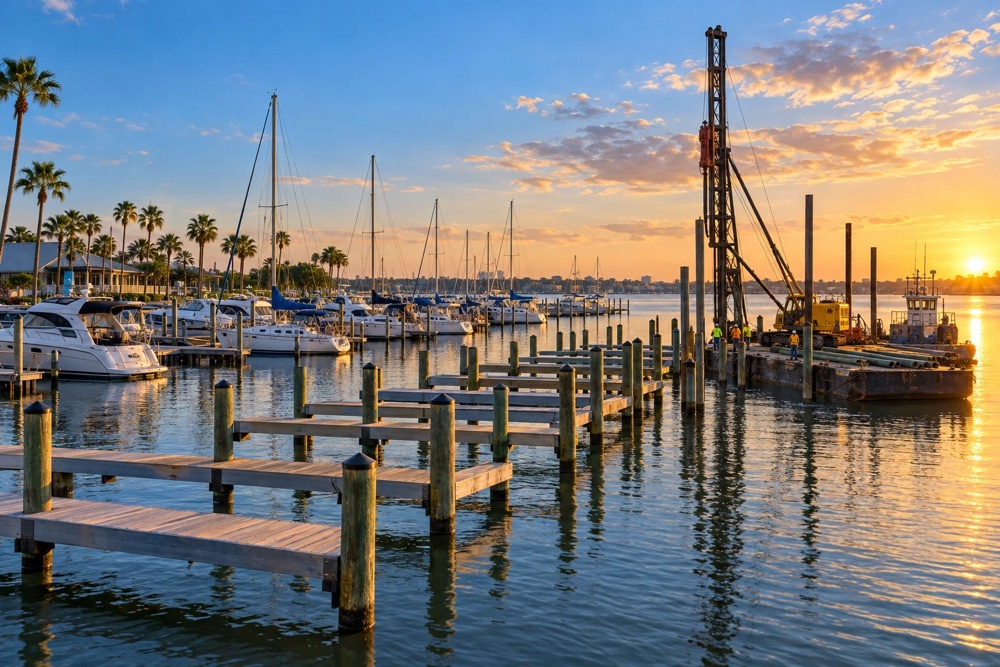
Commercial waterfront construction can involve much more than building a larger version of a residential dock.
Marinas, waterfront businesses, multi-slip facilities, commercial piers, and other marine properties may need to accommodate heavier use, different vessel sizes, utilities, public access, shoreline protection, and more complex permitting requirements.
The right approach depends heavily on the property.
A commercial project on Lake Conroe will have very different considerations from a marina or pier in Seabrook, Clear Lake, Baytown, Kemah, or another coastal area.
Dream Boat Docks has served Texas waterfront property owners since 1987. Its current services include complete pier construction and repair for residential and commercial properties as well as commercial and residential marine piling, docks, bulkheads, boat lifts, and waterfront construction.
This guide explains the major issues commercial property owners should consider when planning new marine infrastructure, replacing aging waterfront structures, or expanding an existing facility.
Key Takeaways
- Commercial marine construction should begin with the site’s use, vessel mix, structural needs, shoreline conditions, and operational goals.
- Commercial does not automatically mean every project needs deeper pilings, steel framing, dredging, or large-scale engineering. Requirements depend on the structure and site.
- Existing docks, pilings, bulkheads, utilities, and shoreline conditions should be evaluated before a major expansion.
- Fixed, floating, and hybrid dock systems can all work for commercial waterfront properties.
- Texas coastal projects may involve the Texas General Land Office, U.S. Army Corps of Engineers, municipalities, navigation districts, or other agencies depending on the property and work proposed.
- Accessibility, electrical systems, fire protection, utilities, pedestrian circulation, and emergency access may become important design considerations for public-facing facilities.
- Commercial waterfront projects should be evaluated according to total operating needs and lifecycle costs rather than simply maximizing the number of slips.
What Is Commercial Marine Construction?
Commercial marine construction covers waterfront structures built or modified for business, public, multi-user, or higher-use applications.
Projects can include:
- Marinas
- Commercial piers
- Multi-slip docks
- Waterfront restaurants or hospitality properties
- Rental and storage facilities
- Commercial boat lifts
- Shoreline stabilization
- Bulkheads
- Marine pilings
- Dock expansions
- Waterfront renovations
- Utility infrastructure associated with docks and piers
The scope can range from repairing a commercial pier to expanding an existing marina.
Dream Boat Docks provides custom pier construction for both residential and commercial properties, along with broader marine construction services.
How Is Commercial Waterfront Construction Different From Residential Work?
Commercial construction is not automatically more complicated in every respect, but it often introduces different operating and design requirements.
Depending on the property, a commercial project may need to accommodate:
- Greater pedestrian traffic
- Multiple vessels
- Larger vessels
- Public access
- Commercial utilities
- More frequent loading and unloading
- Accessibility requirements
- Fire and life-safety considerations
- More complex electrical systems
- Longer operating hours
- Maintenance access
- Future expansion
The loads also need to reflect the actual use.
A commercial fishing pier, marina, waterfront restaurant dock, and industrial pier do not have the same structural requirements simply because they are all “commercial.”
The project should be designed around its intended operation.
Start With the Site and Business Goals
Before deciding how many slips to add or which materials to use, define what the waterfront needs to accomplish.
Questions worth answering include:
- What vessels will use the property?
- How many users need access at the same time?
- Is the dock private to customers or open to the public?
- Will vessels stay overnight?
- Will the facility offer boat storage?
- Are boat lifts needed?
- Will utilities be provided at slips?
- Is fueling involved?
- Are future phases planned?
- Does the existing waterfront infrastructure remain usable?
- How will customers, employees, maintenance crews, and emergency responders move through the property?
These questions help determine what information, engineering, permitting, and construction methods will be needed later.
Evaluate Existing Waterfront Infrastructure
An expansion should not automatically assume that everything already on the property can support the new development.
Existing infrastructure may include:
- Piers
- Docks
- Pilings
- Bulkheads
- Gangways
- Utilities
- Boat lifts
- Electrical systems
- Shoreline drainage
Look for conditions such as:
- Corroded connections
- Piling deterioration
- Structural movement
- Deck deterioration
- Bulkhead leaning
- Sinkholes
- Soil loss
- Utility limitations
- Previous storm damage
Some existing structures may remain useful.
Others may need reinforcement, repair, partial replacement, or complete reconstruction.
Dream Boat Docks provides waterfront construction and remodeling services for existing marine structures in addition to new construction.
Commercial Pier Design
A commercial pier should be designed around how people and vessels will actually use it.
Important considerations may include:
- Pier width
- Vessel access
- Mooring locations
- Structural loading
- Pedestrian flow
- Utilities
- Lighting
- Equipment
- Railings
- Emergency access
- Connections to floating docks or slips
- Maintenance access
A pier serving restaurant patrons will have different operating requirements from one used primarily for boat storage or commercial marine access.
Dream Boat Docks’ pier construction services include custom designs using treated timber, composite materials, concrete, and sheet-pile applications.
Fixed vs. Floating Commercial Docks
There is no universally best dock configuration.
Fixed Docks and Piers
Fixed structures are supported by pilings.
They can provide:
- Stable walking surfaces
- Support for larger structural features
- Integration with certain boat lifts
- Permanent access
- Straightforward connection to fixed shoreline structures
They can work well where site conditions and water-level variation support a fixed elevation.
Floating Dock Systems
Floating docks rise and fall with changing water levels.
They can be useful where maintaining a relatively consistent boarding height is important.
Floating systems still need:
- Anchoring or pile-guidance systems
- Gangways
- Appropriate utility connections
- Structural connections
- Maintenance planning
Hybrid Systems
Some facilities work best with a combination.
For example, a fixed access pier may connect the shoreline to a floating marina system.
Dream Boat Docks builds custom boat docks and discusses the differences between configurations in its guide to choosing the right dock type.
Commercial Pilings and Marine Foundations
The foundation determines how loads from the structure are transferred into the underlying soil.
Depending on the application, piling materials may include:
- Treated timber
- Steel
- Concrete
- Composite materials
- Sheet piling
- Other engineered systems
Dream Boat Docks provides commercial and residential piling and pile-driving services for marine construction.
How Deep Do Commercial Pilings Need to Go?
There is no universal depth.
Required embedment can depend on:
- Soil conditions
- Water depth
- Piling material
- Structure size
- Structural loads
- Vessel loads
- Wave and current exposure
- Lateral forces
- Equipment loads
- Foundation design
A commercial project should not simply use “deeper pilings” because it has a business use.
The foundation should match the actual loads and site conditions.
Does Every Commercial Project Need Geotechnical Testing?
No.
Geotechnical investigation can be important for projects where existing subsurface information is insufficient or where foundation demands justify additional investigation.
More substantial projects may require soil borings or other subsurface analysis to establish foundation capacity.
For other projects, existing information and site conditions may provide what the design team needs.
The appropriate level of investigation should be determined by the project’s engineer and permitting requirements when engineering is involved.
Bulkheads and Commercial Shoreline Stabilization
A bulkhead primarily retains soil and stabilizes the shoreline.
Commercial sites can place different demands on shoreline walls because the land behind the wall may support:
- Parking
- Pedestrian areas
- Buildings
- Storage
- Equipment
- Utilities
- Other improvements
Those additional loads, commonly called surcharge loads, may need to be included in the bulkhead design.
But not every commercial property has the same loading conditions.
A marina lawn area, parking lot, and industrial storage yard should not automatically use the same wall design.
For a broader explanation of how piers and shoreline walls interact, see Dream Boat Docks’ bulkhead and pier construction guide.
Bulkhead Drainage Matters
A bulkhead must resist soil pressure from the land side.
Water trapped behind the wall can add hydrostatic pressure.
Depending on the design, drainage may involve:
- Weep systems
- Drainage materials
- Filter fabric
- Graded backfill
- Other engineered drainage features
The exact system depends on wall design and site conditions.
It would be inaccurate to say every commercial bulkhead simply needs more or larger weep holes.
Drainage should be considered as part of the complete structure.
Choosing Commercial Bulkhead Materials
Dream Boat Docks builds bulkheads using materials including vinyl/PVC, composite/FRP, treated timber, and steel.
There is no universally best choice.
Vinyl/PVC
Vinyl provides resistance to:
- Rot
- Corrosion
- Marine borers
It can be appropriate for many waterfront applications where the structural requirements fit the system.
Learn more about vinyl bulkhead construction.
Composite/FRP
Fiber-reinforced polymer sheet piling can provide:
- Corrosion resistance
- Resistance to rot
- High strength-to-weight performance
- Suitability for demanding marine environments
Read more about composite and FRP bulkhead systems.
Steel
Steel can provide substantial structural capacity.
Corrosion protection becomes an important consideration, particularly in coastal and brackish environments.
Treated Timber
Treated timber remains a legitimate option for appropriate marine applications.
Treatment specifications should match the environmental exposure.
The decision should be based on:
- Wall height
- Soil
- Surcharge loads
- Wave exposure
- Corrosion conditions
- Desired maintenance
- Structural requirements
- Budget
Marina and Multi-Slip Layouts
Adding the greatest possible number of slips is not always the best marina design.
A practical layout should also consider:
- Vessel length and beam
- Fairway width
- Turning space
- Water depth
- Dock orientation
- Prevailing wind
- Wave exposure
- Boarding
- Pedestrian circulation
- Utilities
- Maintenance
- Emergency access
Additional slips can potentially create more revenue-producing capacity, but revenue is not guaranteed simply because capacity increases.
Occupancy, local demand, operating costs, insurance, maintenance, rental rates, and customer experience all affect financial performance.
For properties planning an expansion, see Dream Boat Docks’ marina expansion guide.
Boat Lifts in Commercial Waterfront Facilities
Boat lifts may make sense for:
- Premium slips
- Rental fleets
- Vessel storage
- Personal-watercraft areas
- Covered boat slips
Lift selection should account for:
- Vessel weight
- Hull configuration
- Lift capacity
- Duty cycle
- Piling locations
- Water depth
- Electrical requirements
A lift should be chosen for its actual use rather than assuming hydraulic or cable systems are universally better for commercial applications.
Maintenance should follow the lift manufacturer’s instructions and operating conditions.
Dream Boat Docks provides boat lift installation that can be coordinated with dock and piling work.
Planning Utilities Early
Commercial waterfront facilities may need significantly more utility coordination than a basic private dock.
Potential systems can include:
- Electrical service
- Shore power
- Dock lighting
- Water
- Pump-out systems
- Communications
- Security
- Fire-protection equipment
- Access controls
Utilities should be considered during the initial layout.
Retrofitting them after the dock is complete can create unnecessary demolition and expense.
Electrical installations around marinas and docks also require specialized attention because of the hazards associated with electricity near water.
Qualified professionals should design and install systems subject to applicable electrical codes.
Accessibility for Commercial and Public-Facing Marinas
Accessibility should be evaluated early for commercial and public-facing boating facilities.
Federal ADA standards contain specific requirements for recreational boating facilities, including accessible boat slips, accessible routes, floating piers, boarding piers, and gangways. The required number of accessible slips depends on the total number of slips provided.
Texas also administers the Texas Accessibility Standards through the Texas Department of Licensing and Regulation.
Projects with an estimated construction cost of $50,000 or more generally must be registered with TDLR under the Architectural Barriers program. Projects below that amount may still need to comply with accessibility standards depending on the facility and type of work.
Accessibility should therefore be reviewed based on the actual project rather than assuming that every commercial dock has identical requirements.
Commercial Waterfront Permitting in Coastal Texas
Permitting is another area where there is no universal checklist.
The required approvals depend on:
- Property location
- Ownership
- Waterway
- Proposed structures
- Dredging
- Fill
- Shoreline work
- Utilities
- Environmental impacts
Texas General Land Office
The Texas General Land Office manages commercial uses of much of Texas’ state-owned coastal submerged land.
The GLO specifically identifies projects such as:
- Marinas
- Docks
- Wharves
- Boardwalks
- Fishing piers
- Breakwaters
- Dredged channels
as examples of commercial coastal projects that may require a commercial coastal easement or coastal surface lease when state-owned submerged land is involved.
That does not mean every Texas commercial waterfront project needs a GLO lease.
It depends on land ownership and jurisdiction.
U.S. Army Corps of Engineers
The U.S. Army Corps of Engineers regulates certain structures and work in navigable waters and certain activities in waters of the United States.
Depending on the project, authorization may involve:
- A general permit
- Regional general permit
- Nationwide Permit
- Letter of Permission
- Individual Permit
- Another applicable authorization
The Galveston District currently maintains several regional and programmatic general permits. Its 2026-2031 Pier Regional General Permit, for example, covers qualifying single pile-supported piers at single-family, multi-family, and lodging properties, illustrating why permit type depends on the exact project rather than simply whether a structure is “commercial.”
Larger marina, dredging, shoreline, or commercial waterfront projects may follow different federal permitting paths.
Local Permitting
City, county, navigation-district, floodplain, utility, fire, and other approvals can also apply.
Lake Conroe projects, for example, fall under a different regulatory framework from Galveston Bay coastal projects.
That is why permitting should start by identifying the property and scope rather than assuming that GLO and USACE approval always apply.
Does Every Commercial Marine Project Require an Environmental Impact Assessment?
No.
Federal or state environmental review can be required for projects affecting regulated waters, habitat, dredging, fill, submerged land, or other protected resources.
The level of review depends on the project and applicable permitting process.
Some projects may require specialized studies or agency consultation.
Others may qualify for streamlined permitting.
The environmental requirements should be identified as part of permitting rather than assuming that every commercial dock requires a formal environmental impact assessment.
Hydrographic Surveys
A hydrographic survey maps underwater conditions and can provide useful information about:
- Water depth
- Bottom elevation
- Navigation
- Existing underwater features
- Dredging
- Submerged obstacles
It may be important for larger marina developments or projects involving navigation and dredging.
It is not automatically mandatory for every commercial pier or dock project.
The need should be determined by project complexity, existing information, engineering, and permitting requirements.
Dredging and Water Depth
Some commercial properties already have sufficient water depth.
Others may consider dredging to accommodate larger vessels or improve navigation.
Dredging can substantially change project scope because it may involve:
- Federal permits
- State authorization
- Sediment testing
- Disposal planning
- Environmental requirements
- Hydrographic surveys
Owners should therefore distinguish between a dock expansion and a marina expansion that also requires channel or basin modification.
Environmental Controls During Construction
Marine construction can disturb sediment or create other environmental impacts.
Depending on the project and permit conditions, construction controls may include:
- Turbidity barriers
- Sediment controls
- Waste containment
- Spill prevention
- Restricted work areas
- Timing limitations
- Habitat protections
A turbidity curtain should not automatically be prescribed for every pile-driving project.
The controls should follow project conditions, site needs, and permit requirements.
Designing for Coastal Conditions
Texas coastal projects may need to account for:
- Wind
- Waves
- Tides
- Storm surge
- Corrosion
- Flood elevations
- Debris
- Changing water levels
No contractor should describe a marine structure as hurricane-proof.
Resilience comes from evaluating the entire structure, including:
- Foundation
- Framing
- Connections
- Elevation
- Materials
- Drainage
- Shoreline conditions
The appropriate design criteria should be established for the individual project.
Planning for Changing Water Conditions
For coastal or flood-prone sites, engineers and owners may also evaluate how future water conditions could affect the facility during its expected service life.
That does not mean there is a single “2026 climate standard” requiring every dock to be elevated by the same amount.
Site elevation, floodplain requirements, water-level records, project life, local rules, and engineering criteria should guide those decisions.
Maintenance as Part of Commercial Planning
Commercial marine facilities should have an inspection and maintenance plan appropriate to the assets they operate.
Rather than imposing an arbitrary quarterly inspection on every property, inspection frequency can depend on:
- Structure age
- Materials
- Usage
- Vessel impacts
- Coastal exposure
- Manufacturer recommendations
- Storm events
- Previous deterioration
Items worth monitoring include:
- Pilings
- Bulkheads
- Decking
- Structural connections
- Corrosion
- Utilities
- Gangways
- Boat lifts
- Shoreline drainage
- Soil movement
A major storm, collision, or unusual high-water event may warrant an additional inspection regardless of the normal schedule.
Repair, Replace, or Expand?
Not every aging commercial waterfront needs complete reconstruction.
Repair may be practical when:
- Damage is localized
- The foundation remains serviceable
- The layout still meets operational needs
- Utilities have adequate capacity
- Structural deterioration is limited
Replacement or major reconstruction may make more sense when:
- Foundation problems are widespread
- Multiple structural systems are deteriorated
- The facility no longer accommodates current vessels
- Accessibility or utilities require major upgrades
- Repeated repairs are becoming inefficient
- Expansion would overload existing infrastructure
Dream Boat Docks provides construction and remodeling services for damaged and aging waterfront structures.
A Practical Commercial Waterfront Development Process
A commercial project may move through the following broad stages.
1. Define Operational Goals
Identify:
- Vessel types
- Slip capacity
- Public or private access
- Utilities
- Boat lifts
- Covered areas
- Future growth
- Budget priorities
2. Evaluate the Existing Site
Review:
- Water depth
- Existing docks
- Pilings
- Bulkheads
- Utilities
- Shoreline conditions
- Access
- Known regulatory constraints
3. Identify Additional Technical Information
Depending on the project, this may include:
- Surveying
- Hydrographic data
- Geotechnical investigation
- Structural engineering
- Environmental information
4. Develop the Concept
Determine:
- Dock configuration
- Pier layout
- Slip arrangement
- Foundation concept
- Shoreline work
- Utilities
- Access
- Boat lifts
5. Identify Permitting Requirements
Determine which local, state, and federal agencies need to review the project.
6. Finalize Design and Scope
Detailed plans can then be prepared according to the project’s technical and regulatory needs.
7. Plan Construction Phasing
For an operating waterfront business, construction sequencing may need to consider:
- Temporary slip closures
- Customer access
- Utility interruptions
- Equipment staging
- Barge access
- Safety separation
- Existing operations
8. Complete Construction and Required Inspections
The facility should complete applicable inspections and approvals before affected areas enter normal operation.
Can a Waterfront Business Stay Open During Construction?
Sometimes.
Phased construction can allow portions of an existing marina or waterfront facility to remain operational.
Whether that is practical depends on:
- Site layout
- Construction access
- Safety
- Utility interruptions
- Water access
- Permit conditions
- Scope of demolition
Maintaining operations should be discussed early because it can influence design, staging, and cost.
Does Commercial Marine Construction Increase Property Value?
New waterfront infrastructure can improve functionality and potentially improve a property’s income-producing capacity or market appeal.
However, it would be misleading to say marine construction automatically increases property value or guarantees a specific return.
Financial performance depends on factors such as:
- Demand
- Occupancy
- Rental rates
- Construction cost
- Financing
- Insurance
- Maintenance
- Operating costs
- Property type
- Local real-estate conditions
Commercial owners should evaluate the business case separately from the physical feasibility of construction.
Choosing a Commercial Marine Contractor
When evaluating a contractor, consider experience with:
- Commercial piers
- Pilings
- Dock construction
- Bulkheads
- Waterfront repairs
- Water-based equipment
- Project phasing
- Materials
- Permitting coordination
Also clarify:
- What is included in the contract?
- Who handles engineering?
- Who submits permits?
- Which materials are specified?
- How are changes handled?
- What insurance applies?
- How will existing operations be protected?
- What warranties are provided?
A contractor should be able to explain the proposed approach based on the property rather than relying on generic statements such as “commercial projects always need deeper piles” or “this material is always best.”
Why Dream Boat Docks?
Dream Boat Docks has served Texas waterfront property owners since 1987 and serves Seabrook, League City, Kemah, Clear Lake, La Porte, Baytown, Lake Conroe, Lake Houston, and other Texas areas upon request.
Its services include:
- Commercial and residential pier construction
- Commercial and residential marine piling
- Boat docks
- Bulkheads
- Boat lifts
- Waterfront construction and remodeling
Dream Boat Docks provides complete pier construction and repair for residential and commercial properties.
Property owners can also review completed Dream Boat Docks waterfront projects when planning a new commercial marine project.
Plan the Waterfront as a Complete System
A successful commercial waterfront is rarely just a dock.
The pilings support the structure.
The docks and piers manage vessel and pedestrian access.
The bulkhead may stabilize the shoreline.
Utilities support daily operations.
Gangways connect different elevations.
Accessibility influences how customers use the facility.
Permitting determines what can legally be built.
Maintenance affects long-term operating cost.
When those pieces are considered together, owners can make better decisions about what should be repaired, replaced, built now, or reserved for a future phase.
If you’re planning a commercial pier, piling project, marina improvement, bulkhead, or other waterfront construction in Texas, contact Dream Boat Docks to discuss the property and request an estimate.
Frequently Asked Questions
What is commercial marine construction?
Commercial marine construction includes docks, piers, pilings, bulkheads, marinas, and other waterfront structures used for business, public, multi-user, or higher-use applications.
The exact design requirements depend on how the property will be used.
Does every commercial marine project require engineering?
No.
Engineering requirements depend on the structure, jurisdiction, loads, project complexity, and permitting requirements.
Some projects require sealed engineering plans, while others may not.
Do commercial piers require deeper pilings than residential piers?
Not automatically.
Piling depth depends on foundation capacity, soil conditions, loads, water depth, material, and other site-specific factors.
Commercial use alone does not determine embedment.
Do commercial waterfront projects require a USACE permit?
Not every project does.
USACE jurisdiction depends on the location and proposed activity.
Certain structures or work in navigable waters and certain activities involving waters of the United States require federal authorization, but the appropriate permit type varies by project.
Does every coastal commercial project require a GLO lease?
No.
GLO leases or easements apply when a commercial project uses state-owned submerged land or otherwise falls within GLO jurisdiction.
Commercial marinas, docks, wharves, and dredged channels are among the project types that can require GLO authorization.
Does every commercial marina need to comply with ADA accessibility standards?
Accessibility requirements depend on the facility and scope, but federal ADA standards include specific provisions for recreational boating facilities, accessible boat slips, routes, gangways, and floating piers.
Texas projects may also be subject to Texas Accessibility Standards.
Is the $50,000 threshold an exemption from accessibility requirements in Texas?
No.
Projects with estimated construction costs of $50,000 or more generally must be registered with TDLR under the Architectural Barriers program.
A project under $50,000 may still be subject to accessibility requirements even if mandatory state registration does not apply.
What is the best bulkhead material for a commercial waterfront?
There is no universal best material.
Vinyl/PVC, FRP composite, steel, and treated timber can all have appropriate applications.
The decision should reflect soil, wall height, loads, corrosion exposure, maintenance expectations, and budget.
Do I need a hydrographic survey for a commercial dock?
Not necessarily.
Hydrographic surveying can be useful or required when accurate underwater elevations, dredging quantities, navigation depths, or submerged features must be documented.
The need depends on the project.
Does every commercial marine project require soil testing?
No.
Geotechnical investigation may be necessary for larger or more demanding foundation designs, but it is not automatically required for every commercial dock or pier.
Can an existing commercial pier be expanded?
Possibly.
The existing foundation, framing, utilities, layout, and permitting status should be evaluated before additional loads or slips are added.
Reinforcement or new independent pilings may be necessary in some cases.
Can Dream Boat Docks work on commercial pier and piling projects?
Yes.
Dream Boat Docks provides pier construction for residential and commercial properties and operates as both a commercial and residential piling contractor.
Planning a commercial waterfront project? Contact Dream Boat Docks to request an evaluation and estimate.