If you own waterfront property in La Porte, there’s a good chance your shoreline is working harder than you realize. The Houston Ship Channel runs through some of the busiest commercial waterway traffic in the country. Every loaded tanker and container vessel that passes sends wake energy into your bank, and it happens not once, but dozens of times a day. It’s not dramatic. You don’t notice it happening. But over a few seasons, that energy finds the weak points, and once erosion gets started on an exposed shoreline, it doesn’t slow down on its own.
We’ve been building and repairing bulkheads along this stretch of the Texas Gulf Coast since 1987. What we’ve learned over those decades is that a bulkhead on the Ship Channel is a different animal than a retaining wall on a quiet cove. The engineering has to account for it. This article covers what that actually looks like: the materials, the installation process, the permitting, and what to watch for once a wall is in the water.
Why La Porte Shorelines Are a Different Engineering Problem
Most coastal bulkhead guides are written with calm-water residential properties in mind. La Porte isn’t that.
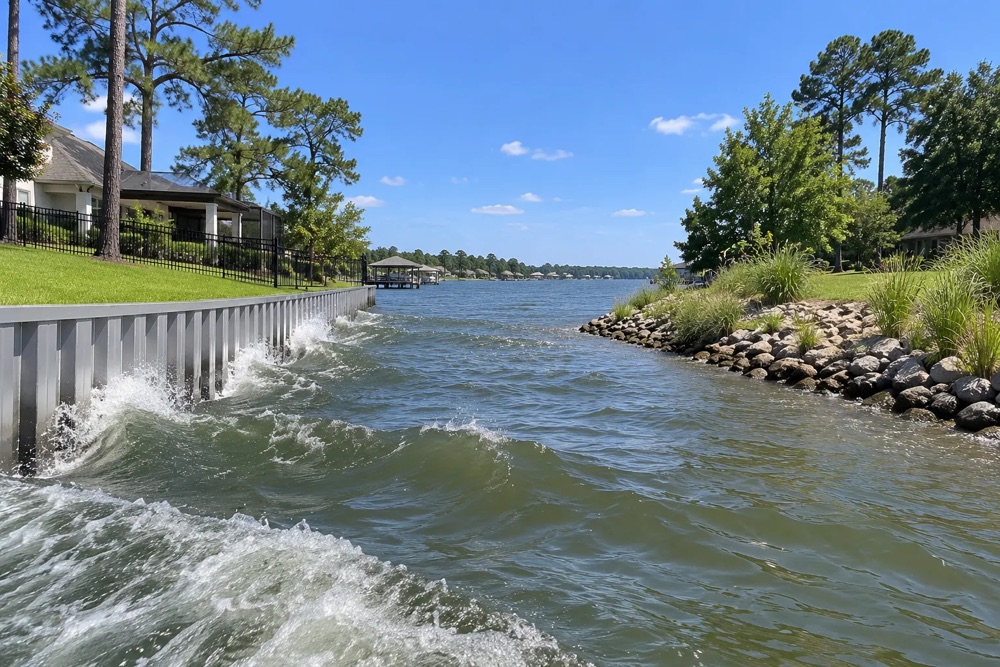
Commercial vessel traffic on the Houston Ship Channel generates what engineers call active hydraulic impact. This is different from the steady hydrostatic pressure a standard retaining wall is designed around. When a loaded ship passes, the resulting wake hits your bank with a sudden, high-energy pulse. That energy repeats throughout the day, every day. A wall that isn’t engineered for it (wrong piling depth, undersized anchors, inadequate drainage) will show signs of stress within a few years and fail well before it should.
Soil conditions add another layer of complexity. La Porte soils commonly shift between dense clay and loose silt along the bay shoreline. Clay expands and contracts with moisture changes; silt offers poor friction for anchor systems. Both require engineering decisions that a contractor without local experience in this specific area may not account for.
The water itself is brackish, a mix of saltwater and freshwater that’s harder on materials and hardware than either one alone. Standard construction fasteners rust out in a matter of seasons here. Material choices that work fine on a freshwater lake fail ahead of schedule in Galveston Bay.
None of this is reason to avoid building on the water. It’s reason to build it right the first time.
Signs Your Bulkhead Is Starting to Fail
Most bulkhead failures don’t happen all at once. The structure shows warning signs for months, sometimes years, before anything gives way. The problem is that most property owners don’t know what to look for until something obvious happens.
Here are the signs we check for on every inspection:
Sinkholes or soft depressions directly behind the cap. When soil is escaping through a gap in the sheeting, it shows up as settling or small holes in the ground right behind the wall. This one is easy to miss because it happens gradually.
Outward lean or bowing in the wall. A wall that’s starting to move toward the water is telling you the tie-back or deadman anchor system is under more load than it can handle. On high-energy shorelines like the Ship Channel, this can progress faster than it would in calmer water.
Soil bleeding through joints during low tide. If you can see dirt washing through cracks or gaps in the sheeting when the water drops, the seal has been compromised. Water movement will continue to widen that gap.
Separation between the cap and the pilings. A visible gap at the top of the wall where the cap meets the sheeting is a structural concern, not just a cosmetic one.
Outward kick at the base. Walk down to the water at low tide and look at the bottom of the piling. If it’s pushing outward, the foundation is shifting.
None of these are situations to monitor and revisit next season. On a shoreline with this level of wake activity, a compromised wall can fail suddenly during a storm or a heavy ship transit. Early repair is far less expensive than reconstruction.
Choosing the Right Material
Material selection drives everything downstream: how long the wall lasts, what maintenance it needs, and how well it integrates with any dock or lift system tied into it.
Vinyl Sheet Piling
Vinyl is what we use on most residential bulkhead projects in La Porte, and it’s become the standard in coastal Texas for good reason. It’s impervious to marine borers, handles UV exposure without degrading, and holds up in brackish water without the corrosion issues that affect steel or the rot issues that affect timber. The tongue-and-groove interlocking design creates a soil-tight seal across the length of the wall. Properly installed, vinyl holds up for 30 to 50 years with minimal maintenance.
The upfront cost is higher than timber. The total cost over the life of the wall is considerably lower.
Many Army Corps of Engineers permit approvals now favor vinyl and composite systems over timber, in part because they don’t leach preservative chemicals into the waterway.
Marine-Grade Timber
Pressure-treated timber rated for saltwater immersion is still a legitimate option, particularly for property owners who want a natural look that complements a traditional pier or boathouse. The initial cost is lower than vinyl. The tradeoffs are a shorter lifespan, more frequent inspection requirements, and vulnerability to marine borers over time. Most property owners who come to us to replace an aging timber bulkhead on the bay don’t go back to wood, but for the right project and budget, it remains a reasonable choice.
Hardware
This is the part that doesn’t get enough attention. The visible sheeting is only as strong as the hardware holding everything together. In the brackish water of Galveston Bay, standard construction hardware corrodes rapidly. Every project we build uses hot-dipped galvanized or stainless steel fasteners throughout, including all tie-rods and deadman anchor hardware. These aren’t cosmetic decisions. They’re what determines whether the wall actually holds up for the lifespan it was designed for.
How We Build a Bulkhead on the Ship Channel
There’s a specific sequence to a professional installation, and shortcuts at any stage show up later.
Site preparation. The shoreline is cleared and a precise line is established for the new wall. Accurate layout here affects everything that follows.
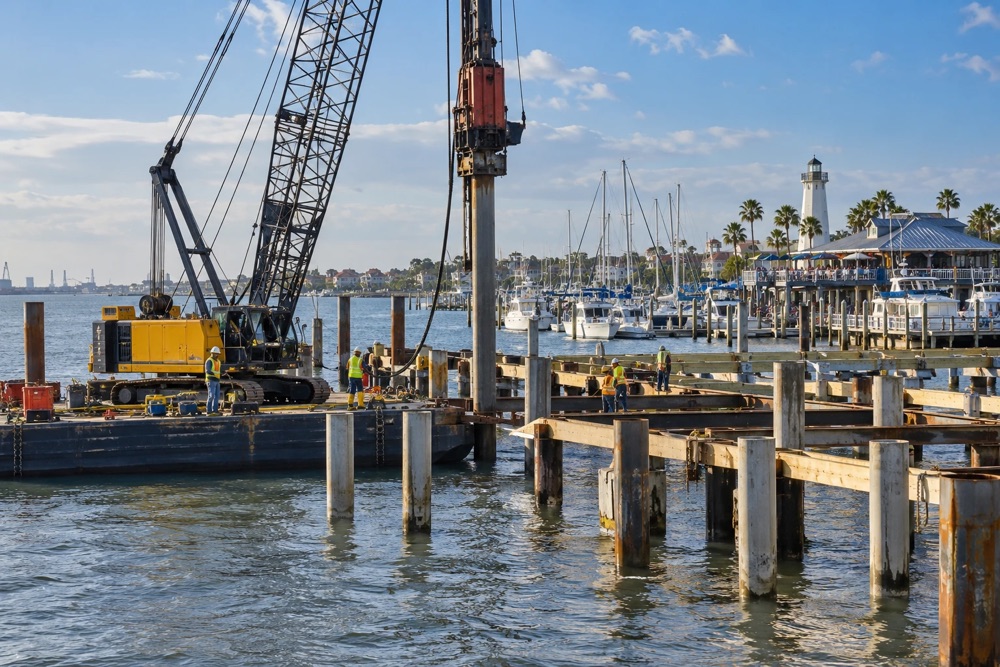
Mechanical pile driving. We drive pilings mechanically to refusal depth, the point at which soil density provides solid resistance to lateral pressure. Some contractors use hydraulic jetting, which uses high-pressure water to push pilings in. It’s faster, but it doesn’t achieve adequate soil friction in the conditions we’re working with here. On a Ship Channel shoreline, that shortcut becomes a problem within a few years. Mechanical driving is the standard for this type of installation.
Deadman anchoring. Deadman anchors are heavy blocks or pilings buried behind your property and connected to the bulkhead wall by high-strength tie-rods. For the soil conditions we encounter in La Porte, these need to be placed at a distance at least twice the height of the wall to reach stable ground. This is the most critical factor in preventing wall collapse under sustained load. It’s also one of the most commonly undersized elements in cheaper installations.
Sheet installation. Vinyl sheeting is installed in the tongue-and-groove configuration, then tie-rods are tensioned.
Drainage. Hydrostatic pressure (water trapped behind the wall after rain or tidal movement) is one of the primary causes of premature failure. We integrate filtered weep holes and gravel backfill into every build. This lets water escape without washing soil through the wall.
Cap installation. The cap ties the vertical system into a single rigid structure. Options include marine-grade timber, composite, or reinforced concrete. It’s also the finished surface for cleats, utilities, and anything else you want to run along the top of the wall.
Integrating Power and Water Into Your Bulkhead
A well-built bulkhead is more than a property line. It’s the foundation for your entire waterfront setup and building in utility access from the start costs far less than retrofitting it later.
Shore power. We install GFI-protected marine power pedestals rated for wet environments. These provide the amperage needed for boat lifts and maintenance equipment, with outlets for tools and cleaning gear. Conduit runs are concealed behind the cap to protect wiring from salt spray and UV exposure.
Freshwater access. Routing water lines to the bulkhead during construction is straightforward. We can incorporate dedicated wash-down lines, fish cleaning stations with drains, and freeze-protected shutoff valves that hold up through Texas cold snaps without burst lines.
Lighting. Recessed LED accent lighting along the cap improves safety at the water’s edge after dark and gives the finished installation a clean, intentional look. It’s a small addition that makes a real difference in both function and how the property presents.
Permits for Bulkhead Work in La Porte
Any bulkhead construction, replacement, or significant repair in La Porte requires permits. The U.S. Army Corps of Engineers has jurisdiction over structures on navigable waterways, which includes Galveston Bay and the Houston Ship Channel. Local floodplain authority approvals in Harris County may also apply depending on project scope.
The permitting process involves site documentation, environmental review, and compliance with current marine engineering standards. Contractors who work regularly in this area handle this as a standard part of the project not as an extra service. Getting the permits sorted before any physical work begins is important. Mid-project stops due to missing approvals are expensive and entirely avoidable.
Keeping a Bulkhead in Good Shape Long-Term
A professionally built bulkhead doesn’t need constant attention, but it does need consistent attention. An annual inspection is the most cost-effective maintenance you can do.
Five things to check every year:
- Soil settling behind the cap sinkholes or depressions forming close to the wall
- Hardware condition bolts and tie-rods showing rust bleed or loosening
- Wall alignment sight down the length and look for any bow or deviation from straight
- Toe condition check the base of the piling at low tide for outward kick
- Weep hole drainage water should be actively flowing through after rain or high tide; clogged weep holes trap pressure against the wall
A few other things that matter: keep soil grade consistent behind the cap, and avoid planting trees with aggressive root systems close to the structure. Roots can work their way into tie-rods and crack concrete caps over time.
Frequently Asked Questions
How long does bulkhead construction take in La Porte?
Physical construction runs one to three weeks depending on shoreline length and conditions. The longer variable is permitting Army Corps approvals and local floodplain review can add several weeks to the pre-construction schedule. We manage that process for every project so there are no surprises when crews arrive.
Do I need a permit for bulkhead repair in Harris County?
Yes. New construction, replacement, and significant repairs all require permits in La Porte and Harris County. The Army Corps of Engineers regulates structures on navigable waterways, and local floodplain authorities may have additional requirements. We handle permit coordination as part of every project.
What’s the best bulkhead material for Galveston Bay?
For most residential properties on Galveston Bay, vinyl sheet piling. It holds up in brackish water without corroding, resists marine borers and UV damage, and typically lasts 30 to 50 years when installed correctly. The higher upfront cost compared to timber is offset by the much lower lifetime maintenance and replacement cost.
Can I add a boat lift to an existing bulkhead?
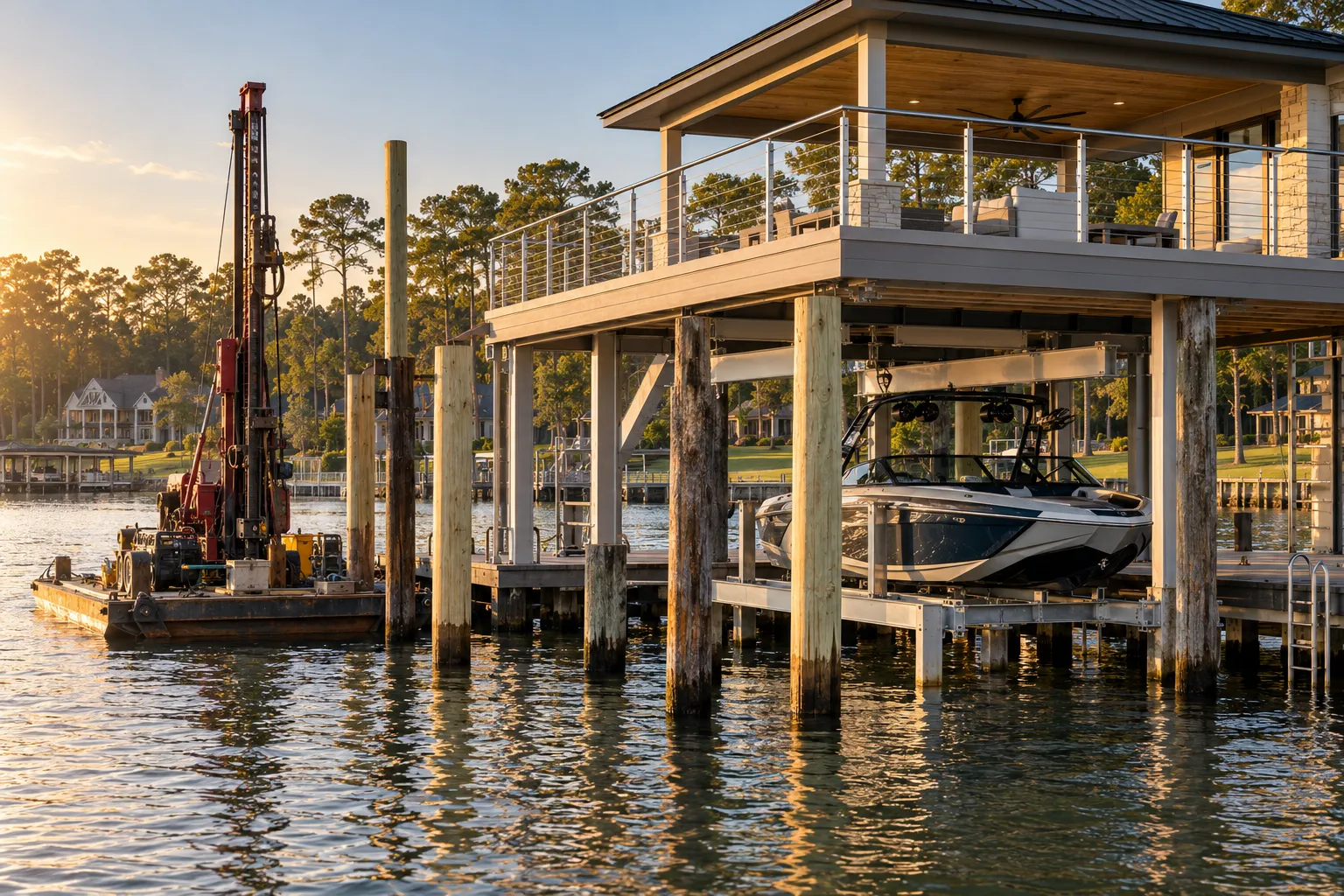
In most cases, yes but the existing wall has to be assessed first. Boat lifts add lateral load to the anchor system, and not every existing bulkhead was built to handle it. We do a structural review before recommending any lift integration on an existing wall.
What causes bulkheads near the Ship Channel to fail before they should?
The most common causes are piling that wasn’t driven to adequate depth, undersized deadman anchors, and blocked weep holes that allow hydrostatic pressure to build up behind the wall. Ship channel wake generates active hydraulic impact not just static water pressure which puts more stress on the structure than a standard coastal wall is typically designed for. Those two factors together are behind most of the premature failures we get called in to assess.
What if my neighbor’s bulkhead is failing and mine is fine?
A failing adjacent wall can allow soil to bleed laterally from behind your wall even if your structure is intact. The standard solution is return walls perpendicular sections that close off your shoreline from neighboring properties. We design these into new builds along shared property lines when it’s relevant.
Is timber still a reasonable option for a La Porte bulkhead?
For the right project, yes. Marine-grade pressure-treated timber handles saltwater immersion and looks at home alongside traditional pier and boathouse designs. It requires more frequent inspection than vinyl and has a shorter service life, but it’s a legitimate choice for property owners factoring those tradeoffs into their decision.
How often should I have a professional inspect my bulkhead?
Once a year at minimum for properties along the Houston Ship Channel. The sustained wake load from commercial traffic puts more stress on tie-backs and hardware than most other coastal environments. Catching a problem early, a piece of hardware starting to go, a weep hole starting to clog consistently saves far more than it costs.
Dream Boat Docks has provided marine construction along the Texas Gulf Coast since 1987. For bulkhead construction, repair, or a free site assessment in La Porte or the greater Houston Bay Area, contact our team directly.