Waterfront property comes with an ongoing challenge: protecting the shoreline from erosion, wave action, changing water levels and soil movement.
For many Texas waterfront properties, a professionally engineered composite bulkhead installation can provide a durable, low-maintenance solution. Fiber-reinforced polymer (FRP) sheet piling offers high strength, corrosion resistance and long-term performance in both freshwater and coastal environments.
But composite isn’t the right material for every property.
Dream Boat Docks installs and works with a range of bulkhead systems, including composite/FRP, vinyl/PVC, treated timber, steel and other solutions. The right choice depends on shoreline conditions, water exposure, soil characteristics, structural requirements, project budget and long-term ownership goals.
Serving Texas waterfront property owners since 1987, Dream Boat Docks designs and builds bulkheads throughout Lake Conroe, Lake Houston, Baytown, Seabrook, Clear Lake and the Greater Houston area.
In this guide, we’ll explain how composite bulkheads work, when FRP may be the right choice, how composite compares with other common bulkhead materials and what property owners should expect during professional installation.
Key Takeaways
- Composite and FRP bulkheads provide excellent resistance to rot, corrosion and marine organisms, making them well suited to demanding waterfront environments.
- Marine-grade composite sheet piling can provide a long service life when properly selected, engineered and installed.
- Composite is not automatically the best choice for every shoreline. Vinyl, timber or steel may make more sense depending on site conditions, loads and budget.
- A successful bulkhead requires more than sheet piling. Proper embedment, anchoring, drainage, backfilling and structural support are critical.
- Bulkhead permitting requirements vary by location. Lake Conroe projects are regulated by the San Jacinto River Authority, while coastal projects may involve the U.S. Army Corps of Engineers, Texas General Land Office and local authorities.
- Working with an experienced marine contractor helps ensure the material, design and installation method are appropriate for the specific property.
What Is a Composite Bulkhead?
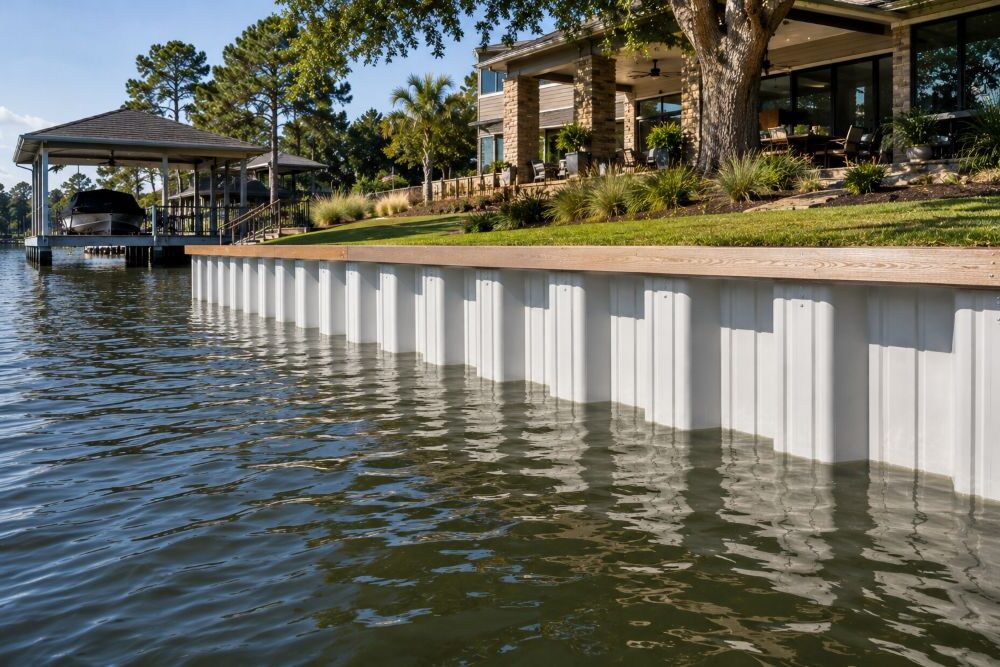
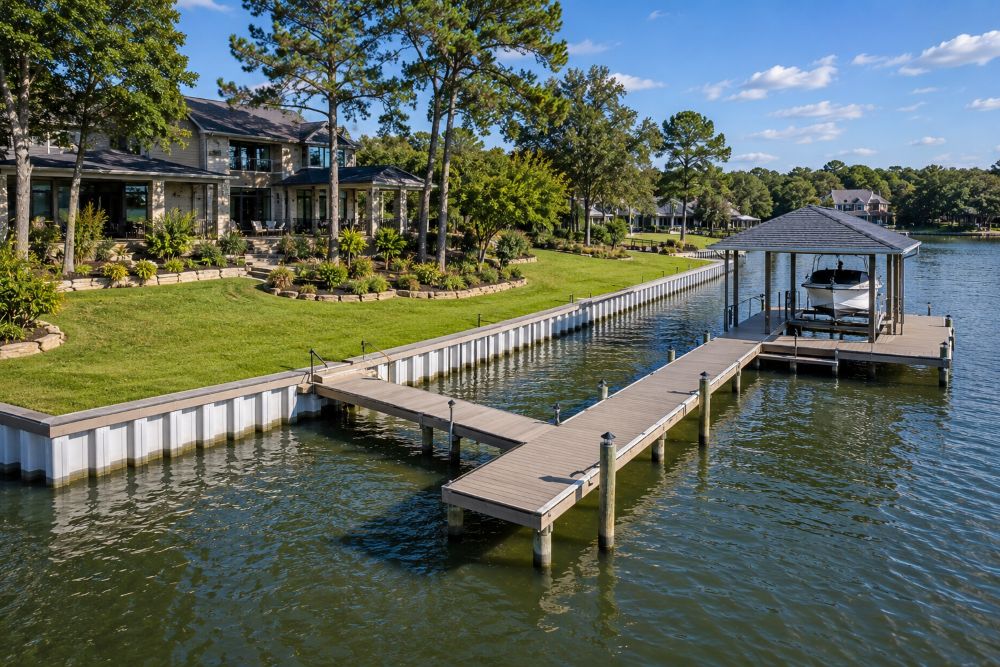
A composite bulkhead is a shoreline retaining system that commonly uses fiber-reinforced polymer, or FRP, sheet piling to create a durable barrier between the water and the soil behind the shoreline.
The primary purpose of a bulkhead is to stabilize the shoreline and reduce soil loss caused by erosion, waves, wakes, changing water levels and drainage.
FRP materials combine a polymer resin with reinforcing fibers, typically glass fibers, to create structural components that offer a high strength-to-weight ratio and excellent resistance to corrosion.
A complete bulkhead system generally includes more than just the visible wall.
Main Components of a Composite Bulkhead
Sheet Piling
Vertical FRP sheets are driven or installed into the soil to create the primary retaining wall.
Wales or Waler Beams
Horizontal structural members help align the wall and distribute loads.
Tie-Rods and Anchors
Tie-rods connect the wall to anchors or deadmen placed behind it, helping resist pressure from the retained soil.
Drainage
Drainage provisions help relieve water pressure behind the wall.
Cap
A cap protects and finishes the top of the wall while helping connect the system structurally.
Backfill
Properly selected and placed backfill restores the land behind the bulkhead and plays an important role in long-term stability.
Each component must work together. Installing premium sheet piling without properly designing the anchoring, drainage and soil support system can still result in bulkhead problems.
Understanding Composite Sheet Piling
Composite sheet piles are manufactured in interlocking profiles designed to create a continuous retaining wall.
Depending on the manufacturer and engineering requirements, different profiles, thicknesses and reinforcement configurations may be used to handle varying loads and wall heights.
For a residential property with a relatively low shoreline, the required system may be very different from one designed for a tall bank, marina or higher-energy coastal environment.
That is why material selection should follow a site evaluation rather than relying solely on a generic recommendation.
Why Use FRP Composite for Shoreline Protection?
Composite materials solve several problems that affect traditional marine construction materials.
Resistance to Rot and Marine Organisms
FRP does not rot like wood and is not a food source for marine borers.
That can make composite particularly attractive in environments where timber structures are exposed continuously to water, moisture and biological activity.
Corrosion Resistance
Unlike unprotected steel, FRP does not rust.
This is especially beneficial around brackish or saltwater environments where corrosion can become an important design and maintenance consideration.
Properties in areas such as Baytown, Seabrook, Clear Lake, Kemah and other coastal portions of the Greater Houston region can face considerably different exposure conditions than inland lakefront properties.
High Strength-to-Weight Ratio
FRP can provide substantial structural strength while weighing significantly less than materials such as steel or concrete.
The lighter weight can make transportation and handling easier and, depending on site conditions and engineering requirements, may reduce some of the logistical challenges associated with moving heavy marine construction materials.
Low Routine Maintenance
Composite bulkhead systems typically do not require the staining associated with timber or corrosion-control coatings commonly required for some steel systems.
No bulkhead should be considered literally maintenance-free. Property owners should periodically inspect the cap, anchors, drainage, surrounding soil and overall alignment of any shoreline structure.
However, the FRP material itself generally requires relatively little routine maintenance.
Long-Term Durability
Marine-grade composite sheet piling is designed for long-term use in demanding environments.
Some FRP systems are engineered around service-life expectations of several decades, but actual longevity depends on the specific material, engineering, installation quality, site conditions and exposure.
Rather than choosing a material based only on an advertised lifespan, property owners should consider the complete bulkhead system.
Composite vs. Vinyl: What’s the Difference?
Composite and vinyl are sometimes grouped together because both are alternatives to traditional timber and steel, but they are not the same material.
Vinyl sheet piling is generally manufactured from PVC.
FRP composite sheet piling combines a resin system with reinforcing fibers that increase structural strength and stiffness.
Both materials offer excellent resistance to rot and corrosion, and both can be appropriate for long-lasting residential bulkheads.
The better choice depends largely on the structural requirements of the project.
Vinyl is often an excellent solution for residential shorelines and low- to moderate-energy environments. FRP may be preferred when greater stiffness or structural capacity is required.
Dream Boat Docks works with multiple bulkhead materials so property owners aren’t forced into one solution regardless of site conditions.
Saltwater vs. Freshwater Performance
One of the advantages of composite bulkheads is their ability to perform in both freshwater and saltwater environments.
But the engineering requirements can differ substantially.
Lake Conroe
Lake Conroe bulkheads must account for factors such as:
- Boat wake activity
- Shoreline configuration
- Water depth
- Soil conditions
- Bank height
- Drainage
- SJRA construction requirements
Composite may be appropriate for certain Lake Conroe properties, although vinyl, steel or treated timber may also provide the right combination of performance and cost.
Lake Houston
Lake Houston properties can vary widely, from protected residential shoreline to areas with greater water movement and changing soil conditions.
The best bulkhead material should be determined after evaluating the property rather than applying the same system across the entire lake.
Houston-Area Coastal and Brackish Water
Properties around Baytown, Clear Lake, Seabrook, Kemah and nearby coastal areas encounter additional considerations, particularly salt and brackish-water exposure.
Corrosion resistance is one reason FRP and other non-corroding sheet-pile materials may be attractive in these environments.
Environmental Considerations
Selecting a bulkhead material isn’t solely a structural decision.
Modern FRP sheet piling does not depend on the preservative treatments required for certain timber products, and its resistance to corrosion and biological degradation can reduce the need for repeated material replacement.
However, the environmental impact of a shoreline project depends on much more than the material itself.
Construction methods, disturbance of the shoreline, placement of fill, effects on wetlands or aquatic habitat and local permitting requirements all need to be considered.
For environmentally sensitive properties, the project should be evaluated as an entire shoreline system rather than simply comparing the composition of individual materials.
Composite vs. Vinyl, Wood and Steel Bulkheads
There isn’t one bulkhead material that is best for every Texas waterfront property.
Here is a general comparison:
| Material | Primary Advantages | Considerations | Often Best Suited For |
| Composite / FRP | Corrosion resistant, rot resistant, high strength-to-weight ratio, low routine maintenance | Higher initial investment than many timber systems; proper engineering is important | Long-term residential or commercial applications and projects requiring greater structural performance |
| Vinyl / PVC | Corrosion resistant, rot resistant, low maintenance, long service life | Structural capacity varies by product and profile | Many residential and low- to moderate-energy shorelines |
| Treated Timber | Lower initial cost, traditional appearance, easy to work with | Requires more inspection and is vulnerable to eventual decay and marine organisms | Budget-sensitive projects and appropriate lower-energy environments |
| Steel | Very high structural capacity and strength | Corrosion protection and ongoing maintenance may be necessary | Heavy-duty, commercial or high-load applications |
| Concrete | High strength and durability | Heavy, more difficult to install and potentially more expensive | Certain commercial and specialized shoreline applications |
The right decision should consider total cost of ownership, not simply the initial construction price.
A lower-cost material can sometimes require greater maintenance or earlier replacement. Conversely, the most expensive material may provide unnecessary structural capacity for a relatively protected residential shoreline.
A qualified marine contractor can help identify the point where cost, longevity and structural performance make the most sense for your property.
For a broader material comparison, see Dream Boat Docks’ guide to choosing the best bulkhead material for a Houston waterfront property.
When Is a Composite Bulkhead the Right Choice?
A composite bulkhead installation can be particularly attractive when the property owner prioritizes:
- Long-term shoreline protection
- Resistance to rot and corrosion
- Reduced material maintenance
- Structural strength without the weight of steel or concrete
- Performance in saltwater or brackish environments
- Resistance to marine borers
- Long-term ownership of the property
- A material suitable for demanding waterfront conditions
However, Dream Boat Docks does not recommend composite simply because it is a premium material.
A site evaluation should consider:
Bank Height
A taller bank creates greater lateral soil pressure and may require greater sheet-pile strength, deeper embedment or a more substantial anchoring system.
Soil Conditions
Soft sediments, clay and other soil conditions can affect pile depth, anchoring and installation method.
Water Depth
Deeper water can affect sheet length, equipment requirements and structural loads.
Wave and Wake Exposure
A quiet protected canal does not impose the same forces as an exposed bay shoreline or heavily trafficked portion of a lake.
Drainage
Water building up behind a bulkhead can create significant pressure. Drainage must be addressed as part of the system design.
Site Access
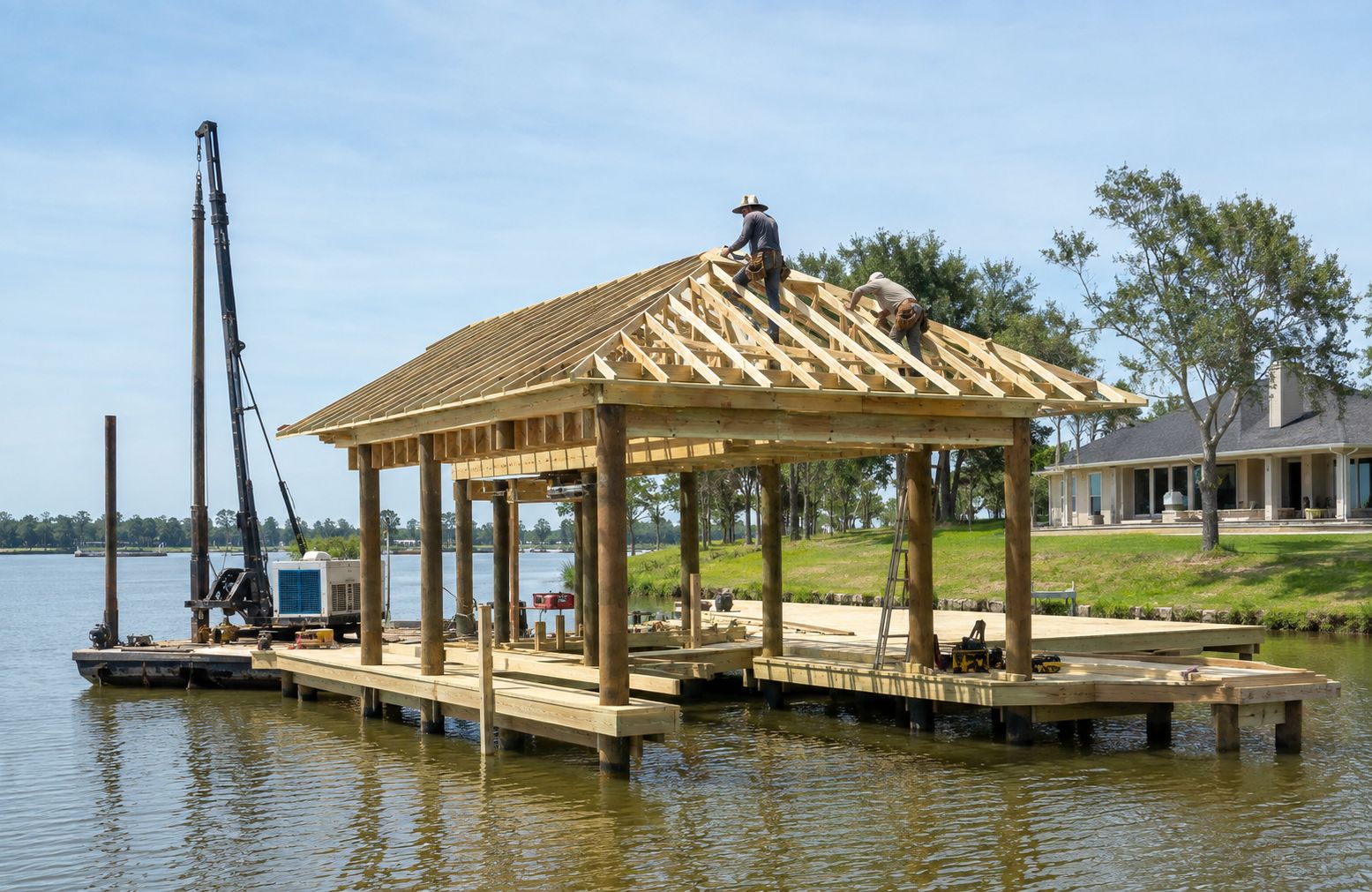
Some projects can be completed with equipment operating from land. Others may require barges or water-based equipment.
Budget and Ownership Goals
A homeowner planning to keep a waterfront property for decades may evaluate upfront cost differently from someone prioritizing the lowest immediate construction expense.
Dream Boat Docks evaluates these factors before recommending composite, vinyl, timber, steel or another bulkhead solution.
How Composite Bulkheads Are Installed
A successful composite bulkhead installation begins well before sheet piling reaches the shoreline.
Phase 1: Site Evaluation and Planning
The contractor first evaluates the property and existing shoreline conditions.
Depending on the project, the assessment may consider:
- Shoreline length
- Existing bulkhead condition
- Bank elevation
- Water depth
- Soil characteristics
- Drainage
- Wave or wake exposure
- Access for construction equipment
- Nearby docks, boathouses and utilities
- Required permits or approvals
These findings help determine the appropriate material, sheet profile, depth, anchoring system and construction approach.
Phase 2: Permitting and Project Preparation
Applicable permits or approvals should be identified before construction begins.
The permitting authority depends on where the property is located.
Lake Conroe, for example, has its own bulkhead permitting requirements through the San Jacinto River Authority.
Coastal and tidally influenced projects may involve state, federal and local authorities.
Once approvals are in place, the project area can be prepared and failing structures addressed according to the construction plan.
Phase 3: Installing the Sheet Piling
Composite sheets are positioned along the engineered bulkhead line and installed to the required depth.
Depending on soil conditions, access and the specified sheet-pile system, marine contractors may use specialized pile-driving or installation equipment.
Correct embedment is critical.
The portion of the sheet below the mudline helps resist lateral forces. Insufficient depth can compromise the stability of the entire wall.
Phase 4: Anchoring and Structural Support
Most bulkhead systems rely on more than the sheet piling itself.
Tie-rods can connect the wall to structural anchors or deadmen buried inland.
The anchoring system helps resist the pressure exerted by the retained soil and keeps the wall aligned.
Anchor spacing, tie-rod size and other structural requirements should be selected according to the demands of the individual project.
Phase 5: Drainage
Water trapped behind a bulkhead can increase pressure on the wall.
Proper drainage allows groundwater and surface water to escape rather than accumulating behind the structure.
The appropriate drainage approach depends on the design and site conditions.
Phase 6: Backfilling and Capping
Once the wall and anchoring system are secure, the area behind the bulkhead is backfilled and compacted appropriately.
A cap is then installed across the top of the wall.
Where a property also includes a dock, pier or boathouse, Dream Boat Docks can coordinate the bulkhead with the surrounding waterfront structures to create a more integrated project.
Learn more about Dream Boat Docks’ bulkhead construction services.
Can a Composite Bulkhead Be Installed in Front of an Existing Wall?
In some situations, yes.
Installing a new wall in front of an older failing bulkhead can sometimes reduce the amount of demolition required and minimize disturbance to the shoreline.
But it should not automatically be assumed that the old wall can remain in place.
The contractor needs to assess:
- The location and condition of the existing wall
- Existing anchors and tie-rods
- Soil loss behind the bulkhead
- Available space
- Shoreline boundaries
- Required permits
- Whether the old system could interfere with proper installation
If the existing wall has suffered severe structural failure or contributed to significant soil instability, removal or more extensive reconstruction may be necessary.
Bulkhead Permitting in the Houston Area
Bulkhead permitting is highly location-specific.
One of the most important steps before construction is determining which agency has jurisdiction over the property.
Lake Conroe Bulkhead Permits
Private bulkhead construction on Lake Conroe requires authorization from the San Jacinto River Authority (SJRA).
Property owners may be required to provide items such as a property survey, proposed structure location, construction plans and information about the materials being used.
Dream Boat Docks regularly works on Lake Conroe waterfront projects and can help property owners navigate the requirements associated with their marine construction project.
Coastal and Tidally Influenced Properties
Around portions of Galveston Bay and other tidally influenced Texas waterways, projects may fall under the jurisdiction of the U.S. Army Corps of Engineers (USACE), Texas General Land Office (GLO) and/or additional local authorities.
Requirements depend on the location, ownership of submerged land, type of work and potential environmental impacts.
Other Houston-Area Waterways
Projects around Lake Houston and other Houston-area waterways can involve different municipal, county, state or federal requirements.
There is no single permit that applies universally to every Texas bulkhead.
An experienced local marine contractor can help identify the agencies and approvals that apply to the specific property before construction begins.
Why Professional Bulkhead Installation Matters
A bulkhead can look relatively simple from the water: a straight wall running along the shoreline.
What you cannot see is often more important.
The depth of the piling, the anchoring system, drainage, soil conditions and structural loads determine whether that wall will continue performing as intended.
Common causes of bulkhead problems include:
- Insufficient sheet-pile embedment
- Inadequate anchoring
- Failed or undersized tiebacks
- Poor drainage
- Soil loss
- Improper backfill
- Material selection that doesn’t match site conditions
- Corrosion or deterioration of structural components
- Poor integration with adjoining shoreline structures
Professional marine construction addresses the entire system rather than focusing only on the visible wall.
Local Bulkhead Experience From Lake Conroe to the Texas Coast
Texas shoreline conditions can change dramatically within the Greater Houston region.
Lake Conroe properties may experience substantial wake activity from recreational boating.
Lake Houston presents its own combination of shoreline geometry, soil and water conditions.
Baytown and Clear Lake-area properties may encounter brackish water and greater corrosion exposure.
Seabrook, Kemah and other areas closer to Galveston Bay introduce additional coastal considerations.
Dream Boat Docks has been serving Texas waterfront property owners since 1987, building and repairing docks, boathouses, piers and bulkheads throughout the region.
That experience allows our team to evaluate more than one type of bulkhead.
Depending on your shoreline, we may recommend:
- Composite / FRP
- Vinyl / PVC
- Treated timber
- Steel
- Concrete or other engineered solutions
The objective is not to sell every property owner the same wall. It is to select a bulkhead system that makes sense for that specific shoreline.
Protect Your Shoreline With the Right Bulkhead System
Shoreline erosion rarely corrects itself.
Over time, soil loss can affect landscaping, docks, boathouses and other waterfront improvements. Addressing a deteriorating shoreline early can help prevent a relatively manageable problem from becoming a larger structural project.
For properties where corrosion resistance, structural performance and low routine maintenance are priorities, FRP composite bulkheads can provide an excellent long-term solution.
But material is only one part of the equation.
A dependable bulkhead combines the right sheet piling with proper depth, anchoring, drainage, backfill and installation practices.
Dream Boat Docks brings decades of Texas marine construction experience to every project and works with multiple bulkhead materials so we can recommend the solution that best fits your property.
If you’re considering a new bulkhead or replacing an existing shoreline wall, contact Dream Boat Docks for a professional shoreline evaluation and estimate.
Composite Bulkhead FAQs
How long does a composite bulkhead last?
Marine-grade FRP bulkhead systems are designed for long-term performance, and some systems are engineered around service lives measured in multiple decades. Actual lifespan depends on the specific product, engineering, installation quality, soil conditions, structural loads and environment.
A professional site evaluation is the best way to determine the appropriate system for a property’s expected service life.
Is a composite bulkhead more expensive than wood?
Composite generally has a higher upfront material cost than pressure-treated timber.
However, upfront price is only one consideration. Composite’s resistance to rot, marine borers and corrosion can reduce material-related maintenance and replacement concerns over the long term.
Property owners should compare total lifecycle costs rather than construction price alone.
For additional budgeting information, see our guide to bulkhead construction costs in Texas.
Is composite better than vinyl for a bulkhead?
Not necessarily.
Both FRP composite and marine-grade vinyl/PVC can provide excellent shoreline protection when properly selected and installed.
Composite typically offers greater structural strength and stiffness for demanding applications, while vinyl can be an excellent long-lasting solution for many residential shorelines.
The right choice depends on bank height, soil conditions, water depth, structural loads, exposure and budget.
Is composite better than steel?
Again, it depends on the application.
FRP provides excellent corrosion resistance and a lower weight than steel. Steel provides very high structural capacity and may be preferable for certain heavy-duty or commercial applications.
A marine contractor should evaluate the structural requirements before recommending either material.
Do composite bulkheads require maintenance?
Composite sheet piling generally requires relatively little material maintenance because it does not rot or rust.
However, the overall bulkhead system should still be periodically inspected.
Property owners should watch for:
- Soil loss
- Changes in wall alignment
- Drainage problems
- Cap damage
- Tieback or anchoring issues
- Erosion around the ends of the wall
Catching small problems early can help prevent larger repairs.
Do I need a permit for a composite bulkhead on Lake Conroe?
Yes. Private bulkheads on Lake Conroe require a permit from the San Jacinto River Authority (SJRA) before construction.
Specific documentation and requirements depend on the project.
Do coastal Texas bulkheads require a USACE permit?
Many bulkhead and shoreline projects in jurisdictional coastal waters can require authorization from the U.S. Army Corps of Engineers, and projects involving state-owned submerged land may also involve the Texas General Land Office.
The exact requirements depend on the location and scope of the project, so permitting should be evaluated individually.
Can a composite bulkhead be installed in front of my existing bulkhead?
In many situations, a new bulkhead can be installed in front of an aging wall, but the existing structure and surrounding soil need to be evaluated first.
If the previous wall has experienced severe failure, soil loss or anchoring problems, additional reconstruction or removal may be required.
How long does composite bulkhead installation take?
Installation time varies considerably depending on:
- Linear footage
- Wall height
- Water depth
- Site accessibility
- Soil conditions
- Existing structures
- Equipment requirements
- Permitting
- Weather
After evaluating the property, Dream Boat Docks can provide a project-specific construction schedule.
How do I know which bulkhead material is right for my property?
The best approach is a professional shoreline evaluation.
Dream Boat Docks works with composite/FRP, vinyl/PVC, treated timber, steel and other bulkhead solutions. We evaluate your shoreline conditions, structural requirements, expected lifespan and budget before recommending a system.
Ready to protect your waterfront property? Request a free bulkhead estimate from Dream Boat Docks.