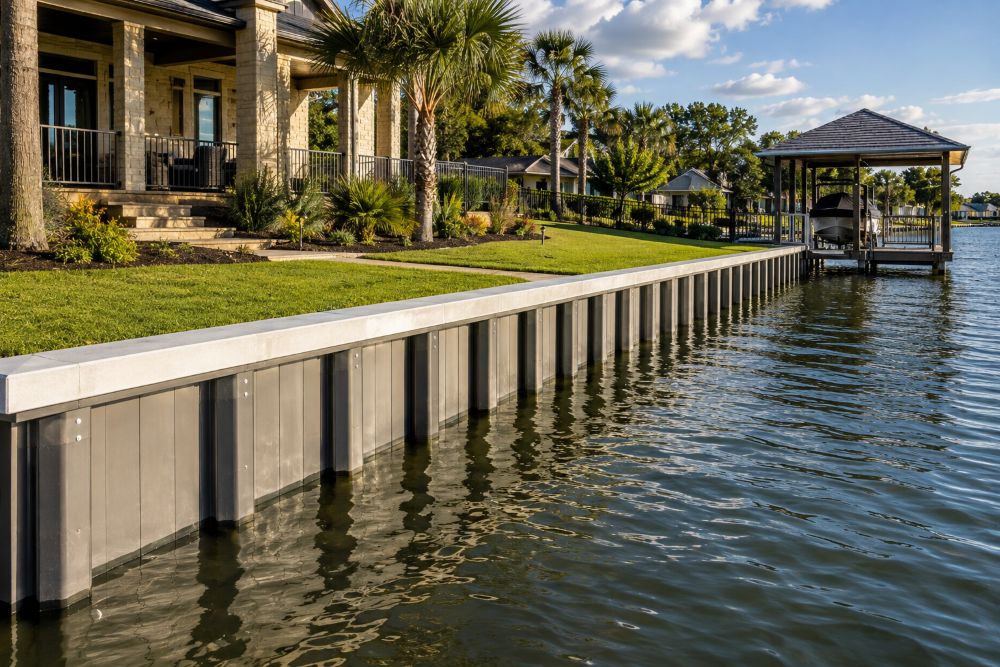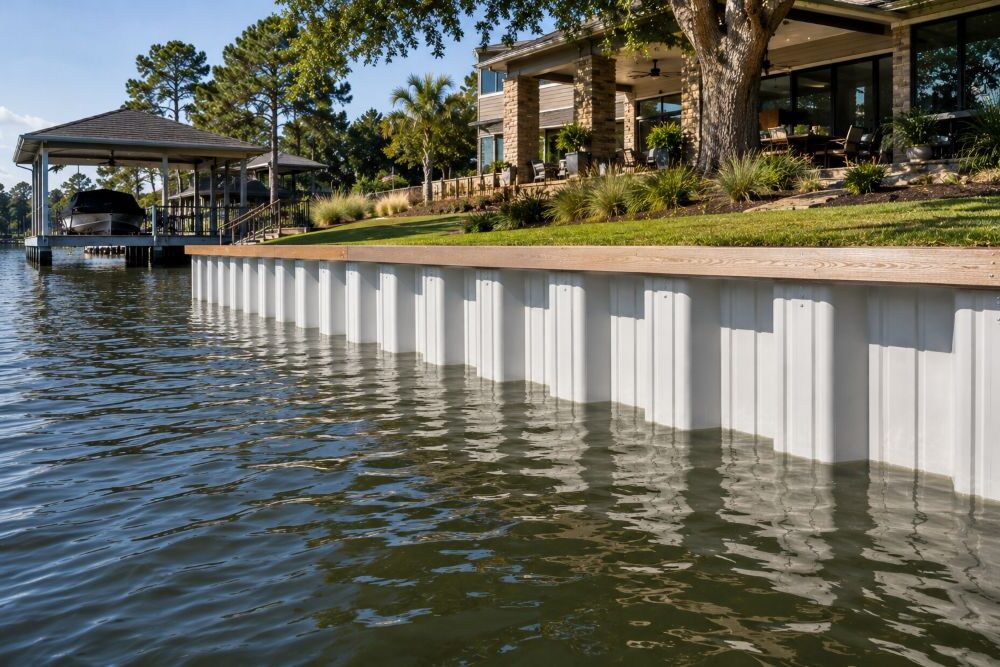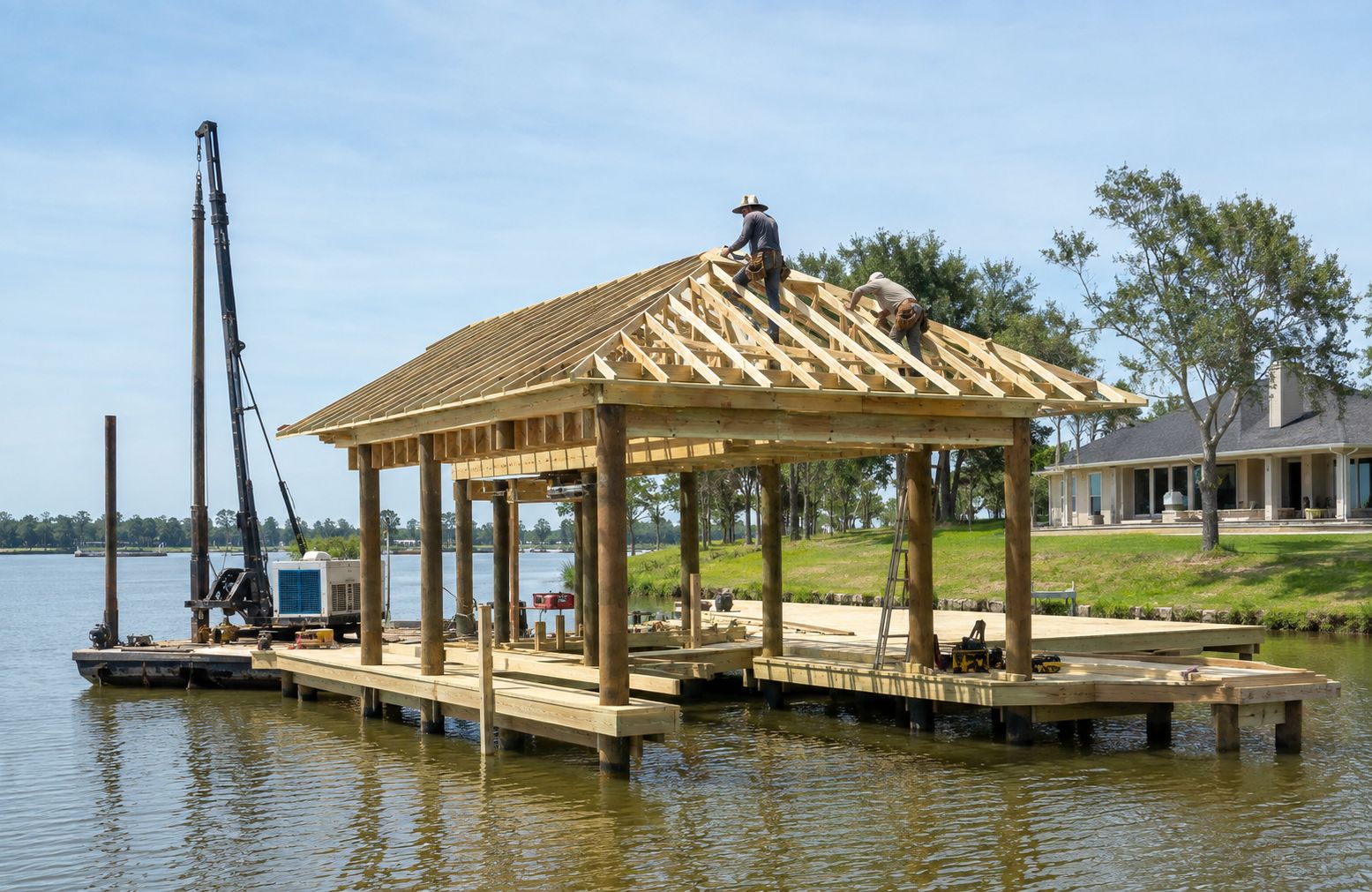
A well-designed waterfront property needs to do two things: protect the shoreline and provide safe, functional access to the water.
That is where professional bulkhead and pier construction comes together.
Bulkheads help stabilize the shoreline and retain soil, while piers and docks create access for boating, fishing, entertaining and waterfront recreation. Although these structures serve different purposes, planning them together can help create a more functional, durable and cohesive waterfront property.
In Texas, marine construction requires careful consideration of soil conditions, water depth, wave and boat-wake exposure, drainage, material selection, structural loads and local permitting requirements.
Dream Boat Docks has served Texas waterfront property owners since 1987, providing bulkheads, piers, docks, pilings, boathouses and other marine construction services throughout Lake Conroe, Lake Houston, Clear Lake, Seabrook, Baytown and the Greater Houston area.
This guide explains how bulkheads and piers are designed, how common materials compare, why piling and anchoring matter and what property owners should expect when planning a waterfront construction project.
Key Takeaways
- Bulkheads and piers perform different but complementary functions: bulkheads stabilize the shoreline while piers provide access to the water.
- Bulkhead material options include vinyl/PVC, composite/FRP, treated timber, steel and other engineered systems.
- Pier performance depends heavily on the foundation and piling system beneath the visible structure.
- Piling depth should be based on soil conditions, structural loads and required foundation capacity rather than a universal depth.
- Fixed, floating and hybrid dock or pier systems each have advantages depending on water-level changes, exposure and intended use.
- Permitting varies significantly by location. Property owners should generally allow several weeks to several months for approvals, while more complex coastal projects can take longer.
- The best waterfront projects are designed around the conditions of the individual property rather than a one-size-fits-all construction method.
What Is Marine Construction?
Marine construction includes the design, construction, repair and replacement of structures built in, over or immediately adjacent to water.
For Texas waterfront property owners, that can include:
- Bulkheads
- Seawalls and shoreline stabilization
- Piers
- Boat docks
- Boathouses
- Pilings
- Boat lifts
- Gangways and ramps
- Waterfront decks
- Repairs and remodeling
Unlike conventional land-based construction, these structures must perform in an environment affected by water movement, saturated soils, corrosion, erosion, changing water levels and, in some locations, significant wave or storm exposure.
That makes material selection, foundation design and local marine-construction experience especially important.
Learn more about Dream Boat Docks’ waterfront construction and remodeling services.
What Is a Bulkhead?
A bulkhead is a retaining structure installed along a shoreline to hold back soil and help reduce erosion.
Although the words “bulkhead” and “seawall” are sometimes used interchangeably, they are not always exactly the same. Bulkheads are generally intended primarily to retain soil, while seawalls may be designed more specifically to resist direct wave forces.
For many residential waterfront properties, the bulkhead establishes a defined shoreline and helps protect the land behind it.
Signs that an existing bulkhead may need professional evaluation include:
- Leaning or bowing
- Sinkholes behind the wall
- Visible soil loss
- Separation between sheets or boards
- Deteriorated timber
- Corroded hardware
- Failed caps
- Erosion around the ends of the wall
- Changes in alignment after major storms or high-water events
Small changes do not always mean the entire bulkhead needs replacement, but they can indicate problems with the wall, drainage, anchoring or surrounding soil.
Dream Boat Docks provides bulkhead construction and repair services throughout the Greater Houston area.
How Does a Bulkhead Work?
The visible wall is only part of a bulkhead system.
Depending on the design, a professionally built bulkhead may include:
Sheet Piling or Vertical Wall Material
Vinyl, composite, timber, steel or another material forms the primary retaining wall.
Embedment
A portion of the wall extends below the mudline or ground surface.
The required depth depends on the wall design, soil conditions, bank height and structural loads.
Tie-Rods
Tie-rods connect the wall to anchors positioned farther inland.
Deadman Anchors
Deadmen or other anchoring systems help resist the lateral pressure created by the soil behind the wall.
Walers
Horizontal structural members distribute loads across the bulkhead.
Drainage
Managing water behind the wall is critical because saturated soil and trapped groundwater can increase pressure on the structure.
Backfill
Properly selected and placed soil or aggregate restores and stabilizes the area behind the new wall.
All of these components need to function together. A premium sheet-pile material alone cannot compensate for inadequate anchoring, drainage or embedment.
Choosing a Bulkhead Material
There is no single bulkhead material that is right for every Texas waterfront property.
Dream Boat Docks works with multiple systems so the material can be matched to the shoreline.
Vinyl / PVC Bulkheads
Marine-grade vinyl sheet piling provides:
- Resistance to rot
- Resistance to corrosion
- Resistance to marine borers
- Low routine material maintenance
- Long-term performance
- A clean, consistent appearance
Vinyl can be an excellent option for many residential shoreline applications.
Composite / FRP Bulkheads
Fiber-reinforced polymer, or FRP, offers:
- High structural strength
- Excellent corrosion resistance
- Resistance to rot and marine organisms
- High strength relative to its weight
- Greater stiffness for certain demanding applications
Composite may be appropriate where greater structural capacity is required or where long-term corrosion resistance is especially important.
Treated Timber Bulkheads
Treated wood remains a viable option for many projects because it offers:
- Lower initial material cost
- Traditional waterfront appearance
- Familiar construction methods
- Flexibility for appropriate residential applications
The tradeoff is that wood can eventually deteriorate from moisture, marine organisms and environmental exposure.
Steel Bulkheads
Steel can provide very high structural capacity and is commonly considered for demanding applications.
The tradeoff is corrosion exposure, particularly around saltwater or brackish environments.
Protective coatings, material specifications and ongoing inspection can therefore become important considerations.
Which Material Is Best?
The answer depends on:
- Bank height
- Soil conditions
- Water depth
- Structural loads
- Wave and wake exposure
- Freshwater versus brackish or saltwater exposure
- Project budget
- Desired lifespan
- Site accessibility
Rather than assuming vinyl, composite, steel or wood is universally superior, a marine contractor should evaluate the shoreline before recommending a system.
For a more detailed comparison, see Dream Boat Docks’ guide to choosing the right bulkhead material for a Houston waterfront property.
What Is a Pier?
A pier is a fixed waterfront structure that extends from the shoreline over the water.
Depending on the property and design, a pier can provide:
- Boat access
- Fishing space
- Seating or entertaining areas
- Access to deeper water
- Connection to a boat lift
- Connection to a boathouse
- A transition from land to another dock structure
Unlike a bulkhead, which primarily retains soil, the pier has its own foundation and structural system.
Dream Boat Docks provides custom pier construction for residential and commercial waterfront properties.
Pier Foundations and Pilings
The visible decking and framing receive much of the attention during a pier project, but the pilings below the structure are among its most important components.
Pilings transfer loads from the pier into the underlying soil.
Depending on the project, piling materials can include:
- Pressure-treated timber
- Steel
- Concrete
- Composite materials
- Other engineered piling systems
Dream Boat Docks provides marine pile-driving services using multiple types of piling for residential, commercial and industrial applications.
How Deep Should Pier Pilings Be?
There is no universal piling depth.
Required depth depends on:
- Soil composition
- Water depth
- Pier dimensions
- Expected loads
- Wave and wind exposure
- Lateral loading
- Piling material and diameter
- Site-specific structural requirements
Depending on the design and subsurface conditions, pilings may be driven to a specified embedment depth or, in some situations, to refusal.
The goal is to achieve the foundation capacity needed for the particular structure—not simply to reach an arbitrary depth.
Marine Pile Driving Methods
Different shoreline conditions can require different installation techniques.
Dream Boat Docks’ current services include both water-jet and weighted-hammer pile-driving capabilities, allowing the installation approach to be adapted to the project.
The appropriate method can depend on:
- Soil conditions
- Piling material
- Water depth
- Structural requirements
- Access
- Nearby structures
- Environmental considerations
A method that works well on one Lake Houston property may not be appropriate for another project on Clear Lake or Lake Conroe.
Fixed vs. Floating Waterfront Structures
One of the first design decisions for many waterfront properties is whether to use a fixed or floating structure.
Fixed Piers and Docks
Fixed structures are supported by pilings.
They can provide:
- A stable walking surface
- Strong support for boat lifts and other features
- A substantial permanent structure
- Good performance in locations with relatively predictable water levels
Dream Boat Docks generally recommends fixed-pile docks for many inland lake environments, including Lake Conroe and Lake Houston, depending on site conditions.
Floating Docks
Floating structures rise and fall with water levels.
They can be advantageous where:
- Water levels fluctuate significantly
- Tidal movement is an important consideration
- Maintaining a consistent boarding height is desirable
Floating systems require their own anchoring and guidance system and are not automatically the right solution simply because a property experiences tides.
Hybrid Systems
Some waterfront properties benefit from combining fixed and floating components.
The appropriate design should consider:
- Water-level variation
- Wave exposure
- Water depth
- Vessel size
- Boat-lift requirements
- Intended recreational use
- Permitting
- Property layout
See Dream Boat Docks’ guide to choosing the right dock type for your waterfront property for a deeper comparison.
Pier Decking Materials
The decking surface affects appearance, maintenance, comfort and safety.
Pressure-Treated Wood
Wood provides a classic waterfront appearance and can offer a lower initial cost.
Routine maintenance may include cleaning, sealing and eventual replacement of individual boards.
Composite Decking
Composite decking is popular because it provides:
- Resistance to rot
- Resistance to splintering
- Lower routine maintenance
- Consistent appearance
- A variety of colors and finishes
However, composite decking can become hot in direct Texas sunlight. Product formulation and color can significantly affect surface temperature, so material selection matters.
Lighter colors and products specifically designed to manage heat may improve comfort in exposed locations.
No single decking material is automatically best for every pier.
Designing Bulkheads and Piers as a Cohesive Waterfront System
Bulkheads and piers have separate structural purposes, but they should often be planned together.
The area where a pier, walkway, ramp or gangway meets the shoreline deserves particular attention.
Design considerations can include:
- Erosion around the transition point
- Drainage
- Changes in elevation
- Access
- Structural movement
- Bulkhead cap design
- Pier framing
- Gangway placement
- Utilities
- Boat-lift access
A pier does not necessarily rely on the bulkhead as its structural foundation.
Instead, both systems should be coordinated so that the shoreline protection and water-access components work well together.
Planning the waterfront as a complete system can also simplify future additions such as:
- Boathouses
- Boat lifts
- Upper decks
- Lighting
- Fishing platforms
- Seating areas
- Outdoor entertainment spaces
Dream Boat Docks provides custom boat dock, pier, boathouse and waterfront construction services, allowing multiple components to be planned together.
Permitting for Texas Bulkhead and Pier Construction
Permitting is one of the areas where waterfront projects vary most significantly.
There is no single permit that covers every bulkhead, pier or dock in Texas.
Requirements depend on:
- The body of water
- Property location
- Type of construction
- Whether work occurs over or within regulated waters
- State-owned submerged land
- Wetlands or sensitive habitat
- Local floodplain requirements
- HOA or subdivision requirements
Lake Conroe
Waterfront construction on Lake Conroe can require approval from the San Jacinto River Authority (SJRA).
Bulkheads and other waterfront improvements should be evaluated for applicable SJRA requirements before construction begins.
Dream Boat Docks regularly works on Lake Conroe dock, boathouse and bulkhead projects and manages permitting for its Lake Conroe clients.
Coastal and Tidally Influenced Waterways
Projects around Clear Lake, Seabrook, Baytown, Kemah and other tidally influenced areas may involve one or more authorities, including:
- U.S. Army Corps of Engineers
- Texas General Land Office
- Local cities or counties
- Other state or federal agencies depending on the project
How Long Does Marine Construction Permitting Take?
There is no guaranteed approval timeline.
For planning purposes, property owners should generally allow anywhere from several weeks to about six months for many routine waterfront approvals, depending on the jurisdiction and type of authorization required.
Projects involving more extensive coastal, environmental or federal review may require six to twelve months or longer.
Straightforward local approvals can sometimes move faster, while projects involving multiple agencies, wetlands, state-owned submerged land or individual federal permits can take considerably longer.
The best approach is to identify the applicable permitting authorities early in the design process so permitting does not become an unexpected project delay.
Lake Conroe vs. Lake Houston vs. Coastal Construction
Local experience matters because Greater Houston waterfront conditions vary considerably.
Lake Conroe
Lake Conroe projects may need to account for:
- Managed water levels
- Significant recreational boat wakes
- Varying shoreline soils
- SJRA requirements
- HOA requirements
- Existing docks and boathouses
Learn more about Dream Boat Docks’ Lake Conroe dock and bulkhead construction services.
Lake Houston
Lake Houston includes protected canals, coves and more exposed shoreline.
Projects can vary considerably based on:
- Water depth
- Soil conditions
- Bank height
- Boat traffic
- Access
- Existing shoreline structures
Dream Boat Docks provides Lake Houston dock, pier and bulkhead construction throughout the area.
Clear Lake, Seabrook and Baytown
Coastal and brackish environments introduce additional considerations such as:
- Salt exposure
- Corrosion
- Tidal variation
- Wave conditions
- Greater regulatory complexity
- Marine habitat considerations
Material selection and construction methods should reflect those conditions rather than simply copying an inland-lake design.
Shoreline Erosion and Bulkhead Failure
Bulkhead problems often begin gradually.
Property owners should watch for:
- Small depressions behind the wall
- Increasing sinkholes
- Loss of soil
- Leaning
- Bowing
- Damaged caps
- Corroded tie-rods or hardware
- Deteriorated timber
- Erosion at either end of the wall
A sinkhole does not necessarily mean the entire bulkhead needs immediate replacement.
It does mean the source of the soil loss should be identified.
Possible causes include:
- Failed wall material
- Open joints
- Drainage problems
- Erosion around wall termination points
- Damaged anchoring
- Settlement
- Backfill loss
Repairing the underlying problem is more effective than repeatedly filling the visible hole.
Maintaining Bulkheads and Piers
Even low-maintenance marine construction should be periodically inspected.
For bulkheads, watch for:
- Wall movement
- Soil loss
- Drainage issues
- Hardware deterioration
- Cap damage
- Erosion at the ends
For piers, inspect:
- Pilings
- Structural framing
- Bracing
- Decking
- Fasteners
- Railings
- Boat-lift connections
- Electrical components where applicable
Severe storms, unusual high-water events or impacts from vessels may justify an additional professional inspection.
Preventive maintenance can often identify smaller problems before they become major reconstruction projects.
How Much Does Bulkhead and Pier Construction Cost?
Pricing depends heavily on the property and scope of work.
Bulkhead cost variables include:
- Linear footage
- Wall height
- Material
- Soil conditions
- Water depth
- Tie-back requirements
- Access
- Existing wall demolition
- Barge requirements
Pier cost variables include:
- Length and width
- Piling requirements
- Framing
- Decking material
- Railings
- Boat lifts
- Electrical systems
- Roofs or boathouses
- Water depth
- Access
For current bulkhead budgeting information, see Dream Boat Docks’ Bulkhead Construction Costs in Texas guide.
A site-specific estimate is the best way to understand the true investment because two waterfront properties with the same linear footage can have very different construction requirements.
Why Work With a Marine Construction Specialist?
Waterfront construction involves different challenges than ordinary residential construction.
An experienced marine contractor understands how to work with:
- Marine pile-driving equipment
- Barges and water-based access
- Sheet piling
- Tie-back systems
- Changing water levels
- Shoreline soils
- Corrosion-resistant materials
- Boat lifts
- Waterfront permitting
- Existing docks and boathouses
Dream Boat Docks’ services include piers, boat docks, bulkheads, pilings, boat houses, boat lifts and broader waterfront construction and remodeling.
The company has served Texas waterfront property owners since 1987, giving its team decades of experience across Lake Conroe, Lake Houston and Greater Houston waterways.
Property owners can also view Dream Boat Docks’ completed bulkhead, pier, dock, piling and boathouse projects before planning their own waterfront improvements.
Plan Your Waterfront as a Complete System
A successful waterfront property is more than a dock or a wall.
The bulkhead protects the shoreline.
The pier creates access to the water.
The pilings support the structure.
The drainage protects the soil behind the wall.
The decking creates a usable outdoor space.
Boat lifts, boathouses and other features make the property work for the owner’s lifestyle.
When these elements are considered together, the result can be a waterfront that is more functional, attractive and easier to maintain over the long term.
Dream Boat Docks designs, constructs, repairs and remodels waterfront structures throughout Lake Conroe, Lake Houston and Greater Houston.
If you’re planning a new bulkhead, pier, dock or complete waterfront renovation, contact Dream Boat Docks for a professional property evaluation and free estimate.
Frequently Asked Questions
How long does a vinyl bulkhead last compared with wood?
Marine-grade vinyl sheet piling is designed for long-term use and some manufacturers offer product warranties of 50 years or longer.
Treated timber can also provide many years of service, but its lifespan depends heavily on treatment, water conditions, marine organisms, installation and ongoing exposure.
Rather than relying solely on a generic lifespan, property owners should compare materials based on the conditions of their shoreline, expected maintenance and long-term ownership goals.
Do I need a permit to replace an existing bulkhead?
Possibly, and in many locations permits or approvals are required even when an existing waterfront structure is being replaced.
The applicable authority depends on the property.
Lake Conroe projects may require SJRA authorization, while coastal or tidally influenced projects may involve the U.S. Army Corps of Engineers, Texas General Land Office and local authorities.
A contractor should confirm applicable requirements before construction begins.
How long should I plan for permits?
A reasonable planning assumption is several weeks to about six months for many routine approvals.
Projects requiring more extensive state, federal, coastal or environmental review can take six to twelve months or longer.
Actual timing depends on location, project complexity, application completeness and the agencies involved.
What is the best decking material for a Texas pier?
There is no single best material.
Pressure-treated wood provides a traditional appearance and competitive initial cost.
Composite decking offers lower maintenance and resistance to rot and splintering but can become hot in direct sunlight depending on the product and color.
The right decking should be selected based on maintenance preferences, budget, appearance, sun exposure and how the pier will be used.
Can I build a pier without a bulkhead?
Yes.
A pier can be built from a natural shoreline without a bulkhead.
Whether shoreline stabilization is also advisable depends on erosion, soil conditions, bank stability, drainage, wave exposure and the design of the land-side transition.
The need for a pier and the need for a bulkhead should be evaluated separately.
How deep do residential pier pilings need to be?
There is no standard depth that applies to every pier.
Piling depth depends on soil conditions, water depth, structural loads, piling type and required foundation capacity.
Depending on the design, piles may be driven to a specified embedment or, in some cases, to refusal.
What are signs that a bulkhead anchoring system may be failing?
Possible warning signs include:
- Increasing wall movement
- Bowing or leaning
- Sinkholes behind the wall
- Soil settlement
- Visible tie-rod deterioration
- Separation between structural components
Because many anchoring components are buried, a professional evaluation may be needed to determine the actual cause.
How does hurricane exposure affect waterfront construction?
Storm exposure should be considered when evaluating structural loads, piling, anchoring, bracing, materials and the overall waterfront layout.
No dock, pier or bulkhead should be described as hurricane-proof.
Proper design and construction can improve resilience, but extreme storms may exceed design conditions or alter the surrounding shoreline itself.
Is composite bulkheading worth the additional cost over wood?
It can be, depending on the project.
FRP composite offers excellent resistance to corrosion, rot and marine organisms and can provide greater structural stiffness for demanding applications.
Treated timber typically has a lower initial material cost and remains appropriate for many projects.
The better investment depends on structural requirements, environmental exposure, anticipated maintenance, budget and how long the owner expects to keep the property.
Should my bulkhead and pier be designed at the same time?
When both are planned for the same waterfront, coordinating them can be beneficial.
The structures do not necessarily share the same foundation, but planning them together can improve shoreline transitions, access, drainage, elevation changes, boat-lift placement and the overall appearance and functionality of the property.
Planning a waterfront project? Contact Dream Boat Docks to request a free estimate for bulkhead, pier, dock, piling or complete marine construction services.