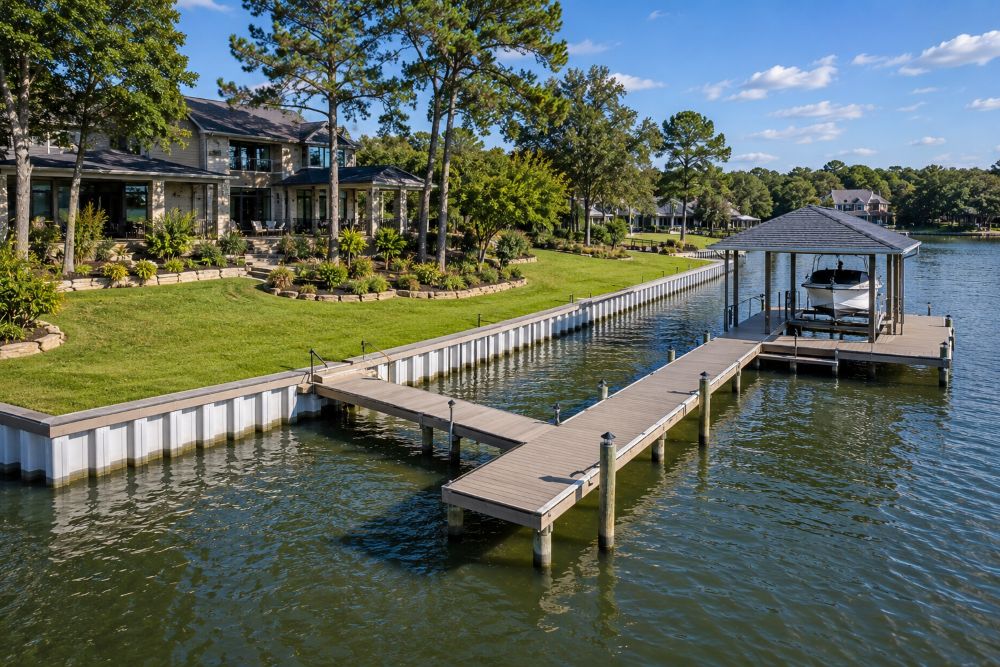
Waterfront property offers incredible views and direct access to the water, but it also comes with an ongoing responsibility: protecting the shoreline.
Wave action, boat wakes, changing water levels, drainage and soil movement can gradually erode waterfront property. Once a bulkhead begins failing, that erosion can lead to soil loss, sinkholes and damage around docks, boathouses, landscaping and other waterfront improvements.
For many properties in Lake Conroe, Lake Houston and the Greater Houston area, vinyl bulkhead installation provides a durable, low-maintenance option for long-term shoreline protection.
Marine-grade vinyl sheet piling is resistant to rot, corrosion and marine organisms, making it particularly attractive for waterfront environments. But vinyl isn’t automatically the best material for every shoreline.
Dream Boat Docks works with vinyl/PVC, composite/FRP, treated timber, steel and other bulkhead systems. The right solution depends on soil conditions, bank height, water depth, wave exposure, structural loads, budget and the property’s long-term goals.
Serving Texas waterfront property owners since 1987, Dream Boat Docks builds and repairs bulkheads throughout Lake Conroe, Lake Houston, Baytown, Seabrook, Clear Lake and surrounding Greater Houston communities.
In this guide, we’ll explain how vinyl bulkheads work, how they compare with other materials, what professional installation involves and when vinyl may be the right choice for your shoreline.
Key Takeaways
- Vinyl/PVC bulkheads are resistant to rot, corrosion and marine borers, making them well suited for many freshwater and coastal environments.
- Many marine-grade vinyl sheet-piling products are designed for long service lives when properly engineered and installed.
- Vinyl is one of several effective bulkhead materials. FRP/composite, timber and steel may be better choices for certain structural conditions or project goals.
- Long-term bulkhead performance depends on much more than the visible sheet piling. Embedment depth, anchors, tie-rods, drainage and backfill are critical parts of the system.
- Permitting requirements vary by location. Lake Conroe bulkheads require SJRA authorization, while coastal and tidally influenced projects may involve state, federal and local agencies.
- A professional site evaluation is the best way to determine which material and design are appropriate for a particular shoreline.
What Is a Vinyl Bulkhead?
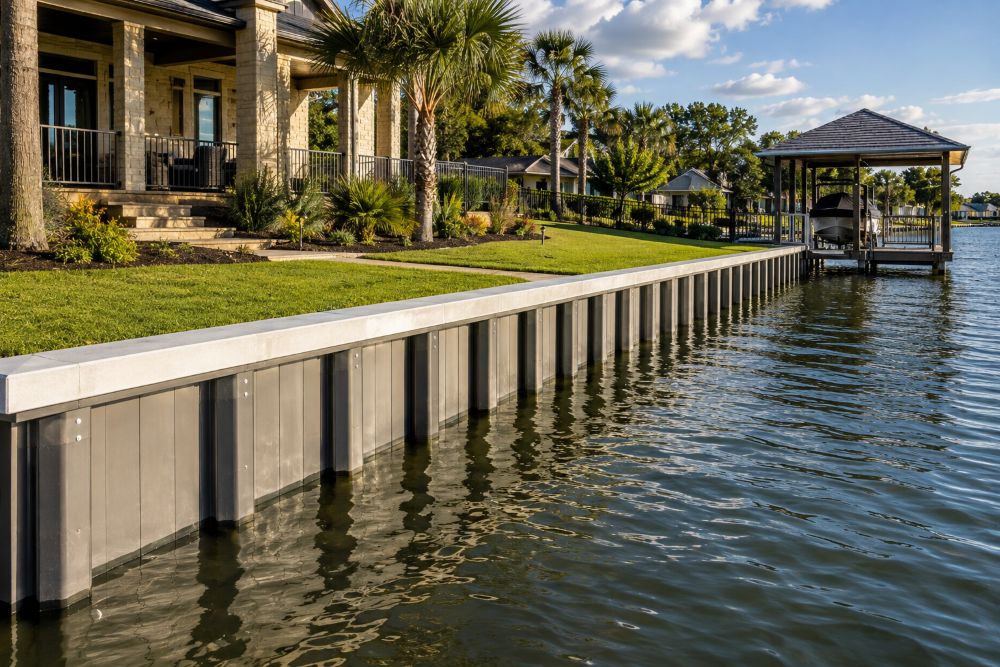
A vinyl bulkhead is a shoreline retaining system typically constructed using interlocking PVC sheet piling.
The vertical sheets create a continuous wall designed to retain soil and help protect the property from erosion caused by water movement, waves, wakes and changing shoreline conditions.
Marine-grade vinyl should not be confused with ordinary consumer plastic.
These sheet-pile products are manufactured specifically for exterior and marine environments and typically incorporate UV stabilizers and structural profiles designed to provide strength and stiffness.
A complete vinyl bulkhead generally includes several components.
Vinyl Sheet Piling
The vertical PVC sheets create the primary retaining wall. Individual sheets interlock with one another to form a continuous barrier along the shoreline.
Waler System
Horizontal structural members help distribute loads across the wall and connect the sheet piling to the anchoring system.
Tie-Rods and Anchors
Tie-rods connect the bulkhead to deadmen or other anchors located behind the wall. These components help the system resist pressure from the retained soil.
Drainage
Water collecting behind a bulkhead can increase pressure on the structure. Appropriate drainage provisions help manage that pressure.
Backfill
Properly selected and placed backfill restores the soil behind the new wall and helps reduce future settlement and erosion problems.
Bulkhead Cap
Wood, composite, aluminum or other materials may be used to finish and protect the top of the wall.
A quality vinyl bulkhead is therefore much more than a row of PVC sheets. All of these components must work together as a complete shoreline stabilization system.
Why Consider Vinyl for a Texas Bulkhead?
Vinyl has become a popular long-term material for residential shoreline protection because it addresses several of the problems that affect traditional marine construction materials.
Resistance to Rot
PVC does not decay the way timber eventually can.
Constant exposure to moisture makes deterioration an important consideration with wood bulkheads, particularly as they age. Vinyl eliminates material rot from the sheet piling itself.
Resistance to Marine Borers
Shipworms and other marine organisms can damage submerged timber over time.
PVC is not a food source for these organisms, making vinyl particularly useful in waterways where biological deterioration is a concern.
Corrosion Resistance
Vinyl does not rust.
That characteristic can be especially beneficial in saltwater and brackish environments, where corrosion needs to be considered when selecting metals and structural hardware.
UV and Weather Resistance
Marine-grade vinyl sheet piling is typically manufactured with UV stabilizers and other additives intended to improve long-term outdoor performance.
That does not mean vinyl is literally unaffected by sunlight, temperature or every environmental condition. It does mean properly manufactured marine PVC is engineered specifically for long-term exterior exposure.
Low Routine Material Maintenance
Unlike timber, vinyl sheet piling doesn’t require staining or preservative treatments. Unlike exposed steel, the PVC itself does not require corrosion-control coatings.
The overall bulkhead should still be inspected periodically.
Anchors, tie-rods, caps, drainage, soil conditions and the ends of the wall can all require attention regardless of which sheet-pile material is used.
How Long Can a Vinyl Bulkhead Last?
One of the primary reasons property owners consider vinyl is longevity.
Many high-quality marine vinyl sheet-piling systems are designed for service lives measured in decades, and some manufacturers offer limited product warranties of 50 years or longer.
That should not be interpreted as a guarantee that every vinyl bulkhead will remain problem-free for a specific number of years.
The lifespan of a completed bulkhead depends on factors including:
- The specific sheet-pile product
- Proper material selection
- Wall height
- Embedment depth
- Anchoring
- Drainage
- Soil conditions
- Wave and wake exposure
- Installation quality
- Maintenance of the overall system
The better question isn’t simply, “How long does vinyl last?”
It is:
“How should this particular shoreline be engineered so the entire bulkhead system performs reliably over the long term?”
Vinyl vs. Wood Bulkheads
Wood and vinyl can both be viable bulkhead materials, but they have different advantages.
Advantages of Wood Bulkheads
Treated timber generally offers a lower upfront material cost and provides a traditional appearance that many waterfront property owners prefer.
Wood is also familiar to marine contractors and can be an effective choice when the project conditions and budget make it appropriate.
Advantages of Vinyl Bulkheads
Vinyl eliminates rot and marine-borer damage to the sheet piling itself and typically requires less material maintenance.
That can make it attractive to property owners who plan to own their property for many years and want to reduce concerns associated with eventual timber deterioration.
Which Costs Less?
Wood often costs less initially.
Vinyl may provide lifecycle advantages because the material doesn’t require the same treatments and isn’t subject to the same decay mechanisms.
However, it is too simplistic to say that vinyl always becomes cheaper after a specific number of years.
Total cost depends on the project, installation requirements, local site conditions, maintenance history and how long each system actually remains in service.
Property owners should consider both initial construction cost and long-term ownership cost.
Vinyl vs. Composite/FRP Bulkheads
Vinyl and FRP composite are both legitimate structural bulkhead materials. Neither is universally better.
The right choice depends on what the shoreline requires.
Vinyl/PVC
Vinyl can provide an excellent combination of:
- Corrosion resistance
- Rot resistance
- Low maintenance
- Long service life
- Competitive lifecycle cost
- Suitability for many residential shoreline applications
Composite/FRP
Fiber-reinforced polymer sheet piling can offer:
- High structural strength
- Greater stiffness for certain applications
- Corrosion resistance
- Resistance to rot and marine organisms
- A high strength-to-weight ratio
- Excellent performance in demanding marine environments
FRP may be preferred for projects requiring greater structural capacity or stiffness, while vinyl may offer an excellent balance of performance and cost for many residential applications.
Dream Boat Docks installs multiple bulkhead materials because shoreline conditions—not marketing claims—should determine the final recommendation.
A site with a tall bank, substantial lateral soil pressure or demanding structural requirements may call for a different solution than a protected residential canal.
Vinyl vs. Steel Bulkheads
Steel provides very high structural capacity and can be an excellent choice for demanding residential, commercial and industrial waterfront applications.
The main tradeoff is corrosion.
In marine and brackish environments, steel systems must be selected and protected appropriately for their exposure conditions.
Vinyl avoids corrosion of the sheet piling itself and is significantly lighter than steel, but it doesn’t provide the same structural properties as every steel system.
Again, the right answer depends on the engineering requirements of the project.
Freshwater vs. Coastal Vinyl Bulkheads
Vinyl can be used in both freshwater and saltwater environments, but the conditions surrounding the wall still matter.
Lake Conroe
Lake Conroe properties can experience substantial boat wake activity along with varying bank heights, water depths and shoreline conditions.
Important design considerations may include:
- Wake exposure
- Soil conditions
- Bank elevation
- Water depth
- Drainage
- Existing bulkhead condition
- Dock or boathouse integration
- SJRA requirements
Vinyl is one potential solution, but FRP, timber or steel may also make sense depending on the property.
Lake Houston
Lake Houston contains everything from protected coves and canals to more exposed shoreline.
Soil conditions can also vary throughout the area, which affects sheet-pile depth, anchoring and construction methods.
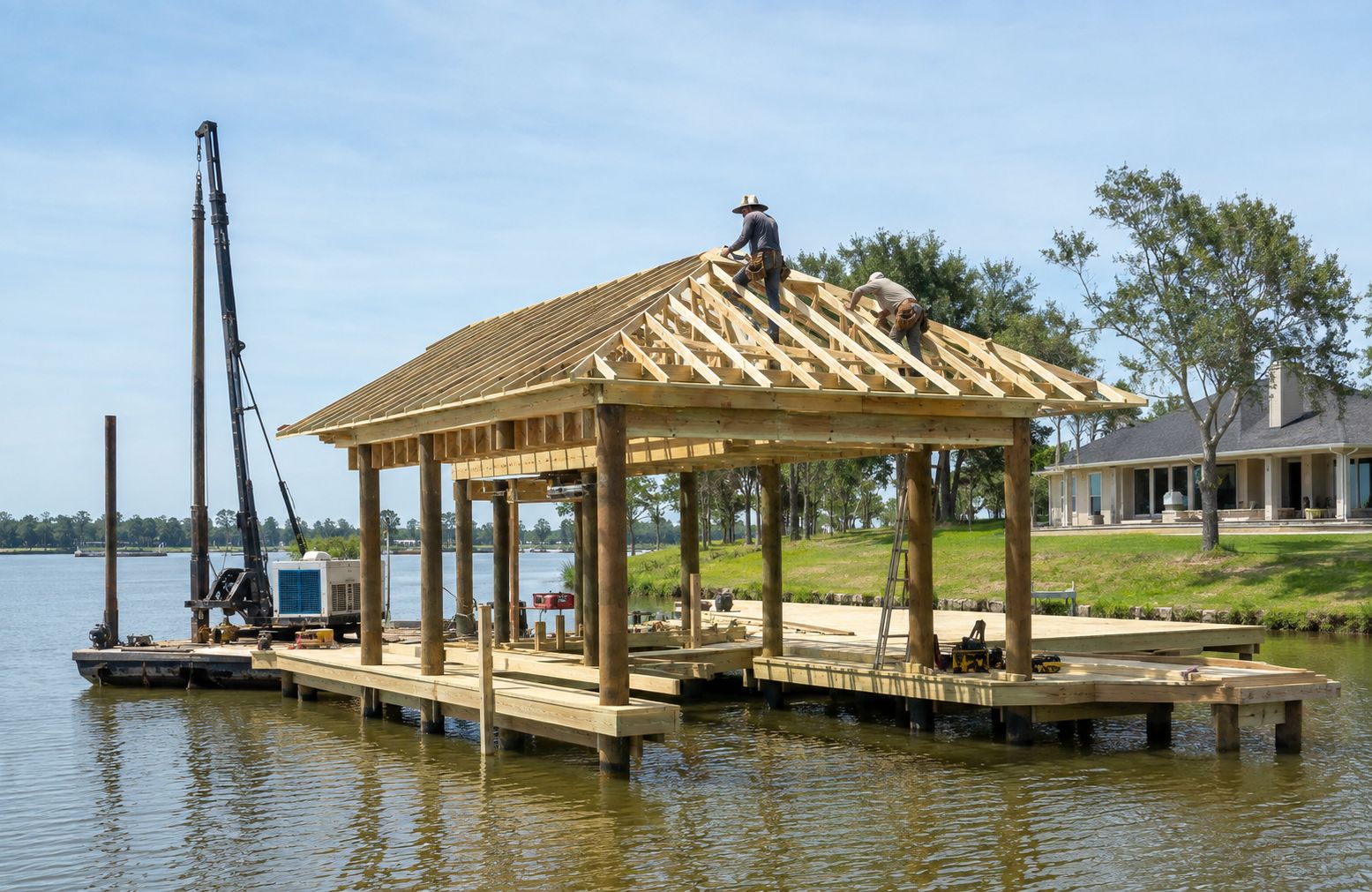
Dream Boat Docks performs bulkhead construction throughout Lake Houston and keeps construction equipment available for waterfront access where projects require it.
Clear Lake, Seabrook, Baytown and Coastal Areas
Brackish and saltwater exposure introduces additional material considerations.
Vinyl’s resistance to rot and corrosion can make it attractive for these environments, but wave conditions, water depth, soil, tidal influence and permitting must still be considered when designing the system.
Can Vinyl Bulkheads Help Prevent Sinkholes?
A failing bulkhead can contribute to soil loss behind the wall.
When backfill escapes through openings, around the ends of the wall or through areas of structural failure, voids can develop behind the bulkhead and eventually appear as depressions or sinkholes in the yard.
Interlocking vinyl sheet piling creates a continuous wall that can help limit soil migration compared with a badly deteriorated bulkhead.
However, installing vinyl does not automatically eliminate every source of soil loss.
Proper installation also requires attention to:
- Sheet interlocks
- Embedment
- Drainage
- Backfill
- Wall termination points
- Existing erosion
- Adjacent structures
If sinkholes are already appearing behind an existing bulkhead, the underlying cause should be evaluated rather than repeatedly adding soil to the affected area.
How Professional Vinyl Bulkhead Installation Works
A successful vinyl bulkhead installation begins with understanding the shoreline.
The process will vary depending on the property, but most professionally built systems follow several major stages.
Phase 1: Site Evaluation
The contractor evaluates existing shoreline and structural conditions.
Important considerations can include:
- Linear footage
- Bank height
- Water depth
- Existing wall condition
- Soil characteristics
- Wave and wake exposure
- Drainage
- Nearby docks and boathouses
- Property access
- Equipment access
- Permitting requirements
These factors help determine whether vinyl is appropriate and what sheet profile, depth and anchoring system may be required.
Phase 2: Material Selection and System Design
Not all vinyl sheet piling is identical.
Sheet profiles differ in thickness, geometry, stiffness and structural capacity.
The appropriate product should be selected based on the demands of the project rather than simply choosing the least expensive sheet.
This is also when the contractor determines the requirements for tie-rods, deadmen, walers, drainage, caps and other structural components.
Phase 3: Permitting and Site Preparation
Required authorizations should be identified before work begins.
Permitting varies significantly across Texas waterways.
Once the applicable approvals are in place, site preparation may include removing or working around an existing wall, establishing the new bulkhead alignment and preparing access for materials and construction equipment.
Phase 4: Installing the Vinyl Sheet Piling
Sheets are installed along the designed bulkhead line and driven or placed to the required depth.
Depending on the sheet-pile system, soil conditions, water depth and accessibility, contractors may use vibratory equipment, water-assisted installation techniques or other specialized methods.
There isn’t one installation method that should automatically be used everywhere in Houston.
The objective is to achieve the appropriate depth and alignment without damaging the sheet piling or compromising the structural design.
Why Embedment Depth Matters
A substantial portion of the sheet piling typically extends below the visible mudline.
This embedment helps the wall resist pressure from the soil behind it.
Insufficient depth can contribute to instability or movement at the bottom of the wall.
The required depth depends on site-specific conditions and engineering requirements.
Phase 5: Anchoring the Wall
The visible sheet piling is only part of the structure.
Many bulkheads rely on tie-rods connected to deadmen or another anchoring system behind the wall.
These anchors help resist the lateral pressure created by the retained soil.
Walers help distribute these loads along the bulkhead rather than allowing them to concentrate on individual sheets.
The anchoring system is one of the most important reasons professional bulkhead construction matters.
A wall may look straight when first installed but still perform poorly later if its underground support system is inadequate.
Phase 6: Drainage, Backfill and Capping
After the wall and anchoring system are installed, attention shifts to what is happening behind the bulkhead.
Proper drainage helps manage water pressure.
Backfill must be placed appropriately to restore the property while minimizing future settlement or soil loss.
Finally, a cap can be installed across the top of the bulkhead to protect the system and provide the desired finished appearance.
Wood, composite, aluminum or other materials may be used depending on the project.
Can Vinyl Be Installed in Front of an Existing Wood Bulkhead?
Sometimes.
Installing a new vinyl wall slightly in front of an aging bulkhead can be an option in certain situations and may reduce demolition and shoreline disturbance.
But removing the old wall should not automatically be required—or automatically avoided.
A contractor should evaluate:
- Condition of the existing wall
- Existing anchors
- Soil loss
- Available space
- New bulkhead alignment
- Property boundaries
- Permitting requirements
- Interference between old and new structural systems
If an existing timber wall has experienced severe structural failure, extensive soil loss or anchoring problems, removal or additional reconstruction may be the better approach.
The decision should be based on site conditions.
Vinyl Bulkhead Permitting in the Houston Area
There is no single Texas bulkhead permit that applies to every waterfront property.
Requirements depend on where the property is located and which agency has jurisdiction.
Lake Conroe
Private bulkheads on Lake Conroe require authorization from the San Jacinto River Authority (SJRA) before construction.
SJRA requires property owners to submit information including an existing property survey, proposed structure location, construction plans and proposed construction materials.
Coastal and Tidally Influenced Properties
Projects along Texas bays and tidally influenced waterways can involve several regulatory authorities.
Depending on the project’s location and scope, applicable approvals may involve:
- Texas General Land Office
- U.S. Army Corps of Engineers
- Local municipalities or counties
- Other state or federal agencies
The Texas General Land Office specifically notes that the required authorization depends on jurisdiction, project design and environmental impacts.
Permitting timelines also vary. Property owners should avoid assuming that every project will be approved within a standard four- or eight-week period.
Lake Houston
Lake Houston projects can have different local permitting requirements depending on property location and the work being performed.
Dream Boat Docks’ Lake Houston service information notes that local waterfront construction can involve City of Houston or Harris County requirements.
Applicable requirements should be confirmed for the individual property before construction begins.
Why Local Bulkhead Experience Matters
Bulkhead construction isn’t simply about choosing a material and driving it into the ground.
Local conditions can change significantly from one Texas waterway to another.
A protected Lake Conroe cove does not present exactly the same conditions as an exposed section of Clear Lake.
A Lake Houston canal may require a different installation approach than a Baytown property exposed to brackish water.
Those differences can affect:
- Material selection
- Sheet-pile profile
- Embedment
- Anchoring
- Drainage
- Equipment
- Construction access
- Permitting
Dream Boat Docks has served Texas waterfront property owners since 1987 and works throughout Lake Conroe, Lake Houston and the Greater Houston region.
Because the company works with multiple bulkhead materials, the recommendation can be based on the property rather than forcing every shoreline into the same system.
Depending on the project, that may include:
- Vinyl/PVC
- Composite/FRP
- Treated timber
- Steel
- Other engineered shoreline solutions
Is Vinyl the Right Bulkhead Material for Your Property?
Vinyl may be particularly attractive when a waterfront property owner wants:
- Resistance to rot
- Resistance to marine organisms
- Corrosion-free sheet piling
- Low routine material maintenance
- Long-term shoreline protection
- A clean, consistent appearance
- Strong lifecycle value for an appropriate residential application
But material selection should come after evaluating the shoreline.
Factors such as bank height, water depth, soil conditions, structural loads, wave exposure, budget and expected ownership horizon should all play a role in the decision.
Sometimes vinyl will be the best fit.
For other properties, Dream Boat Docks may recommend composite/FRP, timber, steel or another approach.
That ability to choose from multiple systems is important because the most expensive material isn’t necessarily the right one—and neither is the least expensive.
Protect Your Texas Shoreline With the Right Bulkhead
Shoreline erosion can gradually turn into a much larger problem.
What begins as minor soil loss behind an aging wall can eventually affect landscaping, docks, boathouses and other waterfront improvements.
A properly designed vinyl bulkhead installation can provide durable, low-maintenance shoreline protection for many Texas waterfront properties.
The key is designing the entire system correctly.
Sheet piling, embedment, anchors, tie-rods, drainage, backfill and site conditions all contribute to long-term performance.
Dream Boat Docks has been serving Texas waterfront property owners since 1987 and builds bulkheads using multiple materials to match the requirements of each shoreline.
If your existing bulkhead is leaning, deteriorating or allowing soil to escape—or you’re planning shoreline protection for a new waterfront property—contact Dream Boat Docks for a professional evaluation and free estimate.
Frequently Asked Questions
How long does vinyl bulkhead installation take?
Construction time depends on the length and height of the wall, site accessibility, soil conditions, existing structures, equipment requirements and weather.
Many residential projects can be physically constructed within a relatively short period once work begins, but permitting and project preparation can significantly affect the overall schedule.
Dream Boat Docks can provide a more accurate timeline after evaluating the property.
Do I need a permit for a vinyl bulkhead in Houston or Lake Conroe?
Permitting depends on location.
Private bulkheads on Lake Conroe require a San Jacinto River Authority permit. Coastal or tidally influenced properties may involve the Texas General Land Office, U.S. Army Corps of Engineers and local authorities. Other Greater Houston waterways can have their own requirements.
The applicable jurisdiction should be determined before construction begins.
Can a vinyl bulkhead be installed in front of my existing wood wall?
In some cases, yes.
A new wall can sometimes be installed in front of an existing structure, but the condition of the old bulkhead, existing anchors, soil stability, available space and permitting requirements must be evaluated first.
Some projects may benefit from leaving portions of an existing wall in place, while others require demolition or additional reconstruction.
How long does a vinyl bulkhead last?
Marine-grade vinyl sheet piling is designed for long-term use, and some manufacturers offer product warranties of 50 years or longer.
The actual lifespan of a completed bulkhead depends on the specific product, structural design, installation, anchoring, soil conditions and waterfront environment.
How much does vinyl bulkhead installation cost per linear foot in Texas?
Bulkhead pricing varies considerably by property.
Major cost factors include:
- Wall height
- Water depth
- Sheet-pile profile
- Soil conditions
- Linear footage
- Anchoring requirements
- Site accessibility
- Barge or equipment requirements
- Demolition of an existing structure
- Permitting
For current budgeting information, see Dream Boat Docks’ guide to Bulkhead Construction Costs in Texas: What to Expect in 2026.
Is vinyl better than composite for shoreline protection?
Neither material is universally better.
Vinyl/PVC can provide an excellent combination of corrosion resistance, low maintenance, longevity and cost effectiveness for many residential shoreline applications.
FRP composite can offer greater structural stiffness and capacity for projects with more demanding engineering requirements.
The right material depends on wall height, soil conditions, water depth, structural loads, exposure and budget.
Dream Boat Docks works with both materials and can recommend the system that best fits the property.
Is vinyl better than wood?
Vinyl offers several advantages over wood, particularly resistance to rot, marine organisms and corrosion.
Wood still has advantages, including a lower initial material cost and traditional appearance.
Which is better depends on the property’s conditions, budget and long-term goals.
Will a vinyl bulkhead withstand a hurricane or major storm?
No responsible contractor should describe any bulkhead as hurricane-proof.
A professionally designed vinyl bulkhead can be engineered to resist substantial soil, water, wave and environmental loads, but extreme storms can exceed design conditions and affect the surrounding shoreline as well as the structure itself.
Storm performance depends on the entire system, including sheet-pile capacity, embedment, anchors, tie-rods, drainage, soil conditions and exposure—not simply whether the visible wall is made from vinyl.
What maintenance does a vinyl bulkhead require?
Vinyl sheet piling itself requires relatively little routine maintenance because it doesn’t rot or rust.
The overall bulkhead should still be inspected periodically for:
- Soil loss
- Changes in wall alignment
- Drainage problems
- Damaged caps
- Visible hardware issues
- Erosion around the ends of the wall
- Changes around docks or adjoining structures
Addressing small problems early can help protect the bulkhead and the property behind it.
How do I know whether vinyl is right for my shoreline?
The best approach is a professional site evaluation.
Dream Boat Docks can evaluate your bank height, water depth, soil, erosion, wave exposure, structural requirements and budget before recommending vinyl/PVC, FRP composite, timber, steel or another bulkhead system.
Protect your waterfront before erosion becomes a larger problem. Contact Dream Boat Docks today to request a free bulkhead evaluation and estimate.