Most bulkhead problems on Lake Conroe don’t announce themselves. The wall looks reasonable from the dock. Maybe there’s a slight lean you’ve been meaning to get checked out, or a soft spot in the lawn near the water that you assumed was just wet soil. By the time something looks obviously wrong, the underlying damage has usually been developing for a season or two.
That’s the part that catches most property owners off guard. Visible failure is almost always a lagging indicator. The bowing, the sinkholes, the soil bleeding through the joints: these appear after the anchoring system has already been under stress for a while. On a lake like Conroe, where wake boat traffic is heavy and water levels fluctuate with SJRA management of the conservation pool, the forces working against your shoreline are consistent and relentless. The wall either handles them or it doesn’t.
This guide covers how to read what your bulkhead is telling you, how to decide between repair and replacement, what a proper repair actually involves, and what the SJRA requires before any work starts. We’ve been doing this work on Lake Conroe since 1987, and the questions below are the ones we get on nearly every site visit.
What Bulkhead Failure Actually Looks Like
There’s a useful distinction between cosmetic damage and structural damage. A soft cap board or a surface crack in timber facing is cosmetic. The rest of the list below is structural, and structural damage doesn’t wait.
Outward bowing or leaning. A wall tilting toward the water is the clearest sign that the anchoring system is losing the fight against lateral soil pressure. This usually means a snapped or corroded tieback rod, a deadman anchor that has pulled free, or a waler connection that has failed. It is not a cosmetic issue.
Soil depressions or sinkholes behind the cap. Cavities forming in the ground close to the wall mean backfill is escaping through gaps in the sheeting, failed panel joints, or compromised filter fabric. The void is already there; the surface collapse just makes it visible.
Rusted or exposed hardware. Tieback rods that are visibly corroded or broken can no longer hold wall tension. This is a failure of the system that holds everything upright, not just a surface problem.
Gaps between panels where soil is escaping. If you can see soil moving through the wall during rain events or when wake hits the shore, the wall is actively losing its backfill. This accelerates the more it goes unaddressed.
Base kickout. Check the bottom of the sheeting at low water. If the toe has shifted lakeward, toe scour has removed the lakebed material that was bracing the piling embedment. The wall is losing its foundation.
Timber splitting or softening below the waterline. Surface rot on a cap board is a maintenance item. Timber pilings that have softened or split below the mudline are a structural problem. The wet-dry cycle around Lake Conroe’s 201-foot conservation pool accelerates fungal decay in wood pilings in ways that aren’t visible until the damage is significant.
The Hydrostatic Pressure Problem
One of the most common causes of premature failure on Lake Conroe has nothing to do with wave energy. When heavy rain saturates the alluvial sands and dense clay soils behind a wall and the water has nowhere to go, the trapped hydrostatic pressure pushes outward against the sheeting with significant force. Weep holes that are clogged or incorrectly installed are the usual culprit. The small gaps that form in sheeting panels under pressure act as funnels, drawing backfill out through the wall every time lake levels fluctuate or a large wake hits. The result is a growing void beneath the lawn that gives no surface warning until the ground actually settles.
This is fixable, but it has to be addressed as part of any repair rather than treated as a separate issue. A wall that still has drainage problems after a repair will fail again.
Repair or Replace? The Decision That Actually Matters
This is the question we’re asked most often on site visits, and the honest answer is that it depends on how much of the wall’s structural integrity is still intact.
As a general threshold: if structural compromise affects less than 30 to 40% of the wall, a targeted repair is usually the right call. The core foundation is still sound, and restoring specific failure points extends the wall’s useful life without the cost of a full rebuild. If compromise has spread beyond 50% of the wall, particularly if widespread rot, bowing, or piling softening is present below the mudline, continuing to patch individual sections becomes a diminishing investment. At that point, replacement is the more economical long-term decision even though it costs more upfront.
A few other factors that lean toward full replacement:
Age. Timber bulkheads on Lake Conroe typically reach their structural limit between 15 and 25 years. If your wall is in that range and showing multiple failure signs, repair may extend the timeline by a few years but won’t change the outcome. A marine-grade vinyl replacement in the same situation carries a projected lifespan of 40 to 50 years with significantly less maintenance.
The 1:1 embedment ratio. A repaired wall has to be capable of meeting the same structural standard as a new one. The piling embedment ratio on Lake Conroe should be between 1:1 and 1.5:1: for every foot of wall above the mudline, at least one to one-and-a-half feet of sheeting needs to be in the ground. If the existing pilings can’t meet this standard, repair alone won’t hold.
Toe scour. A wall where the mudline has been significantly eroded at the base has lost part of its foundation. Repair of the above-grade components doesn’t fix that. Toe scour has to be addressed directly, typically with riprap placement, as part of any repair or replacement scope.
If you’re uncertain which side of the line your wall falls on, a site visit from someone who has worked Lake Conroe for a long time is worth more than any general rule. Soil conditions, wave exposure, and the specific failure pattern all affect the call.
What a Professional Bulkhead Repair Involves
When repair is the right answer, the work goes well beyond surface fixes. A repair that doesn’t address the root cause of the failure just defers the next one.
Tieback and Deadman Anchor Restoration
If the anchoring system has failed, restoring it is the first priority. New hot-dipped galvanized steel tieback rods are driven deep into the shoreline and connected to deadman anchors positioned well behind the active soil failure plane, at a horizontal distance of 1.5 to 2 times the exposed wall height. Anchors placed too close to the wall sit inside the zone of soil that’s already under load, and they don’t provide meaningful resistance. Positioned correctly, they hold the wall upright against both hydrostatic pressure and backfill weight.
Vinyl Sleeving Over Existing Structure
For walls with sound underlying pilings but failing panels or significant timber degradation, installing new vinyl or composite sheet piling directly in front of the old structure is a practical approach. The SJRA permits this build-in-front method, and it avoids the upland excavation that a full tear-out requires. It protects established landscaping, irrigation systems, and mature trees. The new sheeting is connected to new tieback rods running back to freshly installed deadman anchors, and a clean cap encapsulates the old structure. A vinyl facing installed this way carries a 40 to 50 year projected lifespan in Lake Conroe’s freshwater environment.
Before the new face goes on, remaining timber components are treated with marine-grade preservatives to stop active fungal decay. One-way check-valve weep holes replace any that are clogged or improperly positioned.
Drainage and Soil Stabilization
Non-woven geotextile filter fabric installed against the landward face of the sheeting, combined with angular crushed stone backfill creating drainage columns behind the wall, allows trapped groundwater to escape through weep holes without carrying fine soil particles through the wall. This is the fix for the hydrostatic pressure problem. Without it, any repair is working against a problem that will keep coming back.
Toe Protection
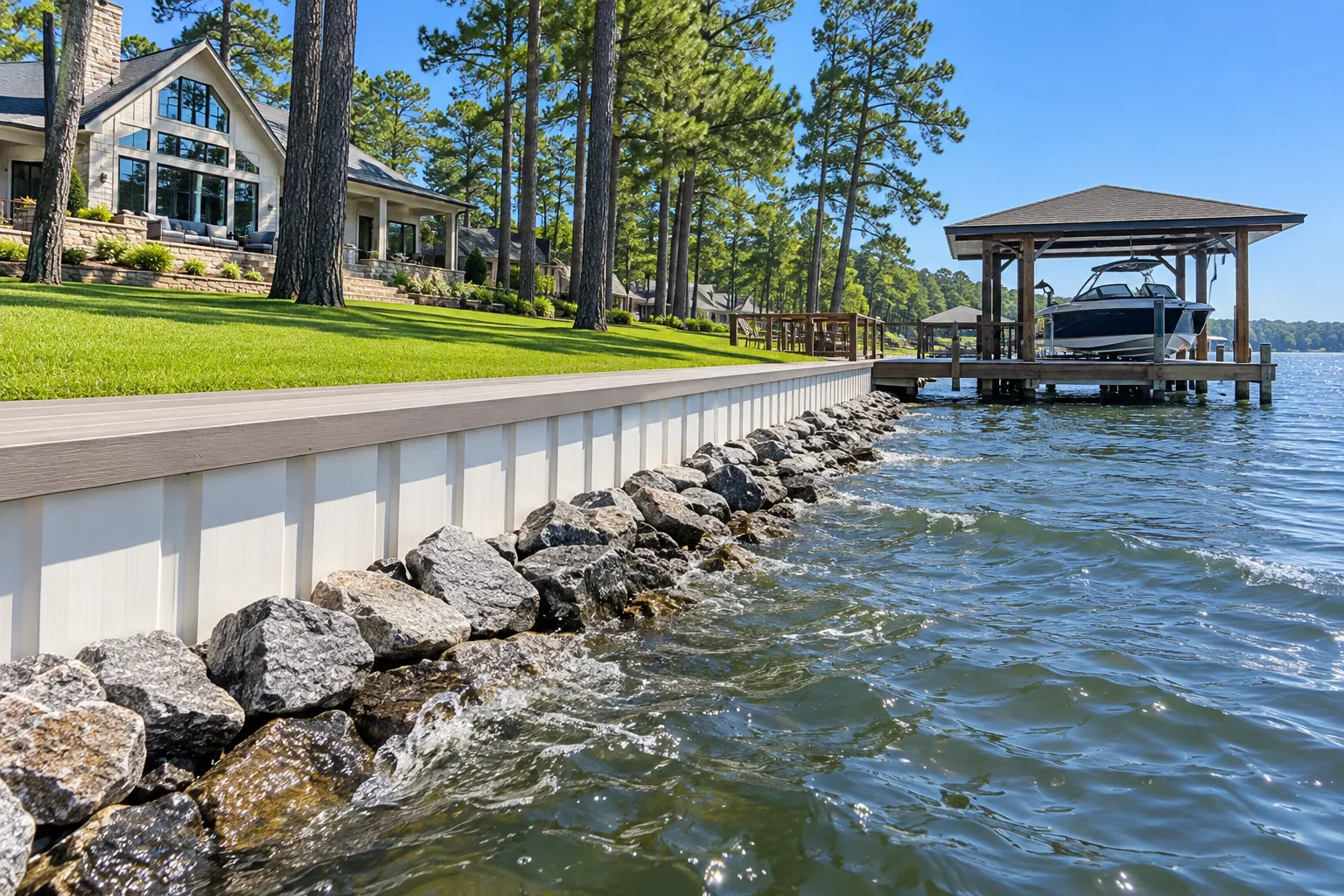
For main-basin and channel-facing properties with meaningful wake exposure, riprap placement at the base of the wall is part of a complete repair. A two to three foot berm of limestone or granite at the mudline absorbs the downward hydraulic energy from wave reflection, breaking the scour cycle that removes lakebed material from around the pilings. Properties tucked into protected coves with minimal fetch may not need this, but open-water Lake Conroe lots almost always do.
Waler and Cap Replacement
Warped or rotted cap boards and waler beams distribute structural load unevenly across the pilings, which accelerates wear at connection points. Replacing these with marine-grade timber or composite alternatives restores even load distribution across the system. The cap is also what ties into a dock, pier, or boathouse foundation, so its condition matters beyond just the bulkhead itself.
Our bulkhead construction and repair services cover the full scope of what a proper Lake Conroe repair involves, from initial assessment through SJRA permit coordination and final grading.
Lake Conroe’s Specific Engineering Challenges
Lake Conroe’s conditions aren’t uniform, and the engineering requirements aren’t either.
Soil variability. The Montgomery County substrate around Lake Conroe is a mix of alluvial sands and dense expansive clay. The clay component shrinks during dry spells and exerts significant lateral pressure when saturated by Gulf Coast rain events. This soil movement is a constant variable that piling embedment and deadman placement have to account for. It’s one reason why a contractor without local experience on this specific lake may undersize anchoring systems that appear adequate on paper.
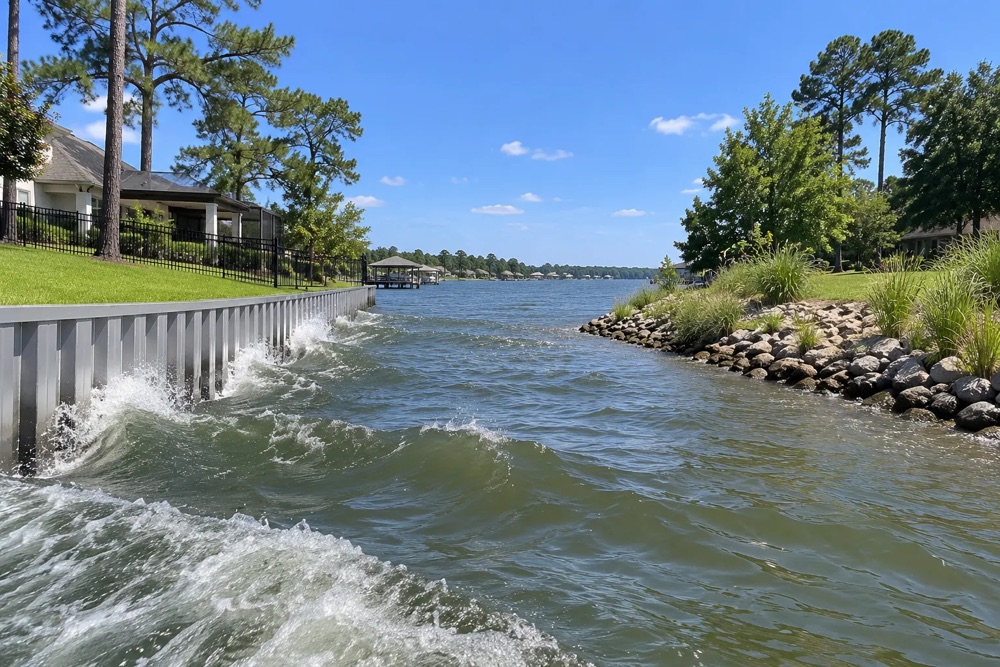
Wave energy by location. Properties on the main body of the lake, particularly in high-traffic corridors near Walden, Bentwater, and April Sound, face a different level of wave energy than cove properties with limited fetch. Deep-draft wake boats generate displacement waves that hit vertical structures repeatedly throughout the day. That energy reflects downward at the base of the wall and contributes to toe scour over time. A repair plan for a main-basin property has to account for this. A cove property with similar surface damage may need less aggressive toe protection.
Water level fluctuation. The SJRA manages Lake Conroe’s conservation pool at 201 feet above mean sea level but conducts controlled releases during significant rain events across Montgomery County. When the lake level drops, external water pressure against the bank decreases while any hydrostatic pressure built up in the soil behind the wall remains. Timber components that cycle repeatedly through wet and dry conditions degrade faster than those in consistently submerged conditions. This is part of why timber walls on Lake Conroe tend to reach their limit on the lower end of the 15 to 25 year range for exposed main-basin properties.
SJRA Permitting for Bulkhead Repairs
The San Jacinto River Authority requires permits for all structural bulkhead work on Lake Conroe, including significant repairs, full replacements, and any work that alters the footprint or structural configuration of the wall. This applies at and below the 201-foot mean sea level conservation pool. The authority also maintains a flowage easement up to 207 feet above mean sea level that restricts unapproved grade modifications along the water margin.
A complete permit submission requires a certified boundary survey from a Texas Registered Professional Land Surveyor, engineered construction plans detailing embedment ratios, tieback rod placement, and deadman anchor setbacks, and subdivision HOA or POA approval where applicable.
Our Lake Conroe marine construction services include full SJRA permit coordination on every project.
Working from a Barge: Why It Matters
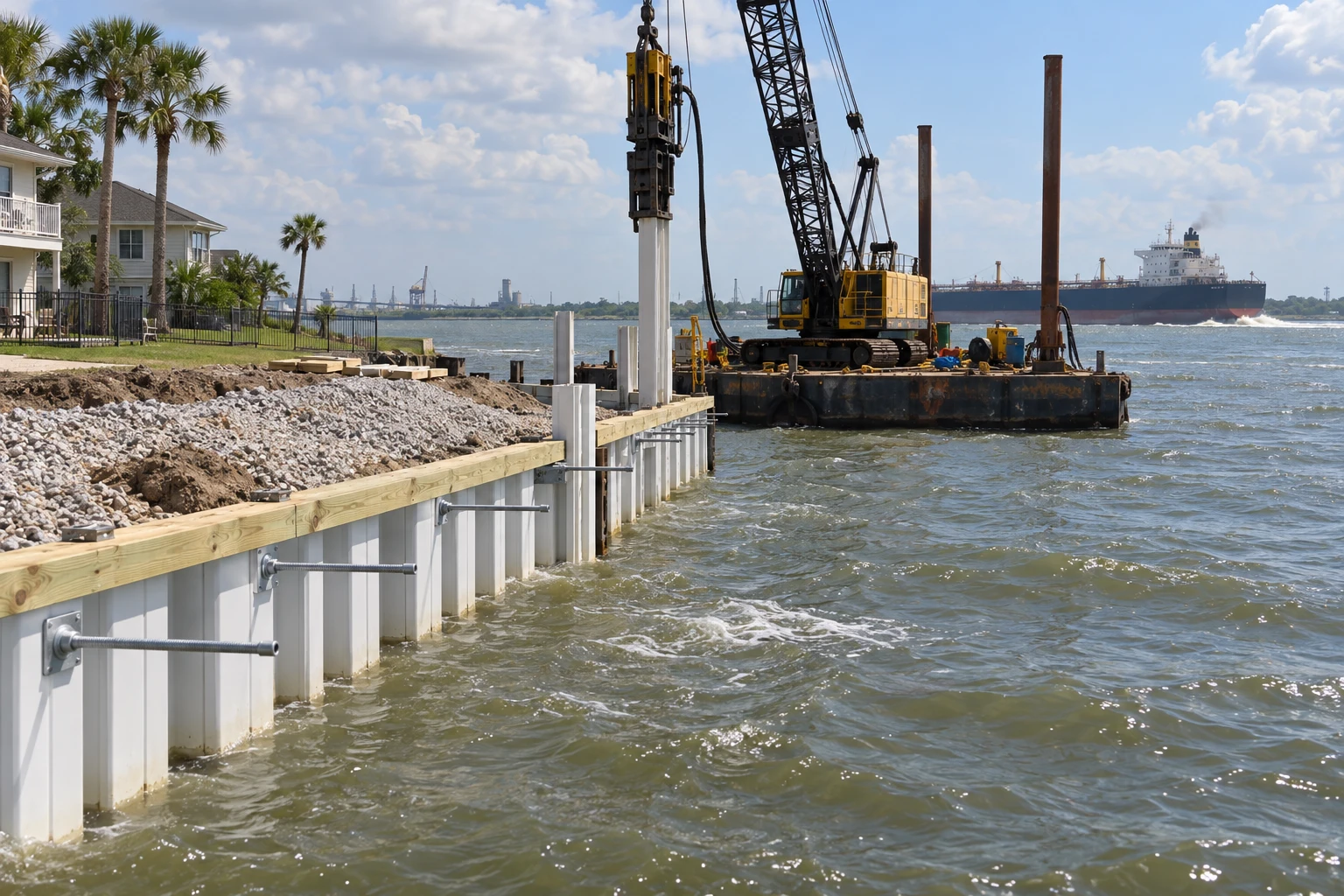
Bulkhead repair on Lake Conroe requires waterborne equipment. There’s no practical way to drive pilings correctly, place riprap, or install sleeved sheeting from land without either major upland excavation or equipment that can’t reach the work properly.
Operating from a floating barge lets crews transport heavy sheet piling, drive structural pilings to proper embedment depth, and place granite or limestone toe protection directly from the lake side. This approach keeps heavy machinery off established lawns, away from irrigation systems, and clear of mature trees and landscaping. It also allows access to the shoreline regardless of current water level, which matters on a managed reservoir where levels can change during a project.
Our marine piling services use dedicated waterborne pile-driving equipment sized for the conditions on Lake Conroe specifically, not land-based excavators trying to reach over a bulkhead.
Can Repairs Be Done Around an Existing Dock?
In most cases, yes. Working from the water side means we’re not dependent on land access, and the construction barge can be positioned to work around existing dock structures without dismantling them. Before any work starts, we assess the connection between the dock foundation and the bulkhead to make sure both structures remain stable throughout the repair. If the dock is integrated into the bulkhead cap, that connection point gets attention as part of the scope rather than after the fact.
Coordinating boat dock repairs or upgrades alongside a bulkhead repair is something we handle regularly on Lake Conroe. One mobilization, one crew, and all the structural connections planned together from the start.
Frequently Asked Questions
How long does a professional bulkhead repair last on Lake Conroe?
A targeted repair on a structurally sound wall typically extends its service life by 10 to 15 years, depending on material and scope. If the repair includes vinyl sleeving over existing timber, that section carries a 40 to 50 year projected lifespan in freshwater. Longevity depends heavily on whether drainage issues are addressed as part of the repair and whether tieback and weep hole systems are properly maintained afterward.
Can I repair a bulkhead myself?
Not practically. Driving pilings to the correct embedment depth, installing deadman anchors at proper distance from the wall, and working at the waterline all require specialized marine equipment. The SJRA also requires permits and engineered plans for structural work, which means any unpermitted DIY repair creates compliance problems in addition to structural risk. Beyond the paperwork, a repair that doesn’t address the root cause (usually drainage or anchoring failure) won’t hold.
Does homeowners insurance cover bulkhead repairs?
Standard homeowners policies typically exclude coverage for bulkheads, piers, and docks damaged by gradual erosion or water level changes. Coverage may apply to sudden damage from a named storm event, and specific riders are sometimes available. Review your policy with your agent before assuming coverage exists. This is one reason why catching failure signs early matters: minor repairs are out-of-pocket but manageable; emergency interventions after a collapse are expensive regardless of what insurance covers.
What’s the best material for bulkhead repair on Lake Conroe?
For most residential properties, marine-grade vinyl sheet piling is the right choice. It doesn’t rot, doesn’t support marine borers, resists UV degradation, and holds up to Lake Conroe’s wet-dry cycling without the maintenance demands of timber. Composite materials perform similarly well. Timber still has a place in certain situations, particularly where initial cost is the priority and the property owner understands the maintenance commitment and shorter lifespan that comes with it.
Do I need an SJRA permit for minor bulkhead repairs?
The SJRA requires permits for all structural bulkhead work, including significant repairs, replacements, and modifications. Minor cosmetic work like replacing surface cap boards may not trigger formal engineering review, but any work affecting load-bearing components, pilings, or the structural configuration of the wall requires a permit. Contractors who work regularly on Lake Conroe handle this process as part of their standard scope.
How does repair cost compare to full replacement?
A targeted repair on a structurally sound wall is significantly less expensive than full replacement. The cost gap narrows as the extent of failure increases. When more than 50% of a wall exhibits rot, bowing, or piling degradation below the mudline, replacement generally becomes the more economical long-term decision even at a higher upfront cost, because continued repair investment on a failing structural skeleton produces diminishing returns.
What happens if I ignore a leaning bulkhead?
The lean will progress. As the wall tilts further, tension on the tieback rods increases until they snap, which typically produces sudden sinkhole formation behind the cap as backfill rushes out through the gap. Continued erosion can eventually reach nearby structures, pools, or the home foundation itself. A leaning wall on Lake Conroe, where wake energy is constant, deteriorates faster than the same wall would on a quieter body of water. It’s not a situation that stabilizes on its own.
Can repairs be done around my existing dock?
In most cases, yes. Working from a construction barge means we’re not dependent on land access, and the barge can be positioned around existing dock structures without dismantling them. We assess the connection between the dock foundation and the bulkhead before any work starts to make sure both structures stay stable throughout the repair.
Dream Boat Docks has provided bulkhead repair and marine construction services on Lake Conroe and the Texas Gulf Coast since 1987. For a free site assessment or estimate, contact our team directly.