If you own waterfront on Lake Conroe, you’ve likely watched what unchecked erosion can do to a shoreline. A few seasons of heavy wake traffic, some periods of high water followed by a drawdown, and what used to be a clean bank starts to look noticeably different. The lawn pulls back. Soil appears where it shouldn’t. A wall that seemed fine starts to lean.
Bulkhead installation on Lake Conroe isn’t a project to put off until the problem is obvious. By the time you can see the damage clearly, the erosion has usually been working for a while. This guide covers what you need to know before making any decisions: how Lake Conroe’s specific conditions affect your shoreline, which materials hold up and which don’t, what the San Jacinto River Authority requires before any work can start, and how a properly engineered installation actually comes together.
Dream Boat Docks has been building and repairing bulkheads on Lake Conroe and across the Texas Gulf Coast since 1987. What follows is based on what we’ve learned working in these specific conditions over nearly four decades.
How Lake Conroe’s Conditions Affect Your Shoreline
Lake Conroe is a 21,000-acre reservoir managed by the San Jacinto River Authority (SJRA), which maintains a normal conservation pool level of 201 feet above mean sea level. That number matters for engineering because it isn’t fixed. The SJRA conducts controlled releases during heavy rainfall events across Montgomery County, which can drop water levels noticeably below pool. When that happens, the external water pressure that had been pushing back against your bank disappears, and any hydrostatic pressure that’s built up in the soil behind your wall now has less to work against.
That’s one pressure source. The other is boat traffic.
High-traffic areas near Walden, Bentwater, April Sound, and the open main basin see a significant volume of deep-draft wake boats. These vessels produce steep, high-energy wakes that hit vertical shoreline structures with repeated lateral force. When that wave energy strikes a wall, it doesn’t just push against it; it also deflects downward toward the lakebed. Over time, that downward energy scours the soil at the base of your pilings, a process called toe scour, which removes the foundational material that holds the wall in place. A structure that was correctly embedded can become undersupported through toe scour alone, without any visible warning above the waterline.
Quiet coves on the lake see significantly less of this than main-basin and channel-facing properties. The engineering requirements aren’t the same across every Lake Conroe shoreline, which is one reason a site visit matters more than a general estimate.
Warning Signs Worth Acting On
Bulkhead failures are rarely sudden. The structure gives signals well before anything gives way:
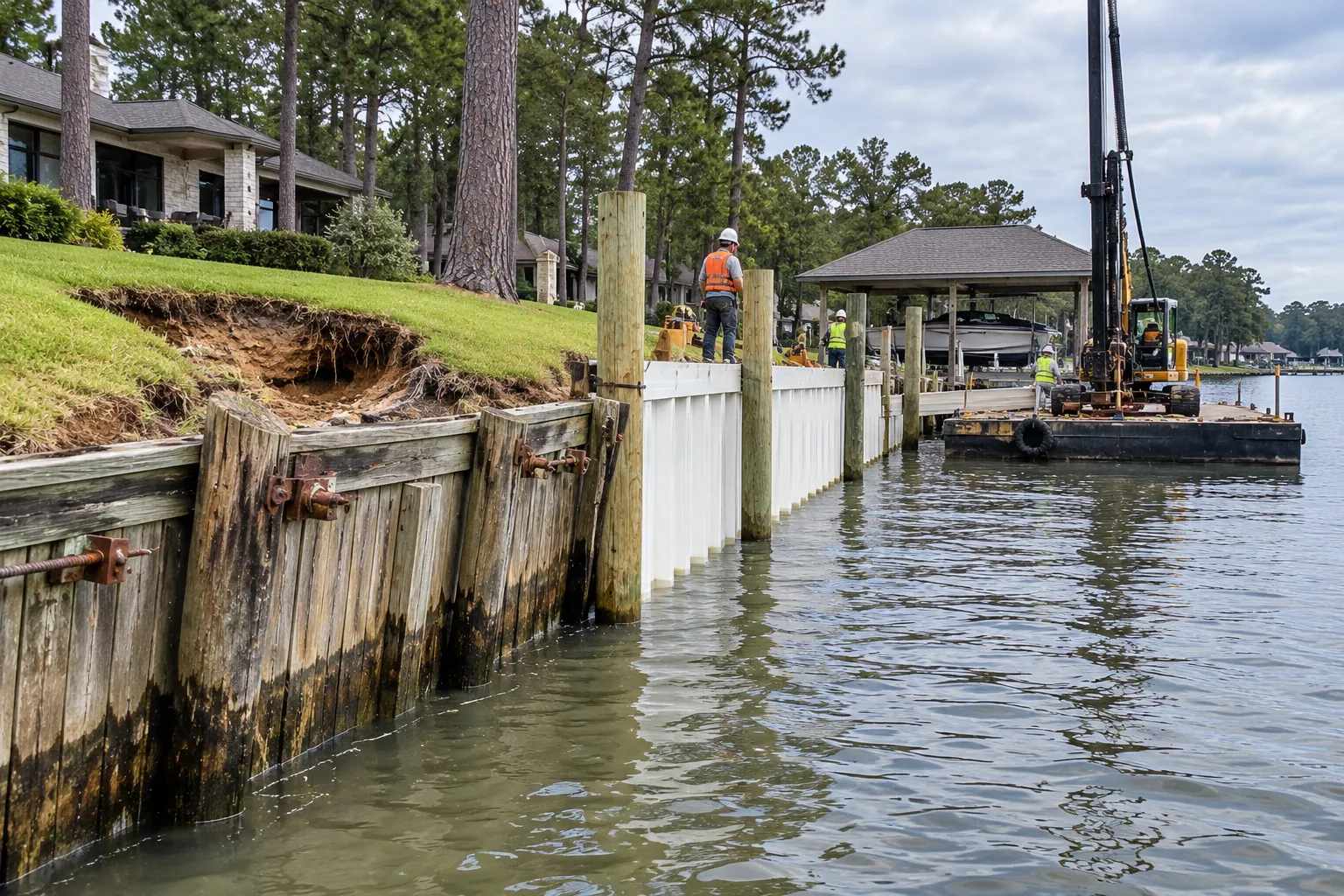
Soil depressions or sinkholes behind the wall. Cavities forming in the ground close to the wall mean backfill is escaping through failed seams, separated joints, or compromised filter fabric. This is a sign the wall has already been breached somewhere along its length.
Outward bowing or leaning. A wall deflecting toward the water is under more load than its anchoring system can hold. This typically means a snapped tieback rod, a rusted deadman anchor, or a failed waler connection.
Base kickout. At low tide, look at the bottom of the sheeting. If the base has shifted forward into the lakebed, toe scour has compromised the embedment depth that keeps the wall upright.
None of these are situations to monitor for another season. On a wake-heavy lake like Conroe, deterioration accelerates once the anchoring system is stressed.
Choosing the Right Bulkhead Material
The material choice determines the lifespan of the wall, the maintenance it requires, and how well it holds up to Lake Conroe’s specific combination of wave energy, water chemistry, and temperature swings. There’s no single right answer, but there are better and worse fits for most situations.
Vinyl Sheet Piling
Heavy-gauge vinyl is the standard for residential bulkhead installation on Lake Conroe for good reasons. It’s engineered from UV-stabilized PVC with a male-female interlocking joint system that creates a soil-tight barrier along the full length of the wall. It won’t rot, doesn’t support marine borers, and holds its structural integrity without the regular maintenance that timber demands. Properly installed, a vinyl bulkhead typically lasts 40 to 50 years in Lake Conroe’s freshwater environment.
The aesthetics stay clean over time too. Vinyl doesn’t splinter, warp, or discolor the way wood does under repeated wet-dry cycling and Texas heat. For most residential properties on Lake Conroe, vinyl is the practical choice.
Marine-Grade Timber
Pressure-treated timber has a long history on Lake Conroe and still makes sense for certain projects, particularly where a natural look is the priority or where initial cost is the deciding factor. For freshwater use, structural lumber should carry a minimum retention rating of 0.60 pcf CCA (chromated copper arsenate) to resist microbial decay. Timber typically provides a working lifespan of 15 to 25 years in these conditions, and face boards will need attention around the ten-year mark, including fastener replacement and surface repairs as checking and warping develop.
Most property owners replacing a timber bulkhead on Lake Conroe don’t return to wood, but for the right situation and budget, it remains a reasonable option.
Steel and Composite Sheet Piling
For high-load shorelines or properties with exceptional wave exposure, heavier materials are available:
Hot-rolled steel sheet piling provides the highest structural modulus for deep-water or high-impact situations. Protected with sacrificial wall thickness or marine coatings, steel typically lasts 30 to 50 years. It’s more common in commercial applications than residential, but some main-basin properties on Lake Conroe benefit from it.
Fiber-reinforced polymer (FRP) composites offer flexural strength comparable to steel with a lifespan exceeding 50 years and complete resistance to rust and biological decay. Hardware compatibility matters here: pairing these materials requires hot-dipped galvanized steel tie-rods throughout to prevent galvanic corrosion between dissimilar metals.
Our bulkhead construction services cover all of these material options. The right call depends on your specific shoreline geometry, wave exposure, and how you’re balancing upfront cost against long-term maintenance.
SJRA Permitting: What You Need Before Work Starts
The San Jacinto River Authority has jurisdiction over all shoreline construction at or below the 201-foot mean sea level conservation pool. The authority also maintains a flowage easement extending up to 207 feet above mean sea level, which restricts unapproved grade modifications along the water margin. Any structural work touching the lakebed requires an SJRA permit before construction begins, no exceptions.
Beyond the SJRA, communities like Walden, Bentwater, and April Sound require Architectural Control Committee (ACC) approval, and setback requirements from adjacent docks and lot lines apply across the lake.
The documentation package a complete application requires:
Boundary survey. A certified survey prepared by a Texas Registered Professional Land Surveyor establishing property corners, adjacent structures, and the exact 201-foot elevation line.
Engineered construction plans. Dimensioned structural drawings detailing sheet pile embedment ratios, waler dimensions, tieback rod placement, and deadman anchor setbacks. These need to be prepared by a licensed engineer, not sketched out by the contractor.
Subdivision clearances. HOA or POA approval sign-off alongside any applicable Army Corps of Engineers nationwide permit compliance documentation.
Inspection coordination. SJRA field inspections need to be scheduled at structural milestones before anchor systems are driven and final backfill is completed.
One important SJRA rule: the authority permits a build-in-front approach, where new sheet piling is installed directly lakeward of a failing wall. This eliminates the need for upland excavation and protects established landscaping, irrigation systems, and mature trees. Unauthorized open-water reclamation beyond what the permit allows is not permitted.
How a Properly Engineered Bulkhead Is Built
There’s a specific sequence to a professionally installed bulkhead, and each stage affects the one that follows.
Pile Driving and Sheet Installation
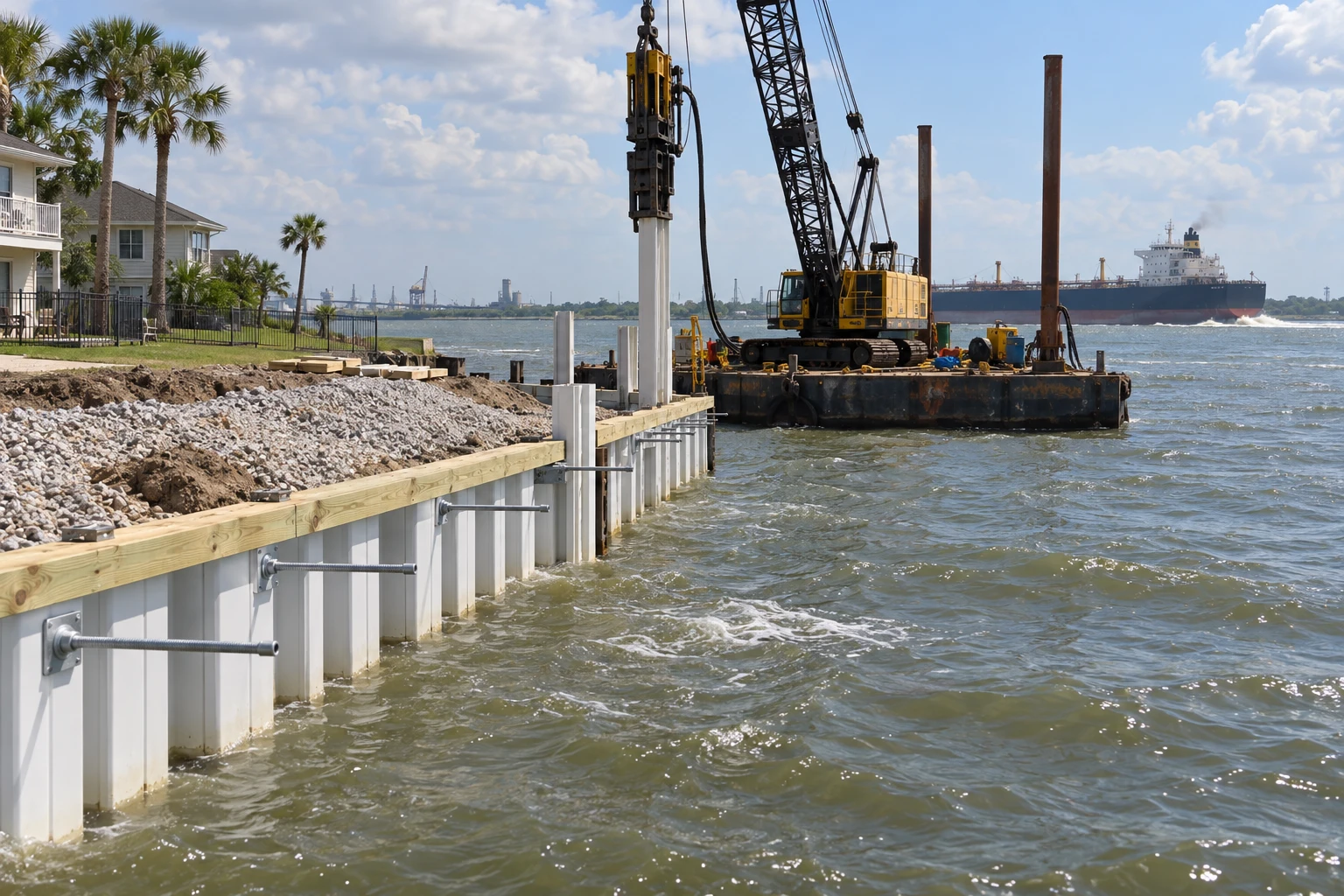
Dense clay layers and compacted sand common around the Lake Conroe basin require hydraulic water-jetting combined with drop-hammer pile rigs for proper installation. Each sheet is driven to exact depth tolerances, with the male-female interlocking joints checked continuously to maintain a soil-tight barrier along the wall’s full length.
The critical number is the embedment ratio. Standard marine engineering on Lake Conroe requires between 1:1 and 1.5:1. For every foot of wall exposed above the mudline, between one and one-and-a-half feet of sheet piling must be driven below the lakebed. That means 50% to 60% of the total sheet length is underground, providing the passive soil resistance that prevents base kickout. A wall driven to inadequate depth will eventually fail at the toe regardless of how well everything else is done.
Our marine piling services cover the equipment and technique that proper embedment depth requires on Lake Conroe specifically.
Tiebacks, Deadman Anchors, and Drainage
The wall’s resistance to outward pressure depends entirely on its anchoring system. Hot-dipped galvanized steel tieback rods pass through the outer waler beams and run inland to deadman anchors buried well behind the wall.
Deadman placement is critical. The anchors need to be positioned at a horizontal distance equal to 1.5 to 2 times the exposed wall height, placing them outside what engineers call the active soil failure plane. If deadmen are placed too close to the wall, they sit inside the zone of soil that’s already under stress from the wall’s load, and they don’t provide meaningful resistance. Placed correctly, they act as a permanent counterweight holding the wall upright against hydrostatic pressure and backfill weight.
Drainage is the detail that gets overlooked most often. When water from heavy rain or high lake levels saturates the soil behind the wall and has nowhere to go, the hydrostatic pressure against the sheeting multiplies significantly. The solution is non-woven geotextile filter fabric laid against the landward face of the sheeting, angular crushed stone backfill immediately behind the wall to create drainage columns, and weep holes positioned to let water escape without washing fine soil through. Get this right and the wall manages pressure naturally. Get it wrong and it’s the most common cause of premature failure we see.
Cap and Riprap Toe Protection
The cap ties the full sheet assembly into a single rigid perimeter and provides the finished surface for integration with a dock, pier, or boathouse foundation. Heavy structural lumber or composite capping works for most residential applications.
At the base of the wall, fractured granite or limestone riprap is placed across the mudline. This is not optional for most Lake Conroe shorelines with meaningful wake exposure. The riprap absorbs the downward hydraulic energy from wave reflection, breaking the scour cycle before it removes the lakebed soil supporting the piling embedment. A wall without toe protection on a main-basin Lake Conroe lot is fighting a problem it can’t win long-term.
Integrating Your Bulkhead with Dock and Boathouse Systems
A bulkhead doesn’t exist in isolation. On most Lake Conroe properties, the shoreline wall is also the foundation that a dock, pier, or boathouse ties into. How that integration is handled affects both structures.
Building the bulkhead and the dock as separate scopes managed by different contractors almost always creates problems: misaligned elevations, incompatible framing connections, or a bulkhead cap that wasn’t designed to accept the lateral load from a dock structure attached to it. Planning them together from the start produces a cleaner result structurally and avoids going back to retrofit connections after the fact.
Our boat dock construction services and boathouse construction services are regularly coordinated with bulkhead builds on Lake Conroe for exactly this reason. One crew, one site mobilization, and all the structural connections planned together from the beginning.
What to Look for in a Lake Conroe Marine Contractor
Bulkhead installation requires equipment and site experience that standard construction contractors don’t have. A few things that separate marine builders from general contractors working near water:
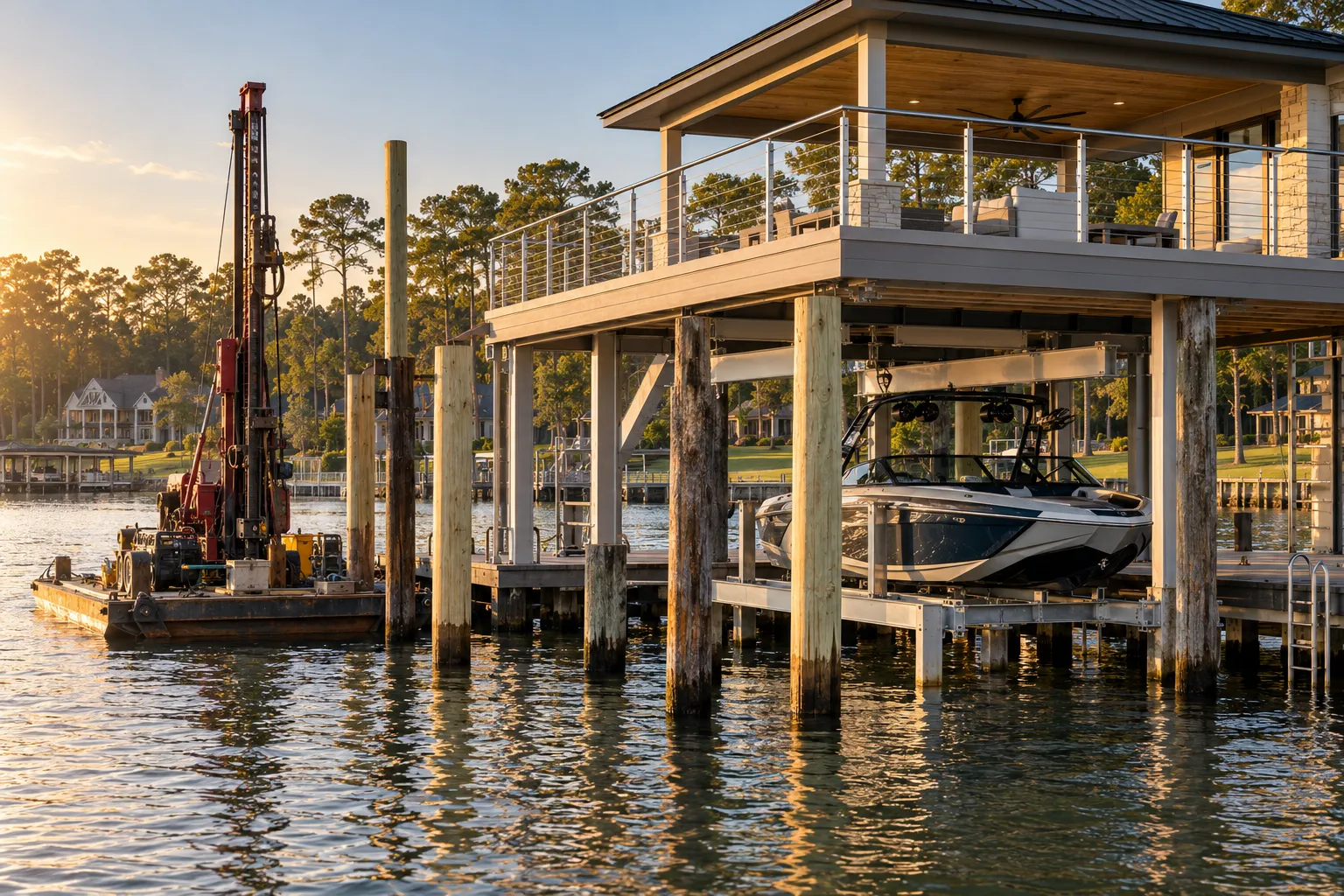
Barge-mounted equipment. Driving piling correctly on Lake Conroe requires waterborne rigs. Working from a floating barge also protects your established lawn, irrigation lines, and landscaping from the heavy equipment damage that land-based machinery causes. This isn’t a luxury; it’s how the work is done correctly.
SJRA familiarity. Contractors who work Lake Conroe regularly know the permitting process, know the permit officers, and handle the full submission and coordination as part of their scope. First-time contractors on this lake will cost you time.
Verified marine insurance. Waterborne operations require commercial marine liability coverage and USL&H (Longshore and Harbor Workers’ Compensation Act) policies. Standard general contractor policies don’t cover on-water work. Verify before signing anything.
Local portfolio. Ask to see completed Lake Conroe bulkhead installations that have been in the water for several years, specifically properties with main-basin or channel exposure similar to yours. A wall that looks good on day one and a wall that still looks good after five seasons of wake traffic are not the same thing.
Frequently Asked Questions
How long does a vinyl bulkhead last on Lake Conroe?
A properly installed heavy-gauge vinyl bulkhead typically lasts 40 to 50 years in Lake Conroe’s freshwater environment. Vinyl resists UV degradation, rot, and boring organisms without the ongoing maintenance that timber requires. Pairing it with marine-grade fasteners and correctly engineered tiebacks is what delivers that lifespan.
Do I need an SJRA permit to replace my bulkhead?
Yes. The SJRA requires a permit for all bulkhead work at or below the 201-foot mean sea level mark, including full replacement. Applications require a certified boundary survey and engineered construction plans. Contractors who work regularly on Lake Conroe handle permit coordination as part of the project.
Can a new bulkhead be installed in front of an existing failing wall?
Yes, and it’s a common approach on Lake Conroe. New vinyl or composite sheeting is driven directly lakeward of the old wall, which eliminates the need for upland excavation and protects established landscaping and irrigation. New tieback rods are driven through to deep deadman anchors, and a clean cap encapsulates the old structure.
Why is riprap placed at the base of a bulkhead?
Riprap prevents toe scour. Wake energy striking a vertical wall deflects downward into the lakebed and gradually removes the soil that supports the piling embedment. Angular granite or limestone boulders at the mudline absorb that energy and interrupt the scour cycle before it compromises the wall’s depth.
How deep do bulkhead pilings need to be driven on Lake Conroe?
The standard embedment ratio on Lake Conroe is between 1:1 and 1.5:1. For every foot of wall above the mudline, at least one to one-and-a-half feet of sheeting must penetrate below the lakebed. This keeps 50% to 60% of the total piling length underground, providing the passive soil resistance that prevents base kickout under load.
What is a deadman anchor and why does it matter?
A deadman anchor is a concrete block or timber pile buried inland and connected to the wall by galvanized steel tieback rods. It provides the resistance that holds the wall upright against outward pressure. Deadmen need to be placed at a horizontal distance of 1.5 to 2 times the exposed wall height to sit outside the active soil failure plane. Too close to the wall and they provide no meaningful resistance; positioned correctly, they’re what keep the wall standing under sustained load.
How long does bulkhead installation take from permitting to completion?
Most projects run three to six weeks from survey to final grading. SJRA permitting and HOA approvals typically take one to two weeks once engineering plans are complete. Physical construction runs one to two weeks depending on shoreline length, site access, and weather. Using waterborne barge equipment keeps construction efficient and protects upland property from equipment damage.
Dream Boat Docks has provided bulkhead construction and marine construction services on Lake Conroe and across the Texas Gulf Coast since 1987. For a free site assessment or estimate, contact our team directly.