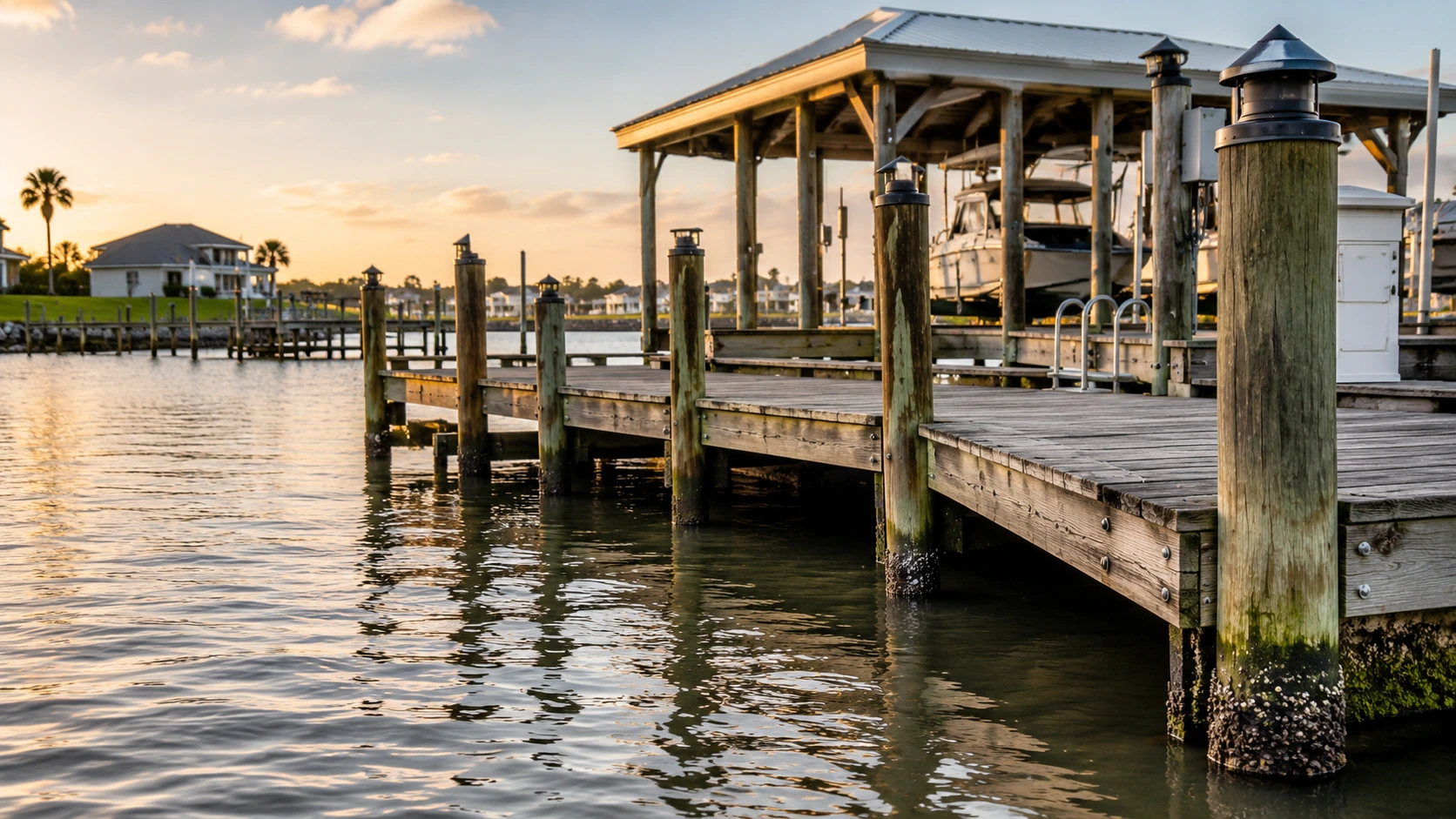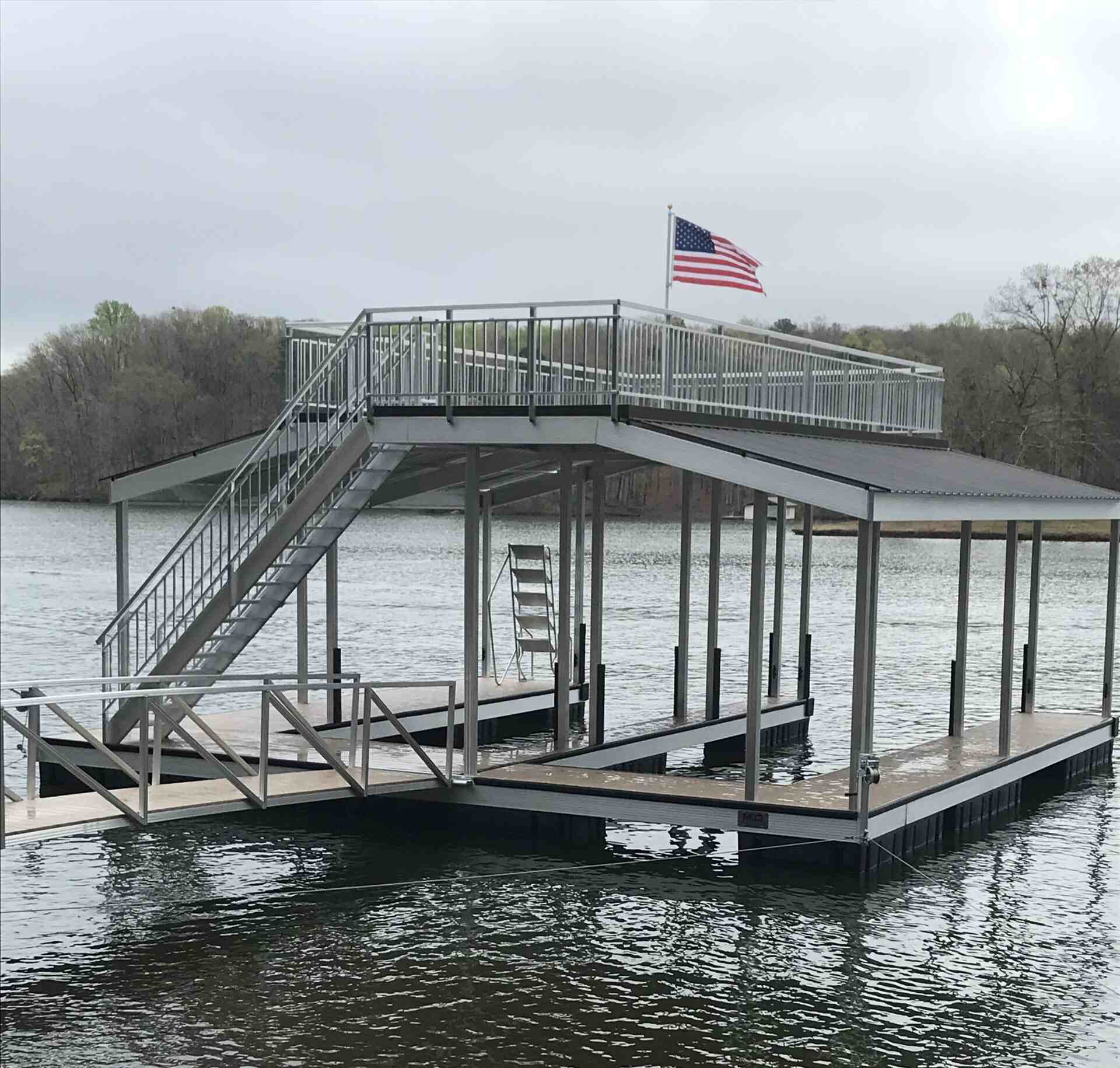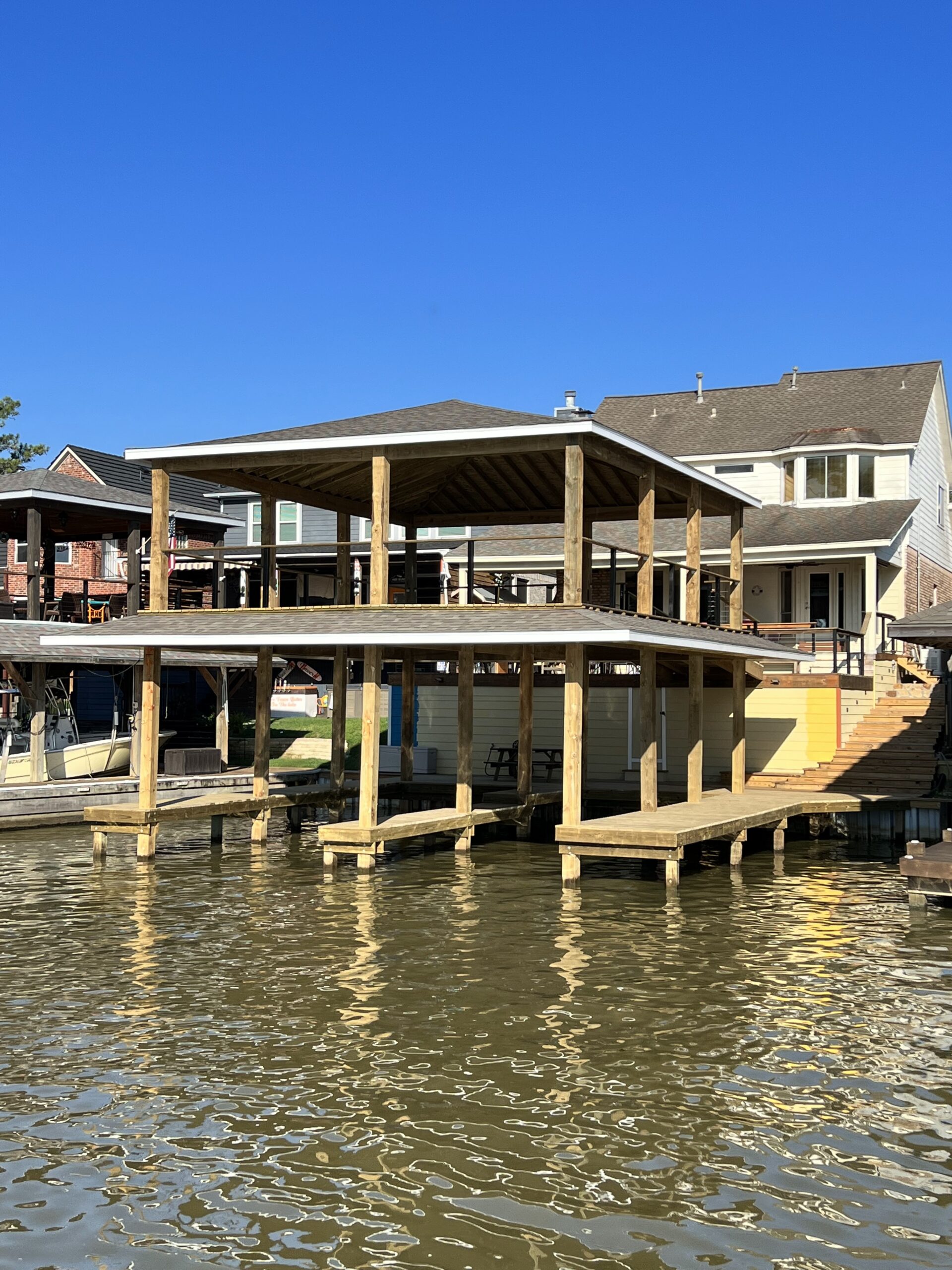
Owning waterfront property in Baytown comes with conditions that can be harder on docks, bulkheads, piers and boat lifts than many inland environments.
Properties along Upper Galveston Bay, Tabbs Bay, canals and nearby estuaries can be exposed to brackish water, tidal movement, strong coastal weather and, depending on location, vessel wakes. Over time, those conditions can accelerate corrosion, expose weaknesses in aging timber and hardware, and contribute to erosion or soil loss around shoreline structures.
That does not mean waterfront structures should be in a constant state of repair.
Regular inspections and timely maintenance can help property owners catch small issues before they develop into larger structural problems.
Dream Boat Docks has served Texas waterfront property owners since 1987 and provides Baytown dock construction, bulkhead work, boat houses, boat lifts and waterfront repairs throughout the area.
This guide explains what Baytown waterfront property owners should look for when checking their bulkhead, dock, pier, pilings and boat lift.
Key Takeaways
- Brackish water and coastal exposure can accelerate corrosion and material wear compared with many freshwater environments.
- Sinkholes, leaning walls, soil loss and changes in bulkhead alignment are signs that deserve attention.
- Dock and pier maintenance should include the pilings, framing and hardware, not just the visible deck boards.
- Boat-lift maintenance should follow the lift manufacturer’s recommendations rather than a one-size-fits-all schedule.
- Electrical systems around docks require particular care because water significantly increases electrical hazards.
- Maintenance needs vary by material. Timber, vinyl, FRP composite and steel structures do not fail in the same way.
- Structural repairs, expansions and shoreline work may require permits or additional approvals, so requirements should be checked before significant work begins.
Why Baytown Waterfront Structures Need Regular Attention
Baytown’s waterfront includes a mix of bays, canals and estuarine environments.
The water can range from fresher conditions to substantially more brackish exposure depending on location, rainfall and tidal influence.
That matters because waterfront materials respond differently to their environment.
Metal hardware may face greater corrosion exposure. Timber can be affected by moisture, marine organisms and repeated wetting and drying. Bulkheads must deal with soil pressure and drainage. Docks and piers are exposed to wind, waves, wakes and fluctuating water levels.
Properties closer to active navigation routes may also experience more vessel-generated wave energy than a protected residential canal.
For these reasons, maintenance should be based on the actual property rather than copying a routine developed for a protected inland lake.
Learn more about the local construction considerations on Dream Boat Docks’ Baytown dock builder and marine construction page.
How Often Should You Inspect a Dock or Bulkhead?
There is no universal inspection schedule that fits every waterfront structure.
As a practical rule, property owners should visually check their waterfront structures several times during the year and after events that could cause damage, including:
- Tropical storms or hurricanes
- Unusually high water
- Significant flooding
- Strong wind events
- Vessel impacts
- Sudden erosion or soil loss
Older structures or properties with heavy wave and brackish-water exposure may deserve closer attention.
You should also schedule a professional evaluation when you notice movement, deterioration, unexplained sinkholes, damaged pilings or other structural changes.
The goal is not to inspect on an arbitrary calendar. It is to notice changes before they become expensive failures.
Bulkhead Maintenance Checklist
A bulkhead retains soil and helps protect the shoreline from erosion.
Because many of its structural components are underground or underwater, some of the first signs of trouble appear in the yard rather than on the visible wall.
Check for Sinkholes and Soil Depressions
One of the most important things to watch is the ground immediately behind the bulkhead.
Look for:
- New depressions
- Sinkholes
- Soil pulling away from the cap
- Voids beneath landscaping
- Repeated areas that require new fill
These conditions can indicate that soil is moving through or around the wall.
Adding dirt may temporarily hide the symptom, but it does not necessarily correct the underlying cause.
The source of the soil loss should be identified.
Look for Leaning or Bowing
Stand back and look along the entire length of the wall.
A bulkhead that once appeared straight but is now leaning, bowing or changing alignment may have a problem with:
- Anchoring
- Tie-rods
- Wall material
- Embedment
- Soil pressure
- Drainage
Small changes should be documented and monitored.
Significant or increasing movement deserves professional evaluation.
Inspect the Cap and Waler
Check the top and horizontal structural components for:
- Separation
- Cracking
- Rot
- Corrosion
- Loose hardware
- Sections pulling away from the wall
- Uneven alignment
Damage at the top of the bulkhead does not automatically mean the entire wall has failed, but it can provide clues about what is happening elsewhere in the system.
Pay Attention to Drainage
Water trapped behind a bulkhead can increase pressure against the wall.
Watch for:
- Standing water behind the bulkhead
- New wet areas
- Clogged visible drains
- Changes in surface drainage
- Erosion after heavy rainfall
Drainage problems should be evaluated as part of the overall shoreline system rather than simply clearing a hole and assuming the problem is solved.
Different Bulkhead Materials Need Different Inspections
Dream Boat Docks works with multiple bulkhead systems, including vinyl/PVC, composite/FRP, treated timber and steel.
Each material has different maintenance concerns.
Timber Bulkheads
Look for:
- Soft or deteriorated wood
- Splitting
- Loose structural connections
- Marine-organism damage in submerged or tidal areas
- Deteriorated caps
- Changes around pilings and tiebacks
Timber can provide many years of service, but moisture and biological exposure eventually need to be considered.
Vinyl/PVC Bulkheads
Vinyl does not rot or rust, which eliminates several common material problems associated with wood and steel.
Still, inspect the overall system for:
- Cracked or damaged sheets
- Movement
- Soil loss
- Failed caps
- Anchoring problems
- Erosion around the ends of the wall
The sheet piling may require relatively little material maintenance, but the bulkhead is still a complete structural system.
For more information, see Dream Boat Docks’ guide to vinyl bulkhead installation.
Composite/FRP Bulkheads
FRP composite systems provide strong resistance to rot and corrosion.
Inspection should still include:
- Wall alignment
- Physical damage
- Caps
- Anchors
- Tie-rods
- Drainage
- Soil loss
Read more in our composite and FRP bulkhead installation guide.
Steel Bulkheads
Steel structures should be checked for:
- Corrosion
- Pitting
- Coating damage
- Holes
- Weld deterioration
- Hardware deterioration
- Changes in wall alignment
The significance of visible corrosion depends on its location, depth and the structural system.
Dock and Pier Maintenance Checklist
A deck that looks good from above can still have problems underneath.
When inspecting a boat dock or pier, look at the entire structure.
Inspect the Pilings
Pilings carry loads from the pier or dock into the underlying soil.
Look for:
- Cracks or splits
- Rot
- Impact damage
- Significant loss of material
- Movement
- Leaning
- Deterioration near the waterline or mudline
Timber pilings in brackish or salt-influenced environments may also be susceptible to marine organisms.
If a piling appears noticeably thinner in one area or has substantial visible deterioration, it should be evaluated before assuming it still has adequate structural capacity.
Check Framing and Bracing
Walk beneath or alongside accessible portions of the structure and look for:
- Cracked framing
- Loose connections
- Missing fasteners
- Corrosion
- Rot
- Sagging
- Damaged bracing
Movement while walking across the dock can sometimes point to framing or connection issues, although some flexibility is normal depending on the structure.
Inspect Deck Boards
For wood decking, look for:
- Splinters
- Cracks
- Soft areas
- Raised fasteners
- Loose boards
- Surface deterioration
For composite decking, check for:
- Loose fasteners
- Damaged boards
- Movement
- Improper spacing
- Areas where debris remains trapped
Composite does not require sealing like wood, but it still needs cleaning and inspection.
How Often Should Wood Decking Be Sealed?
There is no maintenance interval that applies to every wood dock.
The appropriate schedule depends on:
- Wood species
- Treatment
- Finish
- Sun exposure
- Moisture
- Product manufacturer’s instructions
- Desired appearance
Instead of automatically sealing every 12 or 18 months, inspect the surface and follow the recommendations of the coating or sealant manufacturer.
Waterfront owners should also make sure any product used is appropriate for the decking material and surrounding environment.
Cleaning a Waterfront Dock Safely
Algae, mildew and organic growth can make dock surfaces slippery.
Routine cleaning helps improve appearance and reduce slip hazards.
Use cleaning products and methods appropriate for the decking manufacturer.
Avoid assuming that every household cleaner is environmentally harmless simply because it is commonly used.
When cleaning over or near the water:
- Follow manufacturer instructions
- Avoid unnecessary chemical runoff
- Do not mix cleaning chemicals
- Protect nearby plants when appropriate
- Use a soft brush or manufacturer-approved pressure setting
High-pressure cleaning can damage some wood fibers and composite surfaces if used incorrectly.
Piling Wraps and Protective Systems
Some timber pilings use wraps or other protective systems to reduce exposure to marine organisms and environmental deterioration.
These systems can be valuable in the right application, but they are not a substitute for inspecting the piling itself.
Watch for:
- Torn wraps
- Loose seams
- Physical damage
- Movement
- Exposed timber
- Deterioration at the ends of the protected area
If an existing protective system has failed, a marine contractor can evaluate whether repair, replacement or another piling solution is appropriate.
Dream Boat Docks also provides marine piling and pile-driving services for waterfront projects requiring foundation work.
Boat Lift Maintenance Checklist
A boat lift contains moving components that support a substantial load over the water.
Maintenance should always begin with the manufacturer’s instructions for the specific lift.
Check Cables and Moving Components
Look for:
- Frayed cable strands
- Kinks
- Uneven spooling
- Corrosion
- Damaged pulleys
- Unusual noises
- Jerky movement
- Components that appear out of alignment
Do not place yourself beneath a suspended boat or attempt repairs on loaded lift components.
If a cable or structural component appears damaged, stop using the lift until it has been evaluated.
Check Bunks and Cradles
Inspect:
- Bunk alignment
- Carpet or covering
- Loose hardware
- Structural connections
- Uneven contact with the hull
A boat should sit correctly on the lift so its weight is distributed as intended.
Lubrication
Do not automatically lubricate every cable or fitting every month.
Different lifts, gearboxes and cable systems have different maintenance requirements.
Use only manufacturer-approved lubricants and follow the recommended maintenance interval for the specific lift.
Too little maintenance can cause problems, but the wrong lubricant or application method can also be harmful.
Watch the Motor and Gearbox
Look for:
- Unusual sounds
- Corrosion
- Water intrusion
- Difficulty starting
- Overheating
- Changes in lift speed
Mechanical problems are generally easier to address before the lift stops operating with the boat suspended.
Dock Electrical Safety
Electricity around water deserves particular attention.
Article 555 of the National Electrical Code addresses electrical installations at marinas, boatyards and docking facilities, including requirements involving ground-fault protection and equipment installed around docks.
Property owners should visually watch for:
- Damaged conduit
- Corroded boxes
- Broken receptacle covers
- Exposed wires
- Loose fixtures
- Water inside electrical enclosures
- GFCI or other protective devices that do not function properly
Follow the device manufacturer’s instructions for testing GFCI protection.
Electrical modifications, damaged circuits and questionable dock wiring should be evaluated by a qualified electrician familiar with marine or docking-facility installations.
Do not rely on a visual inspection alone when electrical damage is suspected.
What About Stainless Steel and Galvanized Hardware?
The original material choice matters, but there is no rule that every Baytown waterfront structure must use 316 stainless steel in every location.
Hardware selection should consider:
- Freshwater, brackish or saltwater exposure
- Structural loads
- Fastener location
- Connected materials
- Manufacturer requirements
- Corrosion exposure
- Budget
Appropriate stainless-steel grades can offer excellent corrosion resistance, while properly specified hot-dip galvanized hardware can also be suitable for many marine applications.
The important point is using hardware that is appropriate for the environment and structurally compatible with the materials around it.
Watch for Galvanic Corrosion
Using dissimilar metals together in a wet, conductive environment can contribute to galvanic corrosion.
Baytown’s brackish-water environment makes material compatibility especially important.
Property owners do not need to diagnose electrochemical corrosion themselves, but unusual localized corrosion around connections is a good reason to have the hardware evaluated.
Inspect After Major Storms
Normal maintenance is important, but severe weather deserves a separate inspection.
After a major storm, high-water event or unusual surge, check for:
- New bulkhead movement
- Sinkholes
- Soil loss
- Damaged pilings
- Missing deck boards
- Loose railings
- Damaged electrical components
- Boat-lift problems
- Floating debris impacts
- Changes in shoreline elevation
If the structure experienced significant impact or movement, limit use until it has been evaluated.
No dock or bulkhead should be assumed safe simply because it remained standing after a storm.
Repair vs. Replacement: How Do You Decide?
Not every deteriorated structure needs to be completely replaced.
A dock or bulkhead may be repairable if problems are localized and the main structural system remains serviceable.
Potential repairs can include:
- Deck-board replacement
- Framing repairs
- Hardware replacement
- Cap repairs
- Boat-lift repairs
- Piling work
- Drainage corrections
- Localized bulkhead repairs
Replacement may make more sense when deterioration is widespread or the foundation and primary structural system no longer provide reliable support.
Dream Boat Docks provides waterfront construction, remodeling and repair services and can evaluate whether repair or replacement is appropriate for the property.
When Should You Call a Marine Contractor?
Consider scheduling a professional evaluation if you notice:
- A leaning or bowing bulkhead
- Growing sinkholes
- Rapid soil loss
- Damaged or significantly deteriorated pilings
- Major corrosion
- Pier movement
- Failed structural connections
- Repeated boat-lift problems
- Storm damage
- Electrical damage around the dock
A professional inspection can help distinguish cosmetic wear from a structural problem.
That can prevent both unnecessary replacement and delayed repairs.
Do Baytown Dock and Bulkhead Repairs Require Permits?
Permit requirements depend on the scope and location of the work.
The City of Baytown requires permits for many construction and development activities, and its Public Works and Engineering Department reviews applicable engineering, floodplain and development permits. The city updated its engineering plan-set requirements in April 2026.
That does not mean every maintenance task requires an engineering permit.
Routine cleaning or minor maintenance may be treated differently from:
- Structural reconstruction
- Expansion
- New docks or piers
- Major bulkhead work
- Changes to the shoreline
- Work involving fill or regulated waters
Federal or state review can also apply to certain projects.
For example, TCEQ Section 401 certification is tied to projects requiring a U.S. Army Corps of Engineers Section 404 permit for discharges of dredged or fill material into waters of the United States. It is not a blanket certification requirement for every Baytown dock repair.
Because requirements depend on the property and work proposed, confirm the applicable approvals before beginning significant structural or shoreline work.
Why Local Baytown Experience Matters
Baytown waterfront construction is not identical to work on Lake Conroe or Lake Houston.
Properties around Upper Galveston Bay, Tabbs Bay and nearby canals may need to account for:
- Brackish-water exposure
- Tidal movement
- Coastal wind
- Vessel wakes
- Shoreline erosion
- Corrosion
- Local permitting
- Access from water
Dream Boat Docks builds and repairs docks, piers, boat houses, boat lifts and bulkheads throughout Baytown and designs projects around the conditions of each shoreline.
That local experience can also be helpful when an existing structure needs repair rather than complete replacement.
Protect Your Waterfront by Catching Problems Early
The best time to address waterfront deterioration is usually before the structure becomes difficult or unsafe to use.
A small sinkhole, loose board or patch of rust does not automatically mean you have a major structural problem.
It does mean you should pay attention to whether the condition is changing.
A practical maintenance routine includes:
- Looking over the structure regularly
- Checking again after major storms
- Following manufacturer recommendations for equipment
- Keeping drainage and walking surfaces clear
- Addressing corrosion and loose hardware
- Watching for soil loss or movement
- Calling a professional when structural conditions change
Dream Boat Docks has served Texas waterfront property owners since 1987 and provides new construction, repairs and remodeling throughout Baytown and the Greater Houston area.
If your dock, bulkhead, pier or boat lift is showing signs of deterioration, contact Dream Boat Docks for a waterfront evaluation and free estimate.
Frequently Asked Questions
How often should I inspect my bulkhead in Baytown?
There is no mandatory inspection interval that applies to every residential bulkhead.
A good practice is to visually check the wall periodically throughout the year and after major storms, flooding or unusual high-water events.
Older bulkheads and structures with greater wave, tidal or corrosion exposure may warrant more frequent attention.
What are the first signs of bulkhead problems?
Common warning signs include:
- Sinkholes
- Soil depressions
- Wall leaning or bowing
- Separation at the cap
- Soil loss
- Changes in alignment
- Damaged hardware
- Erosion around the ends of the wall
These conditions do not always mean complete failure, but they deserve evaluation if they are new or getting worse.
Should I repair or replace an aging wood bulkhead?
It depends on how much of the structural system has deteriorated.
Localized cap, hardware or wall damage may be repairable.
Widespread timber deterioration, anchoring problems or significant soil loss may make replacement more practical.
Dream Boat Docks works with multiple materials, including wood, vinyl/PVC, FRP composite and steel, so the recommendation can be based on the shoreline rather than assuming one replacement material is right for every property.
Is vinyl a good option for a Baytown bulkhead?
It can be.
Marine-grade vinyl provides strong resistance to rot and corrosion and can work well in brackish-water environments.
However, material selection should also consider structural loads, bank height, soil conditions, water depth, wave exposure and budget.
See our vinyl bulkhead guide for more information.
Does a vinyl bulkhead last 50 years?
Some marine-grade vinyl sheet-piling products are designed for service lives measured in decades, and some manufacturers offer warranties of 50 years or longer.
That should not be treated as a guarantee that every completed bulkhead will last a specific number of years.
Overall longevity depends on the material, anchoring, installation, soil conditions and waterfront exposure.
Can I maintain my boat lift myself?
Owners can usually handle basic visual checks and cleaning tasks recommended by the lift manufacturer.
Cable adjustment, structural repairs, motor work and electrical repairs should be handled by qualified professionals when appropriate.
Always follow the manufacturer’s maintenance instructions for your particular lift.
How does brackish water affect waterfront structures?
Brackish water contains a mix of freshwater and saltwater and can increase corrosion concerns for metals and hardware.
Salt-influenced environments can also support marine organisms that affect submerged timber.
Material selection and routine inspection are therefore especially important on Baytown waterfront properties.
Does every Baytown marine structure need stainless-steel hardware?
No.
Stainless steel can be an excellent option in highly corrosive environments, but properly specified galvanized or other corrosion-resistant hardware may also be appropriate.
The correct material depends on exposure, structural requirements and compatibility with the rest of the structure.
Do I need a permit for minor dock repairs in Baytown?
It depends on the work.
Basic maintenance may not trigger the same requirements as structural alterations, expansions, shoreline work or major reconstruction.
Before making significant changes, confirm requirements with the City of Baytown and any other agency with jurisdiction over the property.
Does TCEQ approval apply to every dock or bulkhead repair?
No.
TCEQ Section 401 certification relates to projects requiring certain federal Clean Water Act permits, including U.S. Army Corps of Engineers Section 404 permits involving dredged or fill material.
Whether those requirements apply depends on the location and scope of the project.
What should I do if I find a sinkhole behind my bulkhead?
Do not assume adding dirt will permanently solve the problem.
A sinkhole can indicate soil loss through or around the wall, drainage problems, erosion or structural deterioration.
The cause should be identified before deciding on the appropriate repair.
Need help evaluating a Baytown waterfront structure? Contact Dream Boat Docks for a professional evaluation and free estimate.