Expanding a marina involves much more than adding another row of slips.
A successful project has to account for how boats will move through the property, how additional docks will be supported, whether existing shoreline structures can accommodate the expansion, how utilities will reach new slips, and which local, state, or federal approvals apply.
For Texas marina owners and commercial waterfront properties, conditions can vary significantly between inland reservoirs such as Lake Conroe and coastal or tidally influenced areas around Clear Lake, Seabrook, Kemah, Baytown, and Galveston Bay.
That makes early planning especially important.
Dream Boat Docks has served Texas waterfront property owners since 1987 and provides commercial and residential pier construction, piling, docks, bulkheads, and other marine construction services throughout Greater Houston and other Texas areas upon request.
This guide covers the major considerations that should be evaluated before expanding an existing marina or commercial waterfront facility.
Key Takeaways
- Marina expansion should begin with the existing property, vessel mix, water access, and operating goals rather than a predetermined number of new slips.
- Fixed, floating, and hybrid dock systems can all be appropriate depending on water-level changes, exposure, vessel size, and site conditions.
- Pilings and foundations should be designed around structural loads and site conditions rather than a universal depth or installation method.
- Existing bulkheads and shoreline conditions should be evaluated before new docks are added, but not every marina expansion requires a new bulkhead.
- Coastal marina projects may involve the Texas General Land Office, U.S. Army Corps of Engineers, local jurisdictions, navigation districts, or other agencies depending on the property.
- Hydrographic surveys, geotechnical investigations, engineering, and environmental studies may be appropriate for some projects, but they are not automatically required for every expansion.
- Utilities, fire protection, lighting, access, drainage, and future maintenance should be considered during planning rather than added after the docks are built.
Why Expand an Existing Marina?
Marina expansion can make sense for several reasons.
A property owner may want to:
- Add additional wet slips
- Accommodate larger vessels
- Replace aging docks
- Reconfigure inefficient slip layouts
- Add covered slips or boat lifts
- Upgrade utilities
- Improve accessibility
- Expand commercial waterfront use
- Repair shoreline infrastructure while improving the facility
- Convert underused waterfront space into more functional marine access
The business case should be evaluated independently for each facility.
Adding slips can potentially increase revenue-producing capacity, but the financial result depends on local demand, occupancy, rental rates, construction costs, ongoing maintenance, insurance, utilities, financing, and the types of vessels the marina serves.
A contractor can help establish the physical feasibility and construction scope, while owners should also evaluate the financial and operational side of the expansion before committing to the project.
Start With Marina Expansion Feasibility
The first question should not be, “How many slips can we fit?”
A better question is:
What kind of expansion makes sense for this site?
An initial feasibility review may consider:
- Existing marina footprint
- Property boundaries
- Water depth
- Vessel sizes
- Current and desired slip count
- Navigation channels
- Dock orientation
- Shoreline configuration
- Existing pilings
- Bulkhead condition
- Utilities
- Vehicle and pedestrian access
- Water-level changes
- Wave and wake exposure
- Existing permits or leases
- Future phases of development
Depending on the complexity of the site, additional surveys or engineering may be needed before a final layout can be developed.
Evaluate the Existing Marina Before Adding New Slips
Expansion is also an opportunity to evaluate the infrastructure that is already there.
Existing docks, piers, pilings, bulkheads, and utilities may have been designed for a smaller facility or a different vessel mix.
Before connecting a major expansion to existing infrastructure, evaluate conditions such as:
- Piling deterioration
- Structural movement
- Corrosion
- Framing condition
- Electrical capacity
- Water-service capacity
- Bulkhead movement
- Shoreline erosion
- Settlement
- Previous repairs
- Storm damage
Dream Boat Docks provides waterfront construction and remodeling services for existing marine structures as well as new construction.
In some cases, portions of an existing facility can remain.
In others, replacing or reinforcing older infrastructure while expanding can be more practical than repeatedly repairing it after the expansion is complete.
Planning Slip Layout and Vessel Access
A marina layout needs to work from the water, not just look efficient on a drawing.
Important questions include:
- What vessel lengths and beams will the marina serve?
- How much maneuvering space is available?
- Will the marina serve powerboats, sailboats, personal watercraft, or a combination?
- Are larger vessels expected in the future?
- How will customers enter and leave their slips?
- Does the layout create conflicts between opposing boat traffic?
- Where are utilities and dock boxes located?
- Is there sufficient access for maintenance and emergency response?
The most efficient layout is not necessarily the one with the highest possible slip count.
Usability and safe navigation need to remain part of the design.
Fixed vs. Floating Marina Docks
Both fixed and floating systems can work for commercial marinas.
Fixed-Pile Docks
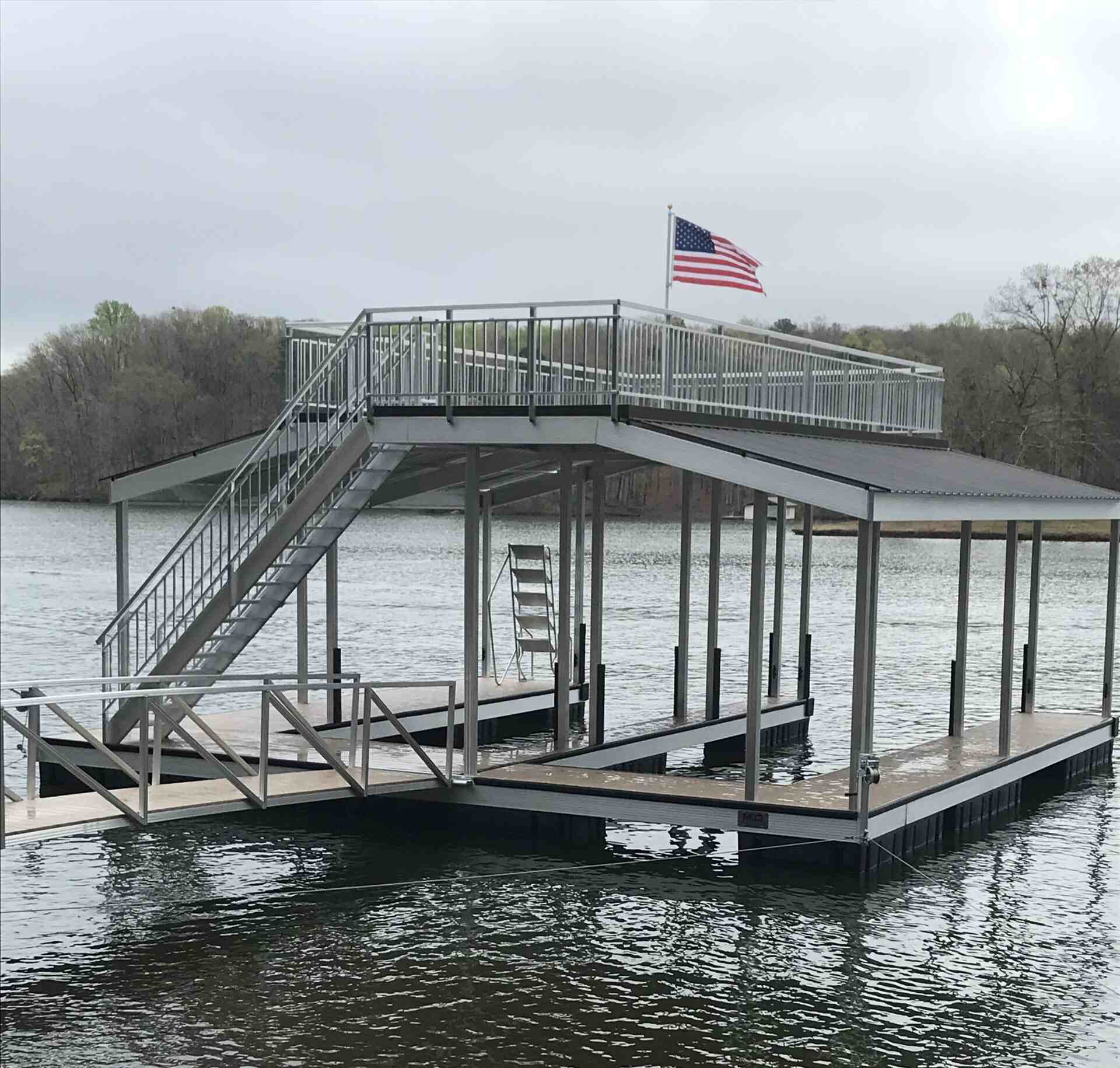
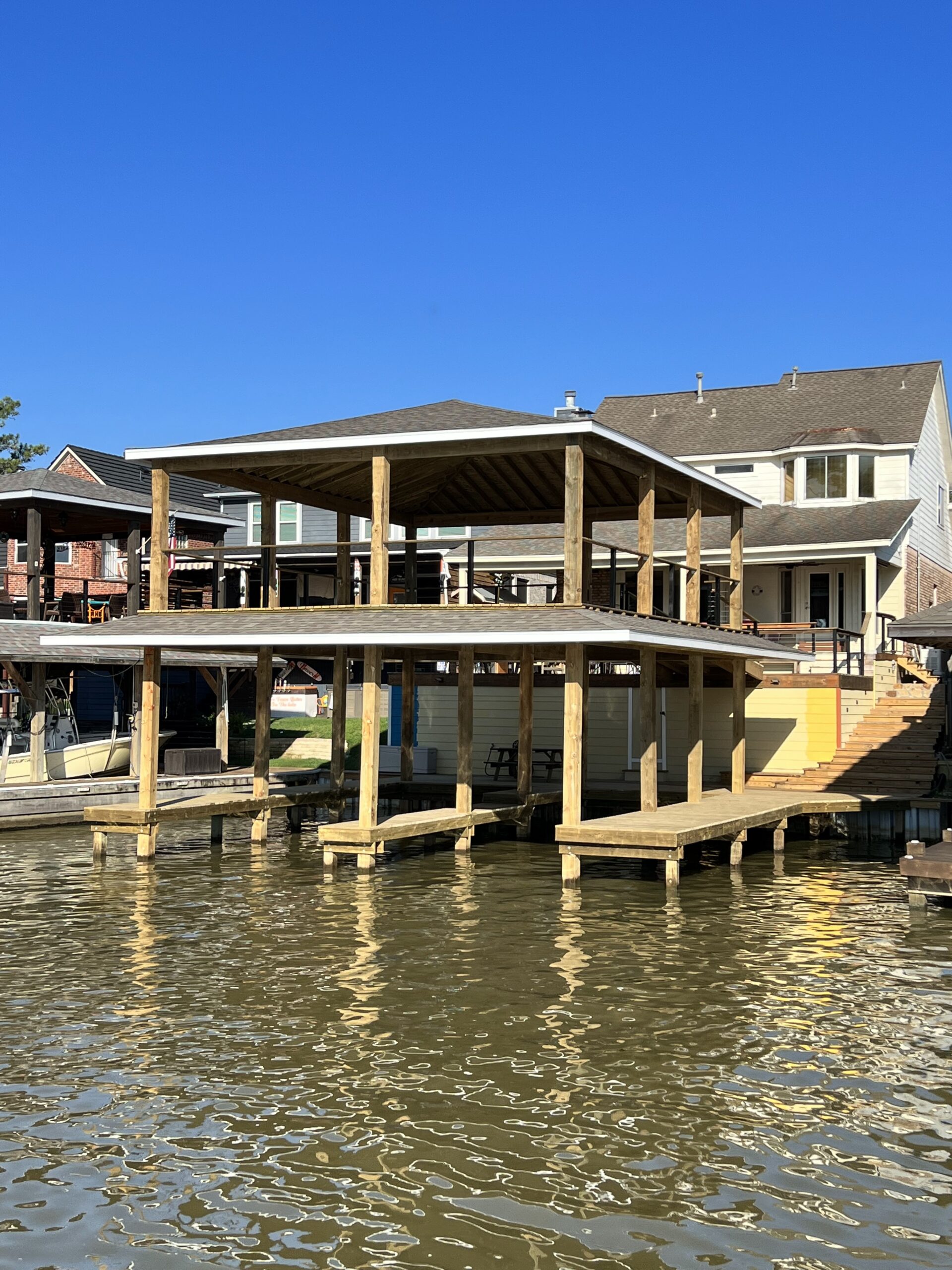
Fixed docks are supported on pilings.
Depending on the project, advantages can include:
- Stable walking surfaces
- Support for heavier structures
- Integration with certain boat lifts
- Straightforward connection to fixed piers and shoreline structures
Fixed docks can be effective where water-level conditions and the overall site support them.
Dream Boat Docks builds custom piers and boat docks for both recreational and commercial applications.
Floating Dock Systems
Floating docks rise and fall with changing water levels.
They can be useful where maintaining a relatively consistent boarding height is important.
Floating systems still require appropriately designed:
- Anchoring or guide systems
- Gangways
- Utility connections
- Structural components
- Connections between dock sections
They are not automatically better simply because a marina is coastal or experiences changing water levels.
Hybrid Marina Designs
Some properties may benefit from combining fixed and floating structures.
For example, a fixed access pier can connect the shoreline to floating slips.
The right configuration depends on the property rather than a universal preference for one dock type.
For additional background, see Dream Boat Docks’ guide to choosing the right dock type for a waterfront property.
Marina Foundations and Pilings
The foundation is one of the most important parts of a marina expansion.
Pilings can support:
- Fixed docks
- Piers
- Covered slips
- Gangways
- Boat lifts
- Utility structures
- Other marine features
Dream Boat Docks provides marine piling and pile-driving services for residential, commercial, and industrial marine construction.
How Deep Should Marina Pilings Be?
There is no standard depth for every marina.
Foundation requirements depend on factors such as:
- Soil conditions
- Water depth
- Piling material
- Dock dimensions
- Vessel loads
- Wind
- Waves
- Current
- Lateral loading
- Boat-lift loads
- Structural configuration
Depending on the project, piling design may require engineering or subsurface information to establish appropriate foundation capacity.
The objective is not simply to drive a piling to the greatest possible depth.
It is to establish a foundation appropriate for the loads and conditions of the project.
Water Jetting vs. Driven Pilings
Different marine construction projects may use different piling installation techniques.
Dream Boat Docks uses both water-jet technology and weighted-hammer driving as part of its marine piling work.
The appropriate method can depend on:
- Soil
- Piling material
- Piling dimensions
- Water depth
- Equipment access
- Existing structures
- Required foundation capacity
A large commercial project may also require installation methods or equipment different from those used on a smaller residential pier.
The contractor and project engineer, when applicable, should determine what is appropriate for the site.
Does Marina Expansion Require a Hydrographic Survey?
Not always.
A hydrographic survey can be extremely useful for projects where detailed underwater information is needed.
It may help establish:
- Water depths
- Bottom elevations
- Navigation constraints
- Existing underwater features
- Dredging requirements
- Changes in underwater terrain
For some expansions, existing data and site measurements may provide enough information during early planning.
For larger or more complex facilities, a professional hydrographic survey may be appropriate or required by the design or permitting process.
It should therefore be treated as a project-specific technical tool rather than a mandatory first step for every marina expansion.
What About Soil Testing?
The same principle applies to geotechnical investigation.
Some structures can be designed using existing subsurface information and established site conditions.
More complex projects may require additional soil investigation to establish:
- Soil properties
- Foundation capacity
- Piling design
- Settlement considerations
- Bulkhead design
The need for geotechnical work should be determined according to the structure, site, engineering requirements, and jurisdiction rather than assumed in advance.
Bulkheads and Marina Expansion
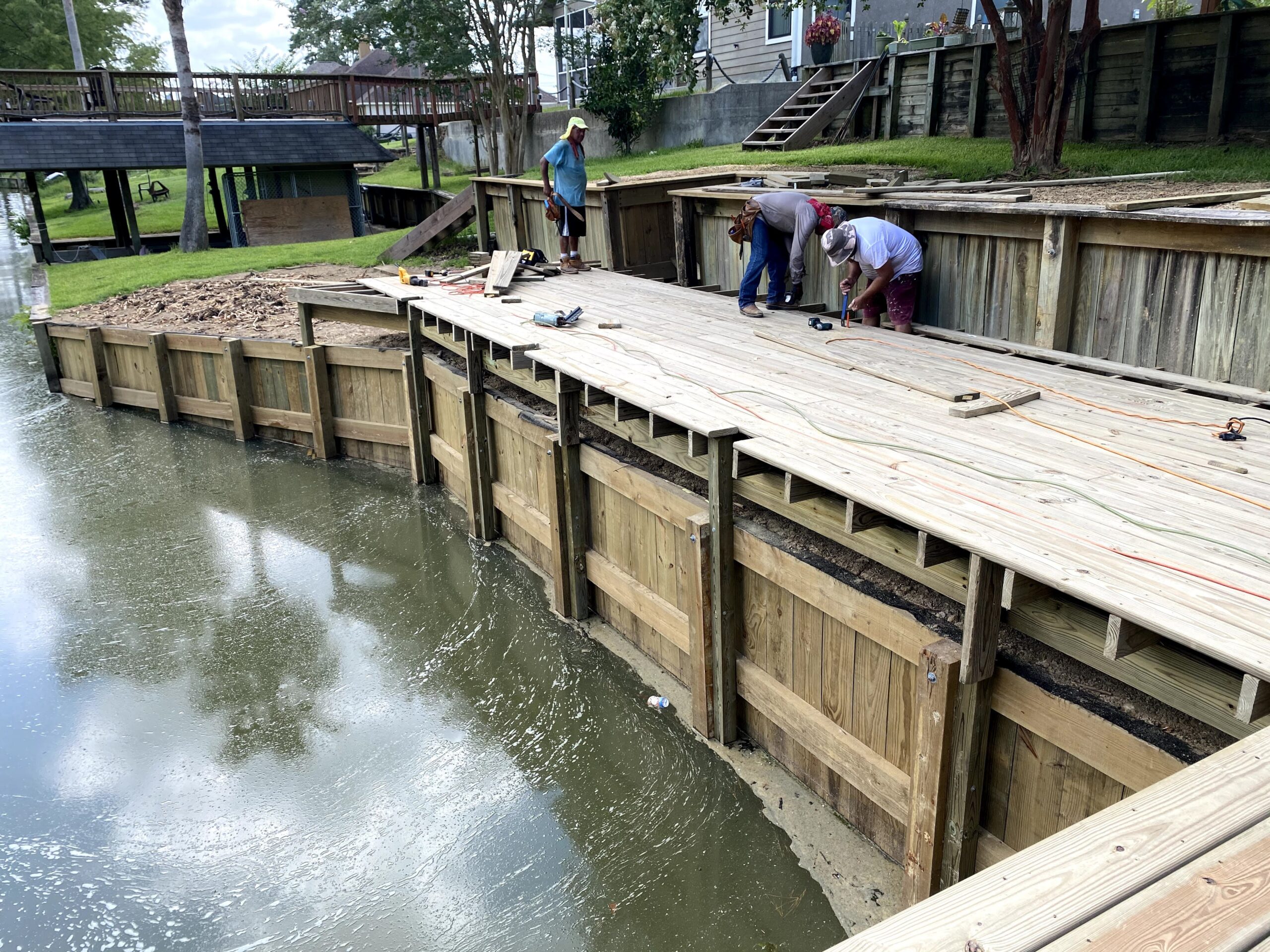
A bulkhead retains soil and helps stabilize the shoreline.
It performs a different function from a pier or dock.
A marina expansion does not automatically require a new bulkhead.
However, an existing shoreline wall should be evaluated when new infrastructure is being planned nearby.
Warning signs can include:
- Leaning
- Bowing
- Sinkholes
- Soil loss
- Failed caps
- Corroded structural components
- Damaged tie-rods
- Drainage problems
- Movement around the ends of the wall
If the existing bulkhead is deteriorated, it may make sense to repair or replace it before completing a major marina expansion.
Dream Boat Docks installs bulkhead systems using materials including:
- Vinyl/PVC
- Composite/FRP
- Treated timber
- Steel
- Other solutions appropriate to the project
Learn more in our Texas bulkhead and pier construction guide.
Choosing Bulkhead Materials for Commercial Waterfronts
There is no universal “best” commercial bulkhead material.
Vinyl/PVC
Vinyl can offer:
- Corrosion resistance
- Resistance to rot
- Relatively low material maintenance
- Suitability for many residential and commercial applications
Composite/FRP
FRP sheet piling can provide:
- High strength-to-weight performance
- Corrosion resistance
- Resistance to rot
- Suitability for demanding marine environments
See Dream Boat Docks’ composite bulkhead installation guide for additional information.
Steel
Steel can provide significant structural capacity, but corrosion protection and exposure conditions require careful consideration.
Treated Timber
Treated timber continues to have legitimate marine applications when the material and treatment are appropriate for the exposure and design.
The final choice should reflect the site’s:
- Soil
- Wall height
- Loads
- Water conditions
- Corrosion exposure
- Desired service characteristics
- Budget
Marina Decking and Walking Surfaces
Commercial docks receive more foot traffic than many private residential structures.
Walking surfaces should therefore consider:
- Slip resistance
- Maintenance
- Splintering
- Surface temperature
- Drainage
- Accessibility
- Replacement
- Appearance
Common options include pressure-treated wood, composite products, and other marine decking systems.
Composite can reduce routine maintenance and resist rot and splintering, but product selection should also consider heat buildup in direct Texas sunlight.
Wood can offer lower initial costs and straightforward replacement but generally requires more ongoing maintenance.
No single decking material is automatically best for every marina.
Adding Boat Lifts to a Marina Expansion
Boat lifts can create an additional service or amenity for certain marina users.
They may be incorporated into:
- Covered slips
- Private lease slips
- Premium slips
- Personal-watercraft areas
Lift planning should take place before the surrounding dock and piling layout is finalized.
Important considerations include:
- Vessel weight
- Beam
- Hull configuration
- Lift capacity
- Piling locations
- Water depth
- Electrical requirements
- Future vessel size
Dream Boat Docks provides boat lift installation that can be coordinated with new dock and piling construction.
Covered Slips and Boat Houses
Depending on the marina and applicable regulations, covered slips can provide additional vessel protection and create a differentiated offering.
However, roofs add:
- Wind loads
- Foundation loads
- Structural framing
- Height considerations
- Additional permitting issues
- Maintenance requirements
The design needs to address those loads from the beginning.
Dream Boat Docks also provides custom boat house construction for waterfront projects requiring covered vessel storage.
Planning Marina Utilities
A dock expansion may also require expanding the supporting infrastructure.
Potential systems include:
- Electrical service
- Shore power
- Lighting
- Potable or wash-down water
- Fire-protection equipment
- Security
- Communications
- Pump-out infrastructure
- Access-control systems
Utility planning should happen before construction rather than after dock sections are installed.
Electrical systems around marinas and docking facilities also have specialized code requirements because of the hazards created by electricity near water.
Qualified professionals should design and install the applicable electrical systems.
Accessibility and Pedestrian Circulation
Commercial marina planning should consider how people move through the facility.
Depending on the property and applicable requirements, considerations may include:
- Gangway slopes
- Accessible routes
- Dock widths
- Handrails
- Changes in elevation
- Lighting
- Slip access
- Emergency access
- Loading and unloading
A marina that maximizes slip count but creates difficult pedestrian circulation may not operate well.
These issues are easier to solve during layout development than after construction.
Texas Marina Expansion Permitting
There is no single permit package that applies to every Texas marina expansion.
Requirements depend heavily on the location and project scope.
Texas General Land Office
The Texas General Land Office manages much of Texas’ state-owned coastal submerged land.
For commercial projects that use state-owned submerged land, the GLO can issue commercial coastal easements or coastal surface leases.
The GLO specifically identifies marinas, docks, wharves, boardwalks, dredged channels, and similar commercial projects among the types of development that can require these authorizations.
The GLO’s Permit Service Center can help determine whether a project is within GLO jurisdiction and which lease, easement, or application process may apply.
U.S. Army Corps of Engineers
The U.S. Army Corps of Engineers regulates certain activities in navigable waters and waters of the United States.
Depending on the project, marina work may require:
- A general permit
- Letter of Permission
- Individual permit
- Other authorization
Expansion involving dredging, fill, new structures, or other regulated work can trigger federal review.
The USACE Galveston District Regulatory Program provides current permitting information for projects in the region.
Joint Permit Application
For projects within the appropriate Texas coastal boundaries, the GLO Permit Service Center can assist with a Joint Permit Application that coordinates information needed for GLO and USACE review.
That does not mean every Texas marina expansion automatically uses exactly the same Joint Permit Application process.
Inland projects such as Lake Conroe can operate under completely different authorities.
Local and Other Requirements
Depending on location, marina projects can also involve:
- Municipal permits
- County requirements
- Navigation districts
- Floodplain regulations
- Fire codes
- Electrical codes
- Environmental reviews
- Utility approvals
- Other state or federal agencies
Permitting should therefore begin by identifying the property and proposed work, not by assuming a generic list of agencies applies everywhere.
Lake Conroe Marina Expansion Is Different From Coastal Expansion
Lake Conroe illustrates why marina permitting cannot be discussed as one statewide process.
Private structures on Lake Conroe fall under the San Jacinto River Authority’s licensing and permitting framework rather than the coastal submerged-land system used by the GLO.
A commercial project can also have requirements different from a residential dock or boat house.
Dream Boat Docks works throughout Lake Conroe and other Greater Houston waterfront markets, allowing project planning to reflect the specific waterway rather than a generic Texas permit checklist.
How Long Does Marina Expansion Take?
There is no dependable universal timeline.
Total duration can depend on:
- Concept development
- Surveys
- Engineering
- Permitting
- Environmental review
- Dredging
- Utilities
- Material procurement
- Foundation work
- Dock fabrication
- Weather
- Existing marina operations
A straightforward addition to an inland marina may move much differently from a coastal project involving dredging or state-owned submerged land.
Some regulatory approvals can take months, while more complex projects may require substantially longer.
The project schedule should be developed after the likely permitting path and construction scope are identified.
Can an Existing Marina Stay Open During Expansion?
Sometimes.
Phased construction may allow portions of an existing marina to remain operational.
Planning can include:
- Temporary closures
- Slip relocation
- Maintaining pedestrian access
- Construction staging
- Material delivery routes
- Barge access
- Utility interruptions
- Safety separation between customers and construction activity
The feasibility of maintaining operations depends on the layout and construction scope.
For commercial owners, construction sequencing should be discussed early because it can affect both customer experience and project cost.
Environmental Considerations During Construction
Marine projects may require measures to limit impacts to surrounding waters or habitat.
Which controls are appropriate depends on the project and permit conditions.
They can potentially include:
- Sediment-control measures
- Construction-area containment
- Waste management
- Timing restrictions
- Turbidity management
- Habitat protections
- Limits on dredging or fill
Those measures should follow the project’s permit conditions and environmental requirements rather than a generic construction checklist.
A Practical Marina Expansion Roadmap
Although every project is different, the planning process often follows several broad stages.
Phase 1: Define the Expansion Goals
Establish:
- Desired slip capacity
- Target vessel sizes
- Operational requirements
- Desired amenities
- Budget range
- Future expansion goals
Phase 2: Evaluate the Site
Review:
- Existing docks
- Pilings
- Shoreline
- Bulkheads
- Water depth
- Utilities
- Access
- Known site constraints
Additional survey or engineering work can then be identified if necessary.
Phase 3: Develop the Concept
Create a preliminary layout showing:
- Slip configuration
- Dock type
- Navigation routes
- Gangways
- Utilities
- Lifts
- Covered areas
- Shoreline connections
Phase 4: Identify Permits and Engineering Requirements
Determine which:
- Local authorities
- State agencies
- Federal agencies
- Engineers
- Surveyors
- Other professionals
need to be involved.
Phase 5: Finalize Design and Construction Scope
Once site information and regulatory requirements are better understood, the project can move into detailed design and pricing.
Phase 6: Build in Logical Stages
Construction can include:
- Demolition
- Bulkhead or shoreline work
- Pilings
- Pier and dock framing
- Floating sections
- Decking
- Utilities
- Boat lifts
- Other amenities
The order should reflect both the design and the need to maintain safe access around the construction area.
Phase 7: Inspection and Turnover
Required inspections should be completed before affected areas are placed into service.
The owner should also receive relevant information about:
- Maintenance
- Equipment
- Utilities
- Warranties
- Future inspections
Choosing a Marina Expansion Contractor
Commercial marine work requires more than ordinary deck-building experience.
When evaluating a contractor, ask about:
- Marine construction experience
- Commercial pier and piling work
- Equipment
- Similar completed projects
- Water-based access
- Piling installation
- Bulkhead experience
- Permitting responsibilities
- Engineering coordination
- Insurance
- Project phasing
- Material specifications
- Warranty terms
Dream Boat Docks provides custom pier construction for residential and commercial properties along with piling, docks, bulkheads, boat lifts, boat houses, and waterfront remodeling.
Property owners can also review completed Dream Boat Docks waterfront projects when evaluating potential marine construction work.
Why Work With Dream Boat Docks?
Dream Boat Docks has served Texas waterfront property owners since 1987.
Its marine construction capabilities include:
- Piers
- Pilings and pile driving
- Boat docks
- Bulkheads
- Boat lifts
- Waterfront construction and remodeling
The company serves Lake Conroe, Lake Houston, Seabrook, Clear Lake, Kemah, La Porte, Baytown, and other Texas locations upon request.
That range of marine construction services can be especially valuable when an expansion involves several interconnected components rather than a single dock.
Plan the Marina as a Complete Waterfront System
An expanded marina is not simply a collection of additional slips.
The pilings support the docks.
The docks create vessel access.
The shoreline provides the land-side transition.
The bulkhead may protect and retain the bank.
Utilities support marina operations.
Gangways and walkways move customers through the property.
Boat lifts or covered slips can serve specialized vessels.
Permitting determines what can legally be constructed.
When these components are evaluated together, owners can make better decisions about what to build now and what to allow for in future phases.
If you’re planning a commercial marina expansion, pier project, piling installation, bulkhead replacement, or broader waterfront improvement in Texas, contact Dream Boat Docks to discuss the property and request an estimate.
Frequently Asked Questions
What should I consider before expanding a marina?
Start with the site’s existing conditions and operating goals.
Important factors include:
- Current and desired slip capacity
- Vessel sizes
- Water depth
- Dock configuration
- Navigation space
- Existing pilings
- Shoreline conditions
- Bulkheads
- Utilities
- Permitting
- Construction access
- Budget
- Future phases
The site should be evaluated before committing to a final slip count.
What permits are required for marina expansion in Texas?
There is no single statewide permit package for every marina expansion.
Coastal projects may involve the Texas General Land Office, U.S. Army Corps of Engineers, municipalities, navigation districts, or other agencies.
Inland projects can fall under entirely different authorities.
The required approvals depend on the location and scope of work.
Does every coastal marina need a GLO lease?
No.
The Texas General Land Office manages much of the state-owned submerged land along the Texas coast, and commercial use of that land can require a lease or easement.
Whether GLO authorization applies depends on ownership and jurisdiction at the specific project site.
The GLO Permit Service Center can help determine whether a property falls within GLO jurisdiction.
Does every marina expansion require a USACE permit?
Not automatically.
USACE regulates certain work in navigable waters and waters of the United States.
Whether authorization is required, and which type of permit applies, depends on the proposed activities and project location.
How long does a marina expansion take?
There is no standard timeline.
A project may involve design, surveys, engineering, permitting, material procurement, piling installation, dock construction, utilities, and inspections.
Projects with more complex regulatory or environmental requirements generally take longer.
Do I need a hydrographic survey for a marina expansion?
Not every project requires one.
A hydrographic survey can be useful or necessary when accurate underwater elevations, navigation depths, dredging quantities, or submerged features need to be documented.
The project designer or permitting team should determine whether one is appropriate.
Does every marina expansion require soil testing?
No.
Geotechnical investigation may be necessary for larger or more structurally demanding projects, but it is not automatically required for every dock expansion.
The need depends on site information, foundation design, engineering requirements, and project complexity.
Should I replace an aging bulkhead before expanding a marina?
Not automatically.
The bulkhead should be evaluated if the expansion is being built near it.
A leaning wall, soil loss, failed anchors, significant corrosion, or other structural deterioration may need to be addressed before nearby construction proceeds.
A serviceable bulkhead does not need replacement simply because the marina is expanding.
What is the best material for commercial marina docks?
There is no universal best material.
Pressure-treated wood, composite decking, steel, concrete, and other products can all have appropriate applications.
The right choice depends on structural requirements, traffic, environmental exposure, maintenance expectations, appearance, and budget.
Are floating docks better than fixed docks for a commercial marina?
Neither is universally better.
Floating docks can accommodate changing water levels well, while fixed docks can provide a stable platform and support different structural configurations.
Some marinas benefit from hybrid systems.
The decision should be based on the waterway, vessels, loads, and operating needs.
Can boat lifts be added to a commercial marina?
Yes, depending on the design.
The lift should be coordinated with the pilings, framing, utilities, vessel dimensions, and slip configuration.
Planning the lift during the expansion design is generally easier than modifying the structure afterward.
Can Dream Boat Docks work on commercial waterfront projects?
Yes. Dream Boat Docks’ current services include commercial and residential pier construction and marine piling, along with docks, bulkheads, boat lifts, and broader waterfront construction.
Planning a marina or commercial waterfront expansion? Contact Dream Boat Docks to discuss the project and request an estimate.